

Why Do Some Appliances Have 3-Prong Plugs?

We may receive a commission on purchases made from links.
To the average homeowner with no background in electrical wiring, it can be pretty confusing to find yourself holding an appliance plug that won't fit into the outlet in front of you. There are a few reasons this can happen, but the most common is probably dealing with a three-prong plug and a two-slot receptacle. Even if your plugs and outlets match, you might still wonder: Why do some have that third prong, while others don't? The short answer is grounding; a more important answer is avoiding tragedy.
Many homeowners assume that the third prong is optional, judging from the number of three-to-two-prong adapters we've all seen in our lifetimes. You know the deal: You need to plug in a three-prong toaster, but the cord won't quite reach, so you find a two-prong Christmas light extension cord and an adapter so the two can work together. Aside from the high chance that you'll burn your house down when using the wrong types of electrical extension cords, you've also introduced another danger: Electrical currents are always seeking the path of least resistance to ground. If something goes wrong and a stray current reaches your toaster's metal housing, it's possible for you to become that path to ground.
The down-to-earth truth about grounding: It's a critical safety feature
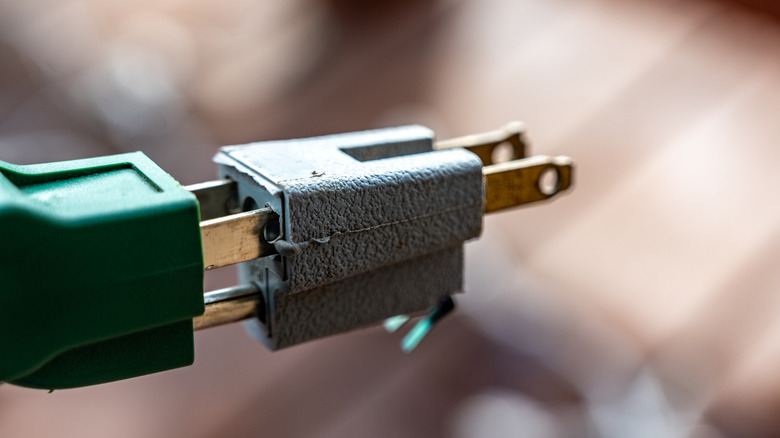
There are three basic plug configurations for a standard 15-amp residential receptacle. (There are a few more options, like locking pins, for 20-amp receptacles.) A three-prong plug has (you guessed it) three conductors that lead to (right again!) three prongs: a round ground pin, and blades for line (hot) and neutral. Two-prong plugs only have the line and neutral blades. One variety is polar, so that the smaller line blade and wider neutral blade can't be reversed. Non-polarized plugs have identical prongs, so the plug can be flipped either way. You tend to see non-polar plugs on small, older, or simpler devices like incandescent lamps for which polarity doesn't matter for function, or devices that handle transforming power internally.
In most cases, an appliance will function without a ground, since the device returns current via the neutral. The ground isn't meant to normally carry current, which is why the ground wires inside of receptacles are often bare. It's meant to discharge current if there is a fault, via the outlet, and into the ground. However, even if your receptacles seem grounded, it's possible they aren't properly wired, so it's worth learning how to check if an electric wall outlet is grounded.
A path to ground is never a bad idea, so another interesting question is: Why don't all appliances have three-prong plugs? It's actually fairly simple. Some devices are well-insulated and/or don't have metal housings that could transfer electricity to your body.
When 3 prongs aren't enough: Dryers nowadays come with a fourth prong
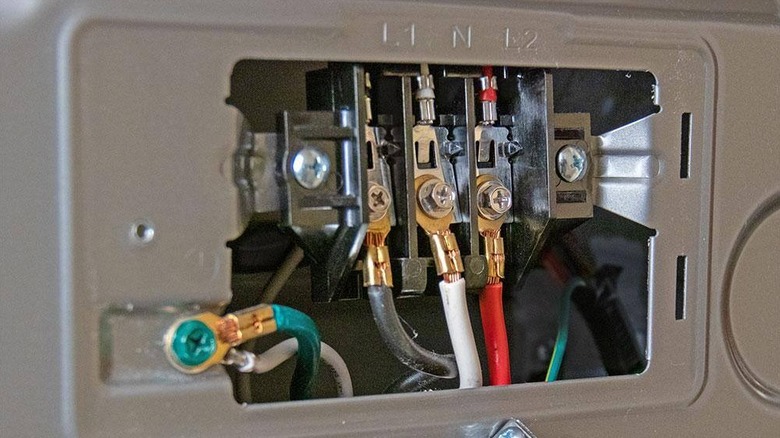
Since we're talking about appliances, there is one other prong situation that occasionally causes confusion when it comes to large, 240-volt appliances: The different types of dryer plugs. Dryers in homes built before 1996 were typically wired for three-prong plugs of a completely different size and configuration than standard three-prong household receptacles. Two of the conductors each supplied 120 volts of power, and the third combined neutral and ground functionality.
In 1996, the National Electrical Code (NEC) was updated to require the safer four-prong standard, which added a dedicated ground — and therefore a fourth prong — to the plug configuration. This is essentially the same situation as the two-to-three-prong transition for 120v receptacles decades before, except that there's an additional 120-volt line in the mix.
Three-prong household receptacles and four-prong major appliance receptacles both have dedicated grounds and are markedly safer. Making the switch often requires rewiring, an expensive proposition. If your ungrounded receptacles are situated inside of grounded metal boxes, you can ground to those, or you can install GFCI outlets to prevent shocks (but these won't protect your electrical equipment). Since a single 240-volt receptacle is easier to rewire than a house full of 120-volt receptacles — and because your dryer almost certainly has a metal housing — the laundry room might be the logical first stop on your rewiring adventure. Note that your range and some HVAC equipment might also use an older three-wire system without a dedicated ground.