

Not Following This Little-Known Rule Could Explain Why Your Lawn Keeps Turning Brown

Running your lawn sprinklers for 30 minutes doesn't measure the moisture levels of the grass or roots. Water volume varies based on a watering system's design, sprinkler pressure, and spacing. One system can use substantially more water than another within the same duration. And this could be a reason your grass continues turning brown: You're not following the 1-inch rule (which is really more of a loose guideline). The 1-inch rule is based on giving your lawn about an inch of water weekly, excluding rainfall. Saturate its roots with water, which usually needs to penetrate the soil by 6 to 8 inches.
Keep in mind that the 1 inch is a general rule. Factors like soil type, seasons, and grass health determine required water volume. But you can always check the lawn by walking on it and examining your footprints or looking at its color. If grass flattens when you walk over it, it's overwatered. If it becomes wilted, curled, or looks bluish-gray, then it might need watering.
Browning grass does not necessarily indicate dying grass. Some cool-season grass varieties may become brown and go into dormancy during hot, dry conditions, so caring for a lawn during drought may require separate guidelines. Also, if you have recently overseeded the lawn, the seeds will require light irrigation before watering.
How to measure 1 inch of water correctly
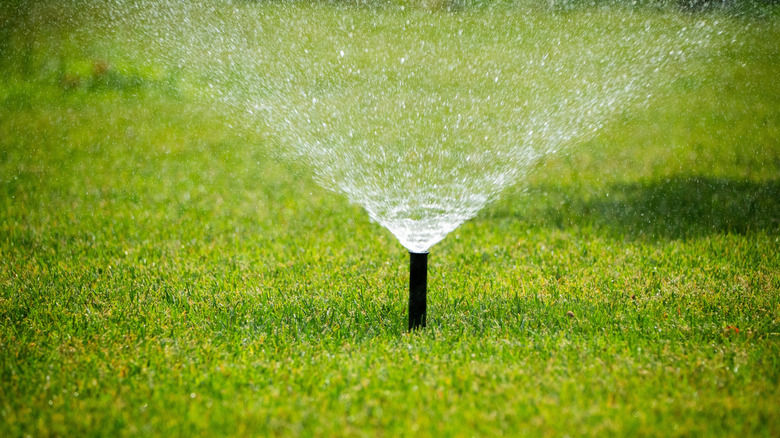
To eliminate any guesswork, you can conduct a catch-can test. To begin, set up six identical straight-sided, flat-bottomed cans within one sprinkler zone and operate the watering system for precisely 10 minutes. Next, inspect each individual can. One can having significantly less water than the rest indicates a possible issue such as a broken sprinkler head. Then pour all the collected water into one can and use a ruler to gauge its depth. This will give you the inches per hour your sprinker is giving you.
Ideal precipitation rates will vary because of soil, exposure, heat, and wind , so be sure to understand your lawn's specific needs. For instance, look out for slopes where water may run off, or instances where soil is compacted and clay-rich, absorbing water reluctantly. The cycle-soak-method will help combat this type of problem. Instead of watering for a half-hour, divide it into multiple segments with time in between, letting water have a chance to soak in.