

Ditch The Wet Vac: Easily Empty Your Toilet Tank With A Drill Attachment
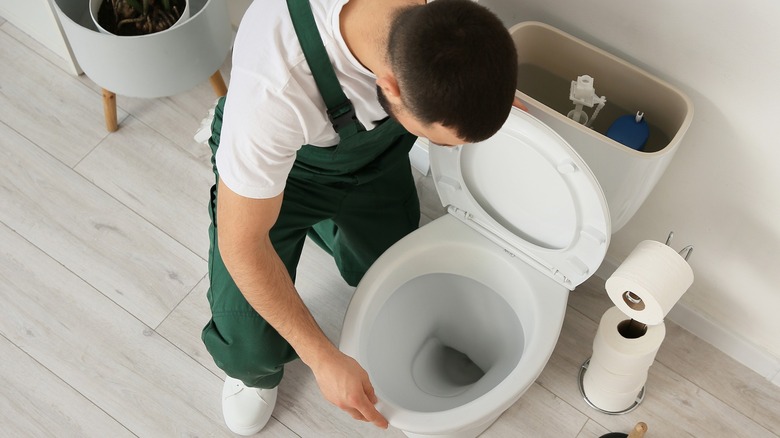
At some point, you will likely find yourself needing to empty the water from your toilet tank or bowl for one of several reasons: repairing or removing the toilet; cleaning and disinfecting the porcelain; or winterizing a toilet prior to leaving for a long period of time. Once you've drained most of the water, you can finish the job with a sponge, but that's slow and involves contact with possibly contaminated water. You can also use a wet/dry vacuum to suck out the water, which is fast and contact-free, but cumbersome. An even better way is to use a drill pump, which is just like it sounds: a water pump that attaches to your drill. The small, portable attachment is a quick way to drain toilets.
This is a really handy tool for moving water, and a well-reviewed model like the Drummond 750 GPH Drill Pump costs only $14.99, which is much less expensive than a wet/dry shop vacuum. It's small enough to fit in your hand, and you won't have any trouble finding a place to store it, which means it will be there in an emergency, such as a toilet or sink backup. You could even keep one stashed in each bathroom and in the kitchen.
Depending on the model you buy and how robust it is, you can also use this tool outdoors to drain standing water in your yard. Because it uses a drill as a power source and doesn't need to be plugged in like a sump pump or wet/dry vacuum, a drill pump can go pretty much anywhere, as long as the drill is cordless.
How to use a drill pump safely
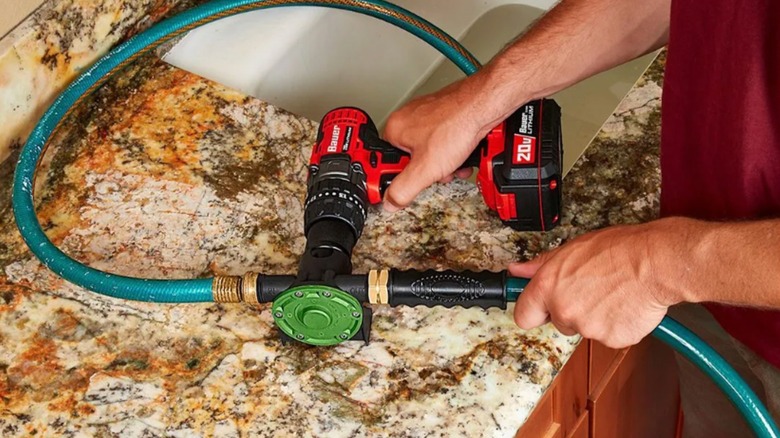
A drill pump has an inlet and an outlet port with male hose threads. The hoses don't come with the pump, but you can easily make your own by cutting two lengths from an old garden hose and attaching a female hose connector to one end of each piece. Keep hoses short (under 2 feet), because the pump has to work harder to transfer water through long tubing.
Whenever you're transferring potentially contaminated water like toilet water, it's important to wear gloves. You might also want to wear goggles and a mask because, even though the pump stays dry, water splashes as it emerges from the outlet hose to the bucket.
To empty a toilet in preparation for repair, replacement, or cleaning, start by shutting off the water and flushing to drain the tank. You can then use the pump to empty the bowl and what's left in the tank and transfer it to a bucket. Just be sure to keep the inlet hose immersed and the outlet pointing into the bucket until all the water is gone.
Most modern low-flow toilets use only 1.28 gallons per flush, so a two-gallon bucket will probably be big enough to hold the water. After the toilet is empty, you can use the water in the bucket to water your lawn or shrubs, but since it could be contaminated with bacteria and pathogens, it's best to keep it out of your vegetable garden. Water from a backed-up sink is fine for lawns and around flowers, but shouldn't be poured around or directly on edible plants.