

Cast Iron Pans Aren't Always Made The Same Way Anymore
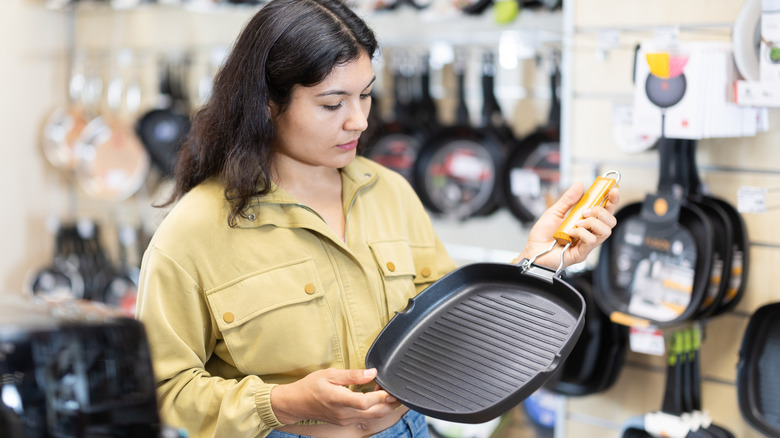
Have you ever wondered why your brand-new cast iron skillet feels bumpy and pebbled compared to the one you inherited from your grandmother? Well, first, congratulations are in order because you've got a vintage collector's item on your hands for which people have paid thousands of dollars. Let that sink in. Now, naturally there's going to be a major difference between your mass-produced skillet worth tens and the one selling for thousands. But what exactly is it? All of it comes down to the manufacturing shortcut most brands adopted decades ago to cut cost.
The dramatic shift in cast iron skillet manufacturing around the 1950s and 60s was driven by a transition from labor-intensive manual craftsmanship to automated mass production. To compete with the rise of "modern" materials like aluminum, Teflon, and stainless steel, as well as with cheap imports, manufacturers automated the mold-making and pouring processes and eliminated the expensive, time-consuming hand-polishing and tumbling steps. These changes altered the weight, surface texture, and usability of the pans.
So much of today's quality cast iron comes from the U.S., but these pans' story goes back much further. Cast iron's first recorded use was in China, in the 5th century BC. From there, it arrived in Europe, where it was widely used for construction. It wasn't until 1707, when Englishman Abraham Darby figured out a method to cast iron into relatively thin pans and kettles, that they became cheap enough to be widely adopted in kitchens. Back then, as cooking on live fire was the norm, people used cast iron pans with legs on the pot's base (usually three) and a heavy lid.
Cast iron gets industrialized
As soon as stoves became a standard for cooking in the late 18th and mid-19th centuries, cast iron skillets also matured into the flat-bottomed ones we know today. Industrialization made them cheaper to manufacture. By the end of the 19th century, many of today's iconic cast iron cookware brands were born. Among them were the original Griswold, Wagner, and Lodge Manufacturing whose pans are now passed down through generations.
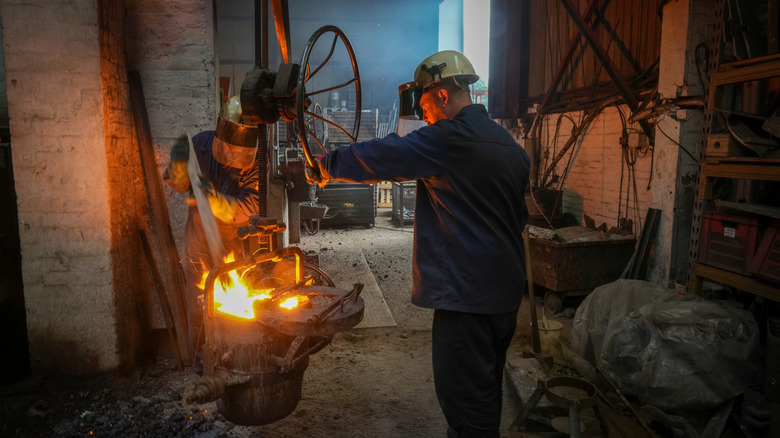
The life of a cast iron skillet back then began as a pattern (the design of the skillet) and a sand mold. A foundryman would use a wooden or metal pattern for a skillet and place it in a two-piece box and manually pack sand tightly around it. These were then separated, pattern removed, and the mold reassembled. The cavity left behind was where molten iron was poured. Finishing was just as manual: as-cast pans involved very little processing, left largely the way they came out of the mold. Most cookware then underwent tumbling — a process that removed roughness and alone took about 24 hours — followed by hand polishing, which made the pans non-stick. Skillets, griddles, Scotch bowls, and Dutch ovens that needed a smooth surface underwent polish grinding, and the rarer pieces that made it to milling ended up with a completely flat, smooth, and unusually thick bottom.
While this process was historically performed by hand, the technological advancements of the late 19th century paved the way for automated molding production lines. As such, the designs were optimized; light castings were no longer feasible, so the walls and handles had to be made thicker, though the added cost was offset by savings in labor. Polish grinding, too, was stopped to cut costs as cheap imports flooded the market.
Cast iron goes from cheap to collectible and comes full circle
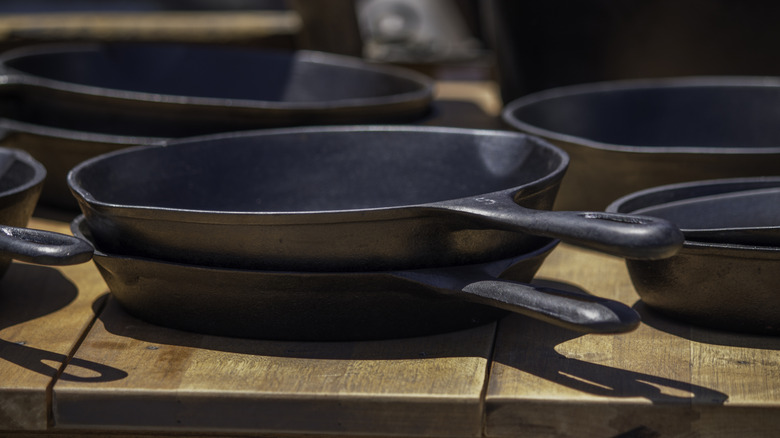
By the 1970s, automation wasn't just experimental. Lodge had started converting its foundry to embrace the automated molding process. Manufacturers kept upgrading from there. In 1994, Lodge replaced its coal-fired furnaces with an electromagnetic induction melting system, reducing hazardous waste. And by 2002, Lodge had introduced seasoned cast iron cookware, which eventually became the industry standard. As the global recession hit in the late 2000s and people started eating at home more, sales of Lodge's iconic 10.25-inch skillet spiked.
Riding this same wave was a broader desire for highly durable "heirloom" items dating back to the 90s. Around 2012, several new companies emerged, all wanting to once again make cast iron cookware in the vintage style. The craze was such that collectors were paying as much as $1,500 for antique pans made by Wagner, Lodge, and Griswold. And these antique pans became one of those valuable kitchen items you should never skip if you see them at an estate sale.
Today, you can buy a 10-inch cast iron pan for as low as $25, but these mass-market versions involve little to no handwork. Some newer manufacturers, like Smithey and Field Company, which manufacture minimalist cookware that will streamline your kitchen, have adopted methods closer to the old ways, like hand-milling or hand-seasoning their pans. Despite this, you won't have to shell out thousands of dollars for one of their productions. It's because they have reduced their pans' wall thickness. So, though their cookware comes with a polished surface and are closer in appearance to vintage pieces, they won't cost beyond a few hundred dollars.