

What Happens If You Mix Concrete And Glue?
We may receive a commission on purchases made from links.
Sometimes you hear an idea that's so common sense that it just has to be true (which is how we know common sense is commonly wrong). One such notion is the seemingly rational idea of adding glue to a concrete mixture. After all, when it comes to the basics of concrete, the curing process is all about getting a liquid to help glue the aggregate together, and what's gluier than actual glue? You can indeed buy products in the concrete aisle of your big box hardware store that seem to be PVA, latex, and acrylic glues to help improve the concrete's performance in various ways. So, why not try mixing in some white glue (PVA, or polyvinyl acetate, is the same stuff as Elmer's glue) or another adhesive you have lying around for your next stoop, slab, or walkway project? Unfortunately, that experiment is likely to go badly, so it's important to be discerning.
PVA, latex, and acrylic products are all described as bonding adhesives for concrete, and acrylic and latex are often sold as interchangeable "fortifiers" for concrete mixes. In these forms, PVA, acrylic, and latex could all be used to strengthen and otherwise improve the performance of concrete. Adhesives create more durable, less permeable bonds in the concrete and can be especially helpful when bonding old concrete to new concrete during repairs. Note that concrete can't usually contain both a PVA bonding adhesive and an acrylic or latex fortifiers. But all those benefits don't necessarily extend to glues you happen to have lying around the house, mainly because of what happens when you get your concrete wet.
PVA additives for concrete
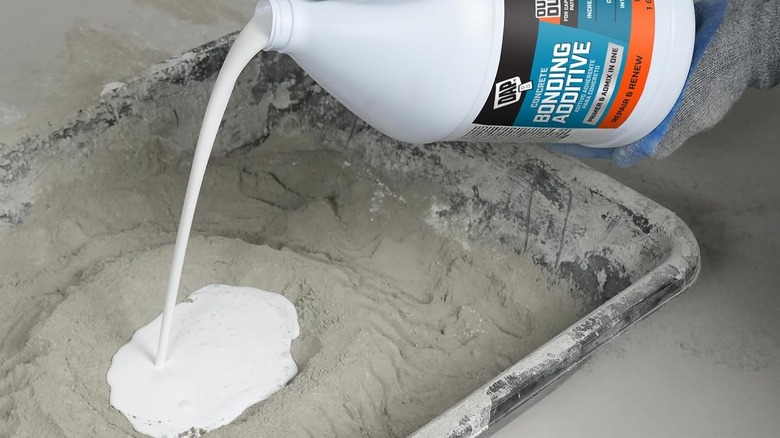
Even for beginners, mixing concrete is a relatively simple process, though all the new chemical additives and modifiers seem alien to that simplicity. And perhaps that's part of the temptation to mix that big jug of white glue in your craft room into it instead. It would probably mix just fine with your concrete and do most of the stuff you expect a PVA admixture to do — improve the flexibility, water resistance, and strength/durability of concrete. Unfortunately, this consumer-grade run-of-the-mill glue isn't quite the same as PVA additives designed for concrete, and the regular glue will re-emulsify when exposed to water. That is, it turns (to some extent) back into liquid glue. In fact, standard PVA glue loses bond strength not only when immersed in water but also when exposed to just moderately high relative humidity.
PVA bonding adhesive can be applied directly to surfaces to connect new concrete or prime the material, but you may also use it in in an admixture to blend with fresh concrete. Adding an appropriate PVA adhesive, such as DAP Concrete Bonding Additive, to a concrete mix makes for a gummier mixture that some find more workable in certain situations. Typically, you simply make a solution of water and around 10% to 20% PVA (depending on the product), and add it as normal to the concrete mix.
Acrylic and latex fortifiers to add to concrete
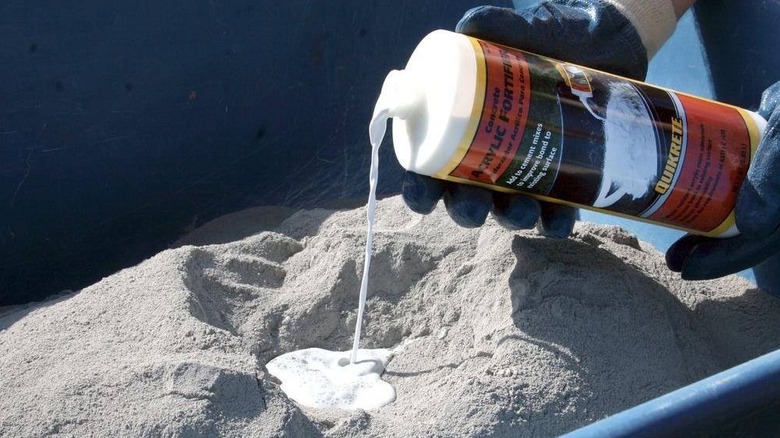
Similarly, household glue containing acrylic or latex (or both) aren't ideal for mixing into concrete ... assuming you can find them at all. Latex adhesives are used throughout the construction industry (and in many manufacturing processes) for its strength and flexibility. Still, they are unlikely to perform as well as proper admixtures and modifiers even if you do manage to get them combined with your cement and aggregate.
Emulsions of styrene-butadiene latex, acrylic polymers, or both aren't technically glue, though they're very similar. Products like Quikrete Acrylic Fortifier improve adhesion, density, water resistance, and, subsequently, the freeze/thaw cycle durability of concrete when introduced in a proper admixture. These adhesive additives generally work better than PVA additives for concrete in outdoor and frequently wet settings, and they improve the curing process and limit shrinkage and cracking. Note that you can't combine acrylic/latex fortifiers with the air-entrainment admixtures you might use when mixing cement and perlite when making lightweight concrete, for example. Unlike everyday white glue or latex adhesives, there are no readily available acrylic-containing glues that might substitute for acrylic fortifiers.