

How To Sharpen Drill Bits Without A Bench Grinder
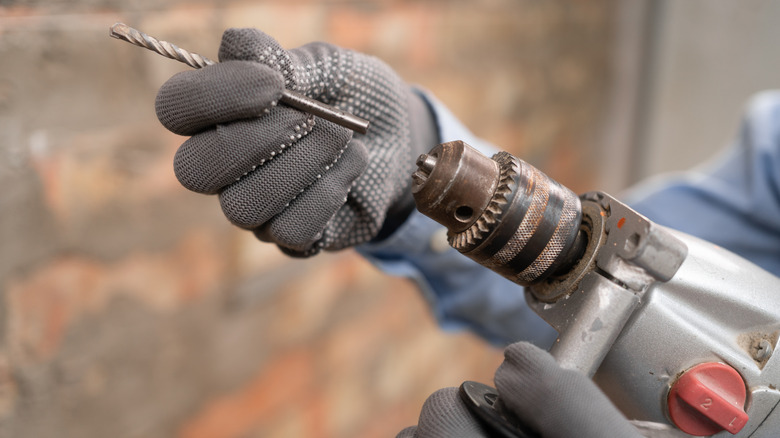
Craft, hacks, and DIY home improvement projects are much easier when you have a drill on hand. They become even easier when you have the right types of drill bits for the job. However, with time, every drill bill starts to lose its edge. You don't need to throw it out and get a new one, though. It just needs to be sharpened. Normally, sharpening drill bits requires a bench grinder or dedicated drill bit sharpener. However, you can use a belt sander to get the job done instead if you don't have a bench grinder.
Belt sanders consist of two wheels with a length of sandpaper or a similarly rough material stretched over them. As the wheels turn, the rough material moves, letting you sand an item more quickly than by hand. The abrasive material is able to strip small slivers of metal off the drill bits, leaving them with a fresh, sharp edge. It's a fairly quick process, but it can take a few attempts to get the hang of it. If you already own a belt sander, then you can jump straight to sharpening. However, if you don't have one, you may need to look at your local hardware stores. Belt sanders are generally inexpensive to rent, although the cost can vary by where you live and what companies are in your area. You may be able to rent them for as little as $25 to $35 per day.
Sharpening drill bits with a belt sander
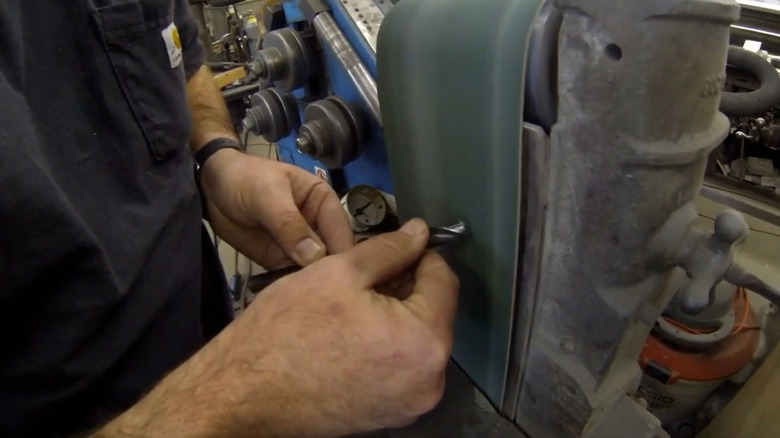
Take a moment before starting to look at the drill bit — see how it's angled, and where the edges and surfaces of it are. If you just press the drill bit into the sander straight on, you'll end up flattening the tip rather than sharpening it. Instead, you'll want to start at an angle, with the flat space just below the edge pressed to the belt sander. Then rotate it, moving the drill bit up the sanding belt as you do. The rotation should be subtle, as you only need to sharpen the section at the very end of the bit. Try to keep the pressure even as you move it, so that you don't end up with bumps. You may want to practice the motion a few times before turning on your belt sander. Repeat the process for each of the cutting edges at the tip of the drill bit.
For the average person, checking the edge by sight and touch alone should work just fine. However, if you use your drill for more precise work where the angle and size of the drill bit is crucial, there's one more step to complete. Check your drill bit against a drill gauge, which is a tool designed to measure the angle of drill bits. While you're checking and sharpening your drill bits, you may want to remove any rust from your drill bits as well to keep them in top shape.