

Ditch The Poured Concrete: A Natural, More Stylish Alternative For Your Front Walkway

If the idea of poured concrete walkways makes you grimace, you aren't alone. They're simple, durable, and low-maintenance, but they can also be boring and artificial-feeling. Why not swap out that option for something both natural and beautiful? Wooden walkways or stepping platforms are charming, easily customizable, and eco-friendly. You can paint or stain them to add color, or let the natural wood color and grain speak for itself. Plus, if you change your mind, the wood can be repurposed or left to biodegrade over time.
Wood tones are generally much warmer, softer, and more inviting than the smooth, uninterrupted expanse of poured concrete. They meld more easily with the natural landscape around them as well, rather than sticking out. If you want to have flowers or pretty shrubs lining your walkway, wood might be a better match than flat gray concrete. In addition, installation is potentially much easier. Depending on the complexity of the design you're going for, it can be as simple as laying down wood boards. You can even use recycled wood, including old wood pallets. This makes it particularly budget friendly, since there are places you can get wood pallets for free.
What to know before building a wooden stepping platform
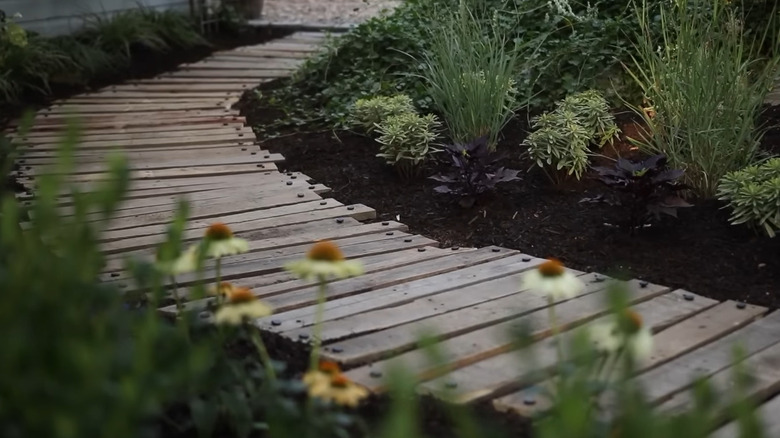
There are a few important things to note before you start creating your wooden walkway. If you can't find any free pallets in your area, the project may be less cost-effective than expected. Some types of wood could be even more expensive than concrete. Poured concrete costs an average of $6 to $10 per square foot. Simple pressure treated boards or low-end bamboo planks are generally more affordable at $3 to $4 per square foot, but a high-end options like ipe or redwood could be as expensive as $12 or $20 per square foot. Low-end, inexpensive wood doesn't look as nice, but you can stain or paint it to improve the appearance. Using reclaimed or recycled wood can help keep costs low, as long as it is still in good condition. You may need to flatten warped wood or clean mildew or moss off the surface first.
The proper maintenance routine for your walkway will also depend on the material you choose. While replacing an individual board is generally easier than fixing cracking concrete, you don't want to need constant replacements. To keep your boards in good condition, you'll want to know how to seal and coat landscape timbers or boards. A sealant will help prevent your walkway from absorbing moisture from the ground and air, reducing the risk of rot and protecting the wood from pests.