

What Happens If You Mix Dawn Dish Soap And Concrete?
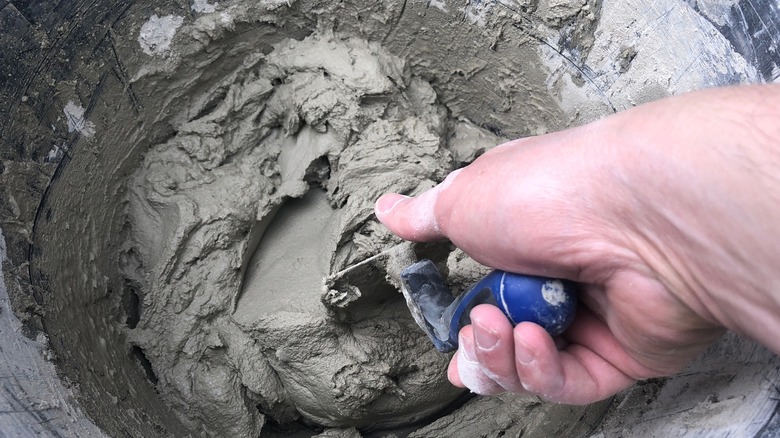
Adding Dawn dish soap to concrete is an old contractors' trick to make concrete stronger in very cold climates, and some swear by it. If you add a tablespoon of dish soap per bag of ready-mix, the bubbles it creates while you're mixing the concrete permeate the slurry and get frozen in place when the concrete solidifies. They provide space for water to expand into when the cured concrete undergoes repeated freezing and thawing. Without this extra space, the concrete is more prone to cracking.
Contractors also use dish soap as a retardant to slow down hardening and buy them more time. They might mix dish soap with water and add it to the concrete during mixing or spray the solution on the concrete after pouring. The solution acts as a plasticizer, making the concrete flow more smoothly as well as harden more slowly.
When it makes bubbles in the concrete, dish soap (also great for cutting grease) acts as an air entrainer. However, the problem that some concrete pros have with dish soap is that the bubbles are unevenly distributed, and some of them are too big, which makes the concrete weaker, not stronger. This weakening happens even if you use a commercial air entrainer, and the way concrete suppliers prevent this is to add more Portland cement to the concrete mixture. If you just add dish soap to your ready-mix, you don't have the benefit of this extra reinforcement.
Does Dawn dish soap actually weaken concrete?
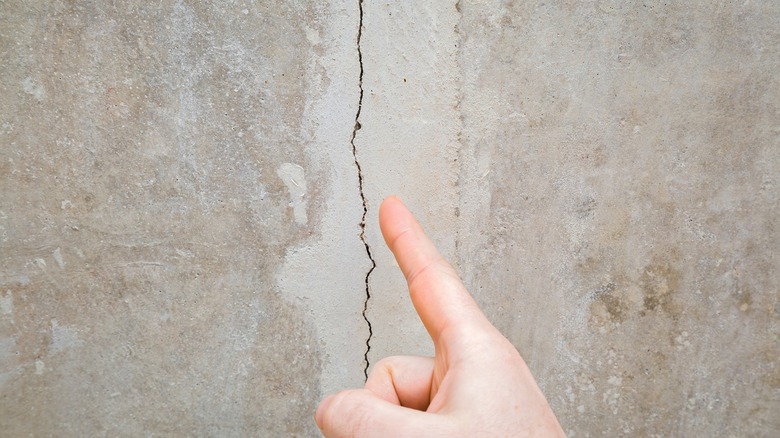
Ultimately, dish soap isn't designed to interact with the chemicals in concrete. Although dish soap is indeed a surfactant, which is what you need to get bubbles, it behaves unpredictably in the mineral-rich environment of curing concrete. A commercial air entrainer doesn't pose this problem because it's formulated with chemicals that are compatible with those in concrete.
To determine whether dish soap actually slows drying and curing and weakens concrete, YouTuber Canadian Concrete Pumper conducted an experiment with three different mixtures, one containing no dish soap, one containing some, and one containing a lot. He extracted a block from each mixture and noted that the one with a lot of dish soap took longer for the concrete to cure than the other two. When curing was complete, however, he and his crew had a tough time figuring out which block was which after hitting each with a hammer. They all seemed equally hard.
Even if dish soap doesn't weaken fresh concrete, it could do so in the long term as irregular moisture pockets expand and contract in the freeze/thaw cycle. Moreover, the effects of the interaction of the many active ingredients in dish soap — fragrances, dyes, and surfactants — are an unknown variable. All in all, you're probably better off using a commercial air entrainer instead of a bottle of Dawn.