

Does Cleaning Vinegar Kill The Smell Of Cat Urine?
We may receive a commission on purchases made from links.
Occasional messes are to be expected when you have pets, but cat urine smells are admittedly one of the most challenging to deal with. The reason behind the persistence of cat urine odors has to do with its uric acid crystal content, which can stick to a variety of surfaces. Even worse, since uric acid crystals in cat urine are not water-soluble, the subsequent ammonia-like odors can last for years, says the Extension Foundation. Needless to say, cat urine stains and related smells can be quite a challenge, so you certainly don't want to waste your time and effort on solutions that won't work. Cleaning vinegar may neutralize cat urine smells to some degree, but it doesn't completely kill it. Overall, the product is not an effective long-term solution compared to other more viable options.
While you might use regular distilled white vinegar for occasional cleaning tasks, cleaning vinegar is a much stronger product. Both contain the active ingredient acetic acid, which can break down a variety of deposits in common stains. However, unlike distilled versions that contain 5% acetic acid, cleaning vinegar has at least 6% or more. Not only does this make for a stronger product, but cleaning vinegar is never safe for ingestion. Moreover, it's much more acidic, and can damage certain surfaces such as metal, stone, hardwood flooring, wood cabinets, electronic screens, and stainless steel. Despite such acidity, cleaning vinegar is not designed for cat urine odor removal.
When it comes to cat urine odors, cleaning vinegar may not cut it
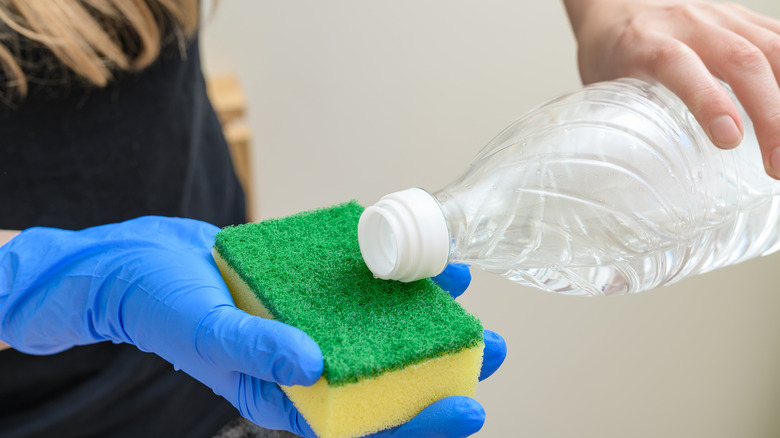
When used with care and by avoiding certain surfaces, cleaning vinegar can indeed be a powerful ally for certain home cleaning scenarios. It can help get rid of mold, soap scum, hard water stains, and grease, and it may be used to remove various stains on carpets and other fabric-based surfaces. Yet this strong acetic acid-containing product may not address the source of cat urine odors to make it an effective solution for these types of messes.
In theory, acetic acid can break down alkaline odors such as cat urine. The problem with using cleaning vinegar for cat urine is that acetic acid cannot break down the uric acid crystals that contribute to these lingering notoriously strong odors. Another problem with this combination is the lack of water-solubility of uric acid, as well as the fact that cleaning vinegar products contain mostly water along with acetic acid. What's more, given the strong nature of cleaning vinegar more broadly, you could essentially be replacing one odorous problem with a potent vinegar smell and possible respiratory irritation.
You might be able to try cleaning vinegar for cat urine as a quick fix, but know there's a good chance the odor will still linger after the product dries. If you're considering home remedies for cat urine smells, you'll also want to refrain from the age-old advice of white vinegar and baking soda. These two products essentially cancel the effects of one another when combined together, and will not effectively treat cat urine smells embedded in carpets and rugs.
Consider an alternative to cleaning vinegar for cat urine smells
Instead of cleaning vinegar, you may consider options that are proven to help address the problem of uric acid crystals in cat urine. One such option is an enzymatic cleaner, such as Nature's Miracle Cat Urine Destroyer Plus. These types of products help to break down uric acid and its associated smell, rather than masking the odor. They're also much safer to use on surfaces, including rugs and carpets (one exception is leather). Enzyme cleaners are also effective options against other pet-related odors, such as for tackling dried dog urine in carpets.
These types of cleaning products are safe to use around both pets and people, as long as you let the area dry after use. As a bonus, the enzymes can help break down cat urine to a point where no traces of the odors are left behind to encourage future accidents in the same spots. Look for a product that is specifically advertised for cat urine stains, and carefully follow all instructions for use. No matter which type of product you end up using to clean up cat urine, make sure the affected area also gets plenty of ventilation, too.