

What Does The Red Light On An Outlet Mean?
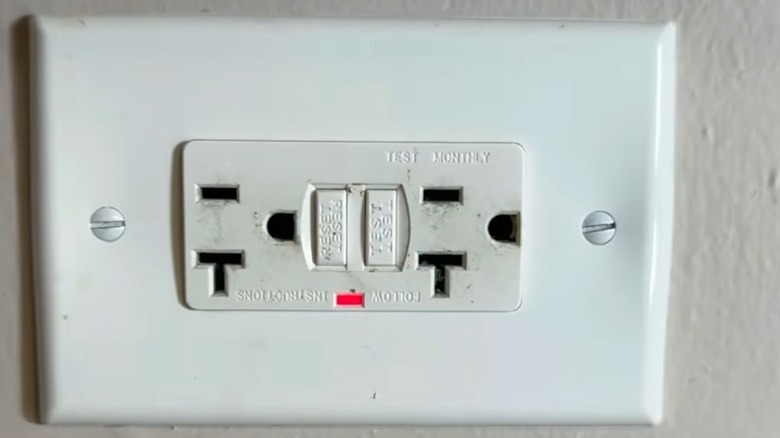
Our wall sockets don't typically get a whole lot of attention. Even when you're plugging in an appliance or piece of equipment, they may receive a cursory glance at best. Consequently, you might not notice if the light on one of your outlets goes from green to red. If you do spot this, don't brush it off. "Usually, a red indicator on the outlet signals either that it has tripped or that there is some problem detected," Carl Murawski, a licensed electrician, explained in an exclusive interview with Hunker.
Most common on GFCI (Ground Fault Circuit Interrupter) or AFCI (Arc Fault Circuit Interrupter) outlets, the light can signify two different kinds of issues. "Sometimes a solid red light means that the outlet has tripped and must be reset," Murawski explained, "while a blinking one means that the outlet has failed its internal self-checking and should be changed." The light could even point toward exposure to moisture and faulty wiring connections. That being said, he warned that the true meaning will depend on your GFCI or AFCI manufacturer. With that in mind, it's best if you look up the manual or check the brand's website to be 100% sure. "However, in most cases, a blinking red light should be considered a warning, not a signal that the outlet is functioning normally," Murawski added. So, don't ignore it — take remedial action immediately.
What should you do if you see a red light glowing on an outlet
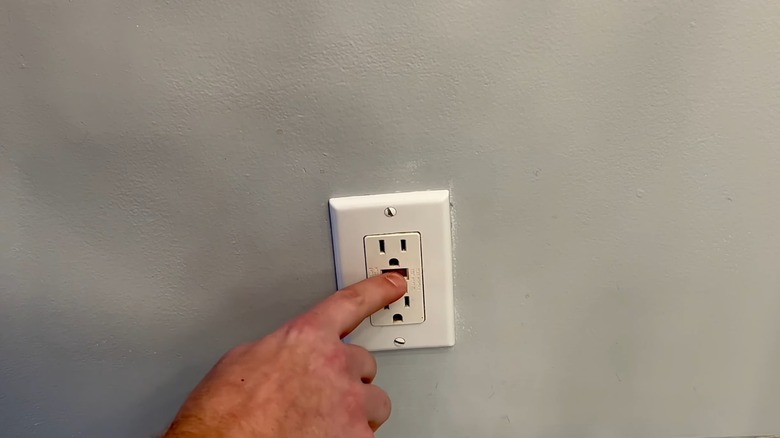
As mentioned above, you'll generally see red indicator lights on your GFCI and/or AFCI outlets. Since their primary function is to prevent electrical accidents, Carl Murawski told Hunker that you'll often find them "in places where protection from shocks or fires is required, such as kitchens, bathrooms, garages, laundry rooms, basements, and outdoor spaces." As such, when you see a glowing red LED light, push the "Reset" button at once. This should help clear minor issues, like a small electricity surge, and encourage it to return to its default state. But if that doesn't work, try pushing the "Test" button before you again click the "Reset" one.
If resetting your GFCI outlet doesn't work, you should eject anything plugged into it and shut down the breaker for that particular circuit. "In case the red light appears again after the outlet has been reset, or it cannot be reset at all, it is high time to consult an electrician," Murawski advised. "Such a situation can be caused by a faulty outlet, moisture in the box, a ground fault, [or] damage in the wiring or to some appliance connected to the circuit." It can be something as benign as an old fridge or a malfunctioning new model with a faulty compressor. Or, maybe your outlet has reached the end of its 10- to 15-year lifecycle and requires a replacement. "I would also advise calling an expert if the outlet feels warm, emits a burning smell, has scorch marks, or trips even though no apparent devices are connected to it," Murawski added.
How to determine whether your GFCI outlet has tripped without a LED light indicator
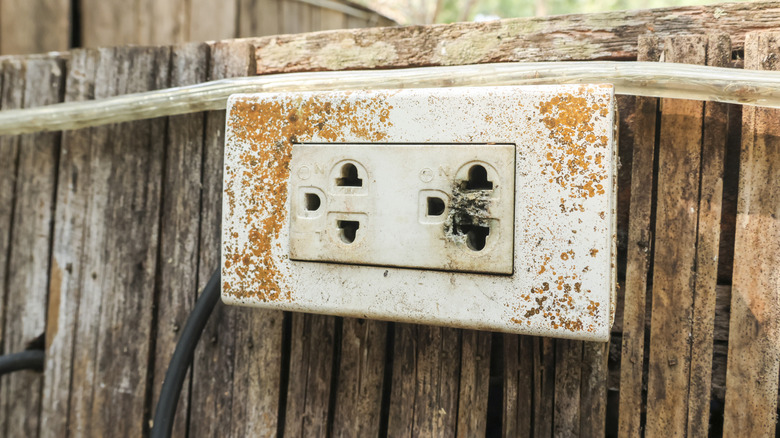
If you didn't have your GFCI outlets updated recently, there's a chance they might not feature built-in LED light indicators. In this case, there won't be an easy way for you to know when the outlet trips (maybe your styling tools have a burnt cord?) or moisture creeps in. But there are still a few ways you can monitor the health of your GFCI outlets. "The first signal is that the outlet stops working properly, especially if it happens in a kitchen, bathroom, garage, basement, or outdoors," Carl Murawski told Hunker in our exclusive interview. "There is a possibility that the tripped GFCI outlet is placed on another outlet on the same circuit, so I suggest finding it." This way, you can reset it or hire an electrician to come look at it. However, there's a chance you won't notice this if you don't use that particular outlet often.
"The second signal is that there is some heat, buzzing, crackling, discoloration, or a burnt smell near the outlet," Murawski added. "It might indicate that there is a loose connection or a faulty outlet. It is better to stop using it and have it examined by an electrician." These signs suggest the underlying problem(s) might not be benign or isolated to that specific outlet. So, have a pro check it out to negate unwarranted accidents in the future. "Finally, one more indicator is that plugs are not tightly fit in the outlet and easily fall from it," Murasaki continued. "It indicates that contacts inside are worn out. It may seem to be a small issue, but a loose connection can cause overheating, so I recommend replacing the outlet." A new GFCI outlet will cost between $15 and $50.