

Hard Water Vs. Soft Water: What's The Difference?
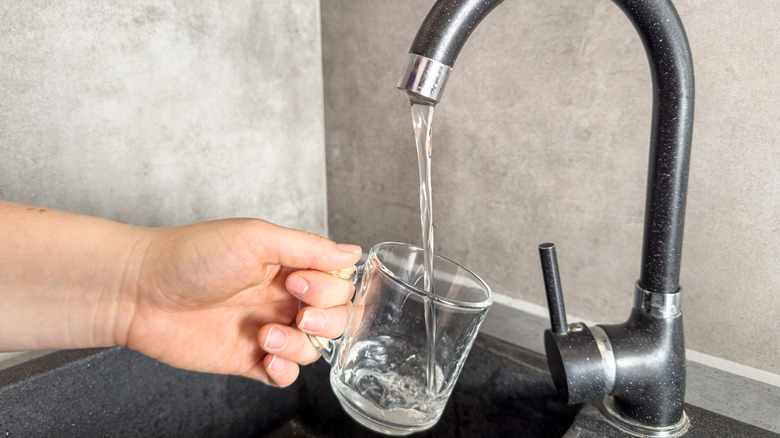
You've likely heard people complain about their water being hard, with many such homeowners choosing to make their home tap water softer. While "hard water" and "soft water" are terms that are used quite often, it's arguably just as common not to know their meanings. The hardness or softness actually points to the amount of certain dissolved minerals, with the term "hard water" getting its moniker from its reputation for being difficult to clean with at times. While neither hard nor soft water significantly affects your health, there are other benefits to testing for and treating hard water due to its poorer ability to clean and reputation for buildup.
Tap water contains two key minerals: Calcium and magnesium. The more of these minerals are present, the harder the water. As essential nutrients, drinking hard water is not detrimental, and it may even be beneficial in some cases. Hard water may even taste better than its soft counterpart, which may have a slight salty taste depending on the type of water softener used.
The only way to confirm water hardness is with testing that measures the amount of calcium and magnesium. Results may be presented in grains per gallon (gpg), as well as milligrams per liter (mg/l) or parts per million (ppm). Soft water is classified as less than 1.0 gpg and 17 ppm. True hard water is 7.0 to 10.5 gpg and 120 to 180 ppm, per PennState Extension. Anything below this is classified as slightly to moderately hard water, while larger numbers of greater than 10.5 gpg and 180 ppm is considered very hard water. Most water in the US is indeed hard water.
Downsides of hard water, and how to soften it
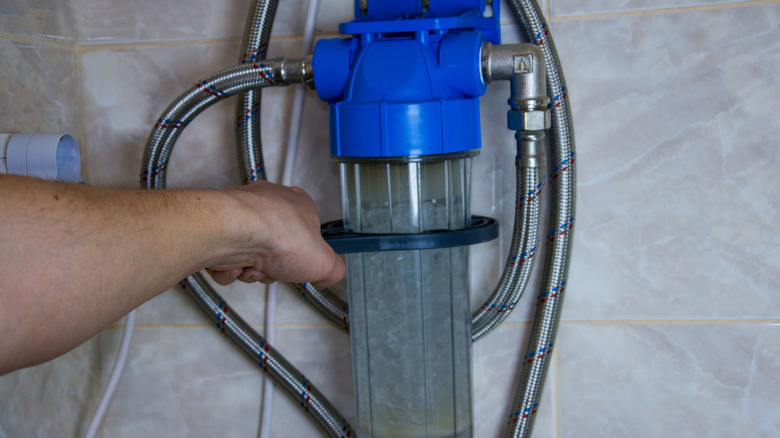
Hard water isn't usually a significant concern, but it can interfere with some household tasks and appliances. For one, these minerals can create deposits that build up around plumbing fixtures like faucets, where you might see some white and scaly debris. When pipes are affected, such buildup can impact appliances and hot water tanks by reducing their lifespan. Hard water might also not work as well for cleaning dishes and laundry, as it doesn't work as well with detergents and soaps. This can result in water spots on dishes, and your clothing and towels may not feel as soft and clean as they ought to be. You might notice soap buildup in appliances, and even on your skin.
If you are seeing some of these signs in your own home, you may consider testing your water and softening it. While home water testing kits are widely available, the University of Nebraska Extension notes that professional testing with a lab analysis is a more accurate option. Once confirmed, you have a few options for softening your water. Some people opt for whole-home water softening systems, which work with an ion exchange unit that filters your tap water and neutralizes calcium and magnesium with the help of sodium ions. It's also possible to soften the water directly in appliances such as dishwashers and washing machines, if these are your primary points of concern. Finally, know that regularly cleaning your hot water tank, dishwasher, and plumbing fixtures can also help to reduce hard water-induced buildup without necessarily having to buy water softeners.