

Neither Wood Nor Carpet: There's A Cheaper, Eco-Friendly Flooring Alternative
Sustainability and eco-friendliness are increasingly important considerations for homeowners looking for new flooring, right up there with durability and appearance. Among the green options currently available are engineered hardwoods, laminates, bamboo, cork, and linoleum (the real stuff — not vinyl). These are all alternatives to solid hardwood planks, vinyl flooring products, and nylon or polyester carpeting. Vinyl flooring, as well as nylon or polyester carpeting, is manufactured using fossil fuels. However, there is an eco-friendly flooring option you might not know about: recycled rubber.
The main source of recycled rubber for flooring is worn-out automobile tires, and there's no shortage of them. More than 287 million tires are thrown away each year. They take up space, provide breeding grounds for mosquitoes, rodents, and snakes, and catch fire easily. Turning old tires into flooring is an effective way to convert them from a liability into an asset.
You might think of rubber flooring as purely utilitarian, and much of it is. It's often used in commercial buildings, workshops, and hospitals. However, its low price, resilience, and slip-resistance also attract homeowners looking for a floor covering for the kitchen, patio, basement, laundry room, or home gym. It repels water, making it a good material for bathrooms and kitchens, and it absorbs sound, so some people use it to cover floors in home studios, music rooms, and other rooms that need soundproofing.
What to expect before installing rubber flooring
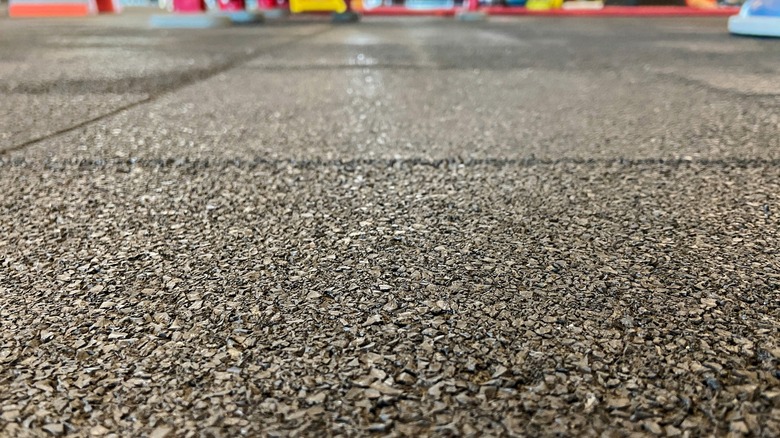
Rubber flooring comes in two formats: rolls and interlocking tiles. You can also buy rubber mats to place over existing flooring. Rubber flooring prices vary depending on the format, thickness, and style. Rolls are generally cheaper than tiles, with prices ranging from $1.31 per square foot (psf) for ¼-inch material to $2.31 psf for ½-inch material. Tiles, on the other hand, range from $1.89 to $3.18 psf for the same thicknesses. Compare that to laminates, which cost from $1 to $5 psf.
Rubber flooring is easy to install, which should interest anyone looking for a budget flooring option, because you can save a lot by doing the installation yourself once the subfloor is cleaned and prepped. Tiles simply snap together like puzzle pieces, and you can cut them with a utility knife, making them easy to install. Rolls take a bit more effort, usually calling for a two-step process: start with dry-fitting, then secure the rolls to the subfloor with glue or tape. Finally, apply a sealer to prevent moisture from seeping through the seams onto the subfloor.
Once the floor is in place, it doesn't need much maintenance other than an occasional wash with a mild detergent. It's important to use a detergent that dissolves in water, and not an oil-based cleaner. Solvents in these cleaners can dissolve rubber and ruin the appearance of the floor.