

The Insulation Material That's No Longer Allowed In Homes
Whether you're building a new home or researching your options after a roof leak, there's more to understanding home insulation than you might think. Learning the differences between spray foam and fiberglass or the best R-value for your local climate isn't as exciting as picking out a new wallpaper pattern or flooring material. But along with determining the best product for your situation, it's also important to know about the insulation material that's no longer allowed in homes. Although it was once the go-to option, asbestos insulation has been banned for decades because when its needle-like fibers are disturbed, they often cause serious lung disease.
A naturally-occurring mineral that's resistant to heat and corrosion, asbestos was long embraced by the construction world for a variety of building materials including roofing shingles, floor tiles, and various types of insulation. First popularized in the early 1900s, by the end of World War II asbestos insulation was commonly used during the subsequent housing boom because of its durability and fire-resistant properties. However, around that time, medical professionals, insulation scientists, and industry executives alike started becoming more aware of its possible health risks.
As medical studies continued to conclusively prove a link between asbestos exposure and lung disease, the Environmental Protection Agency (EPA) banned spray-applied insulation containing asbestos in 1973 under the Clean Air Act. Attempts to further regulate the use of asbestos followed for decades. Although it was banned in spray-on insulation, other asbestos-containing products weren't fully banned in the United States until 2024.
Asbestos can be hard to identify and remove
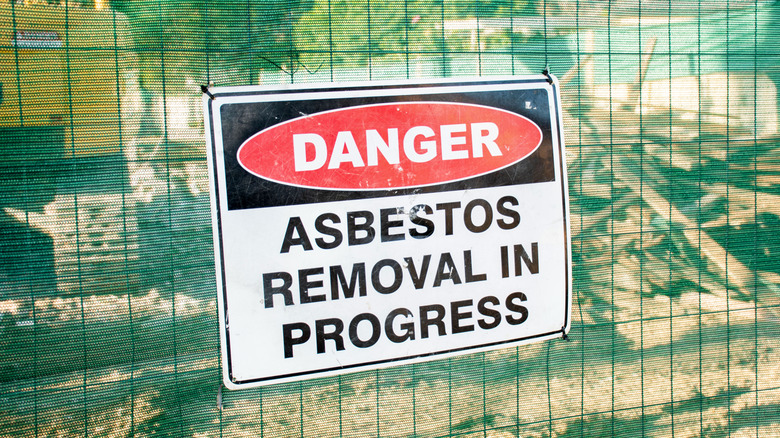
Despite the fact that asbestos insulation is no longer allowed in residential construction today, it's one of the hidden health hazards in homes built before its use was banned. Along with finding it in attics, basements, and crawl spaces, asbestos insulation was commonly wrapped around boilers and water heaters. Since it was used in so many different building materials, from loose fill insulation to corrugated paper wraps, without clear labeling, it can be difficult and dangerous to identify asbestos by looks alone.
That doesn't necessarily mean you need to panic if you live in a house built in the 1980s or earlier. Asbestos-related lung damage is caused by tiny airborne particles, not exposure to the mineral itself. According to the EPA, harmful exposure can often be avoided by making sure you're not disturbing old insulation materials. If you're concerned, hiring an asbestos abatement professional to safely test and remove your old insulation is a much better idea than attempting to DIY.
Even though modern insulation materials are generally safer than old-school asbestos versions, they also require caution. Fiberglass is a popular and budget-friendly option. Since it's made from recycled glass and sand, it offers fire-resistance like old asbestos insulation without the health risks. That said, you should always wear protective gear when interacting with fiberglass insulation, since contact with its tiny glass fibers can temporarily irritate your skin and respiratory system. Spray foam is another popular option that provides highly effective home insulation. However, unless it's professionally applied and allowed to properly cure, its vapors can also cause temporary respiratory irritation.