

How To Turn The Eyesore Of An Exposed Septic Tank Into A Stylish Landscaping Feature
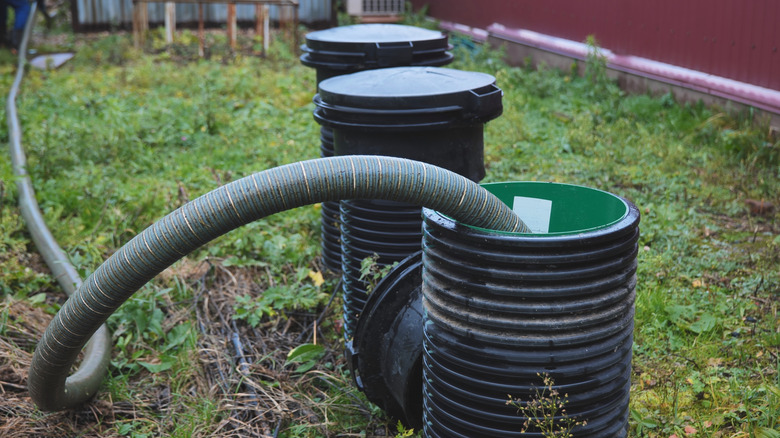
TikTok design and DIY influencer Alli Devlin (@the.hoss.homestead) had a very common problem in her Washington State home: She ignored the eventual necessity of emptying her septic tank. Three years later, when it finally needed to be emptied, she was forced to destroy her plantings to give the pump truck access. To make matters worse, all this was happening only a few feet from her house. Fortunately, she came up with a brilliant solution to avoid this sort of thing in the future: A modular deck with removable top panels that completely hides the septic port but offers easy access to them when necessary.
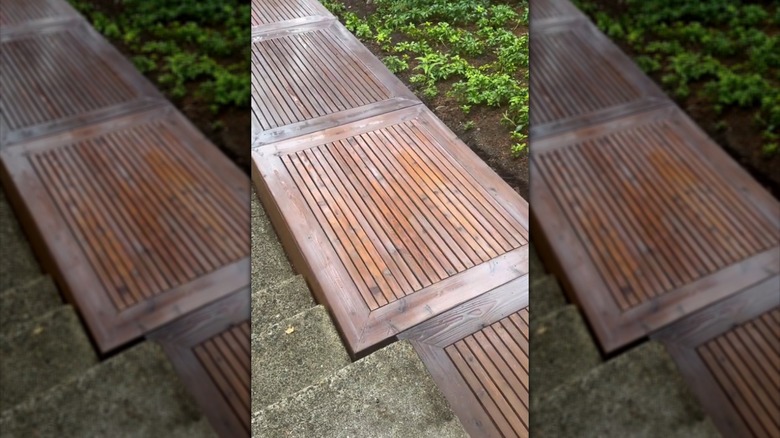
Devlin wanted the solution to be a non-structural, purely landscape feature in order to avoid the necessary permits. She and her husband arrived at a great solution, which she at first described as a "walkway deck" but later started referring to as "benchtops." The idea was to build a large box with an open top around the entire septic tank area, then subdivide that box into four areas and build four removable tops for them. (The top next to the porch was smaller than the other three, which are all the same size.) Keep in mind that, while you're free to build such a structure over your septic tanks, building a deck over a septic field is generally not a good idea.
Building the deck/benchtops
The project started, as so many do, by clearing the area. For Alli Devlin and her husband, this included removing some substantial boulders that had to be broken apart and rolled away. Afterward, they added risers to the septic tank ports to make them easier to access without digging. The risers would have made the septic even more of an eyesore without the new deck, and this alone might make such a project worthwhile.
Devlin poured pea gravel as a base for the benchtop project, then built the main box and three dividers on which to rest the individual tops. These were slatted to match a nearby privacy screen, and the slats were ripped from larger lumber. Each section's top — designed to seat within the main box and dividers so that they don't move around — was framed individually, as opposed to trying to create continuous/seamless slats across all four. This improved the stability of the individual benchtops and almost certainly made them easier to construct. Meanwhile, Allied crowdsourced stain color ideas from her TikTok audience, eventually going with TWP Natural Effect in walnut with a protective clear coat over it. (She stripped and stained the privacy screen to match.)
The septic tank is very close
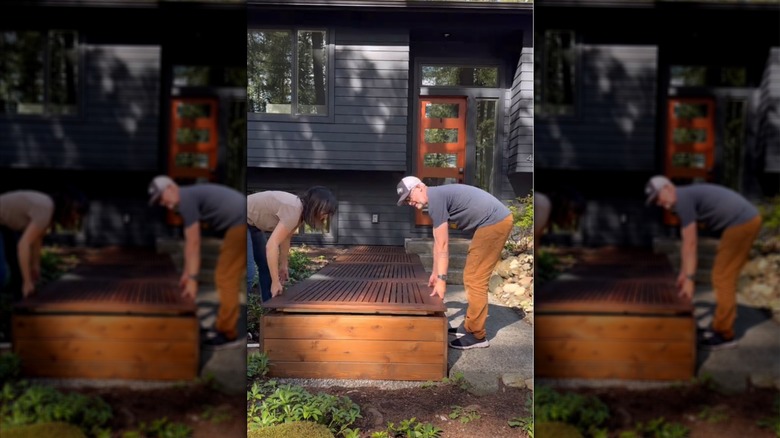
As a few commenters noted, Alli Devlin's septic tank is unusually close to her home, and she says she doesn't know why. It appears that the closest tank port riser is around 5 feet from the foundation, while you should normally put the septic tank at least 10 feet from the house (experts say 20 to 30 feet is ideal). Septic tanks set too close to a home can cause a number of problems, notably structural and hygienic issues from leaking and potential system failure leading to catastrophic backups. A longer waste drain line adds a bit of margin in the event of a septic failure — you might notice the problems before untreated sewage backs up into your abode.
Of course, septic regulations vary by municipality, and variances are granted all the time. Siting a septic tank and drain field involves a lot of variables, such as steepness of grade, stability of soil, percolation rate of drain field soil, and other factors. It's not outrageous to have a tank so close to a house, especially in a hilly or mountainous setting, but it does create some potential septic system problems homeowners should look out for. Work with a licensed septic contractor, your permitting office, or an inspector if you have concerns about your tank's location.