

What's The Best Thermostat Setting During An Extreme Heat Warning?
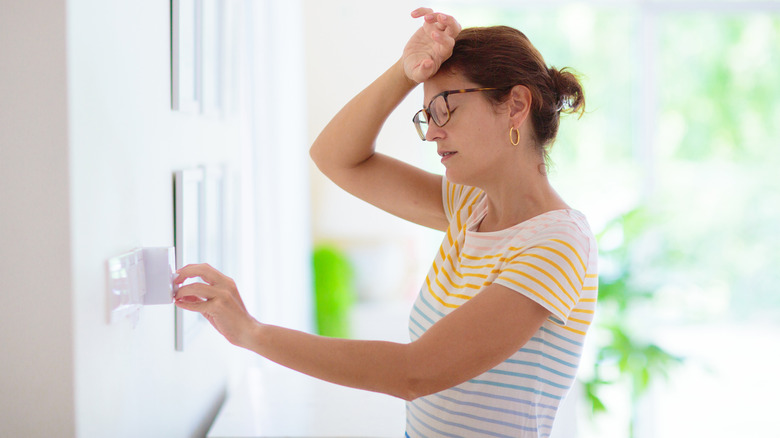
When temperatures outside are scorching, it's tempting to crank your air conditioning. However, heat waves can put a lot of stress on your HVAC system and cause you to use more power. To ensure your cooling system is protected and to help save energy, there's a specific temperature suggestion for your thermostat. Various HVAC companies, news outlets, and home magazines cite the Department of Energy's recommendation of setting thermostats to run somewhere between 75 and 78 degrees Fahrenheit. But, the webpage with the department's advice on home cooling was recently deleted, according to Newsweek. Keeping your home this warm might sound uncomfortable, but setting the temperature a little higher will help you to use your A/C more efficiently when outdoor temperatures are much hotter than normal.
While you might typically keep your thermostat in the low 70s, bumping it up prevents your cooling system from having to work as hard during heat waves. Jody Wright, owner of Wright Home services, told Martha Stewart about how a thermostat setting around 78 degrees can save energy and wear and tear on your A/C. "I tell homeowners that every degree you raise the thermostat takes a little bit of strain off the system, so the higher you can comfortably set it, the less energy you're going to use. That's why homes with higher thermostat settings generally see lower cooling costs." If you can't stand 78 degrees, aim for the highest temperature that's still comfortable enough for your home.
Advice for thermostat settings during excessive heat

As you work to keep your home cool during a brutal heat wave, think about how many degrees your system has to cool your space compared to outside temperatures. Besides setting your thermostat around 78 degrees, the Energy Star Guide to Energy-Efficient Heating and Cooling recommends slightly increasing the temperature when you leave for the day. While small adjustments like this are helpful during extreme heat conditions, try not to wildly change the temperature in your home.
The vice president of Air Control Home Services, Jamie Jensen, told Martha Stewart about the dangers of constantly or overly adjusting your thermostat in the middle of a heat wave. "Your system will work harder to switch temperatures, and it's also when power companies typically charge the most during peak demand, adding further costs," he said, adding "... Your system starting and stopping is when it draws the highest power and is also when it is most likely to fail."
Besides saving energy, this simple practice can help to make sure your A/C doesn't drive up your electric bill this summer. No matter what temperature you choose, check that your thermostat is set to the automatic function to prevent the fan from continuously running. With some thermostats, you may be able to set programs to alter the temperature throughout the day. Whatever you do, avoid turning the temperature way down in an effort to quickly cool your space.