

Move Over, Paint & Stain: A Better Way To Update Maple Cabinets
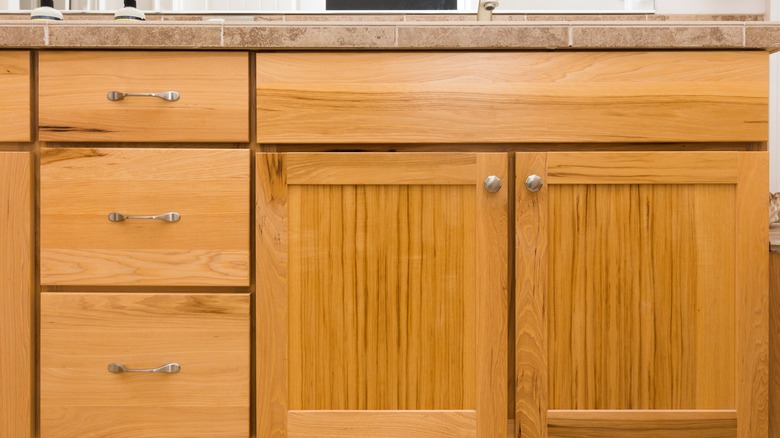
As a furniture and floor finisher, I've sprayed and brushed my share of wood finishes, including lacquer, polyurethane, and shellac. However, when working on a vintage piece of furniture — like an old maple cabinet — my preference has always been a penetrating oil. It's easy to apply, leaves the wood looking natural, and provides some moisture resistance, but it doesn't supply a film coating that resists stains and reflects light. The usual way to fix this problem and get a muted, lustrous finish would have been to apply a coat of hard wax and buff it up, until a fairly new product made it possible to combine two steps into one. The product, developed in Europe in the 1990s, is hardwax oil.
Several versions are available under such names as Odies Oil, Atomic Wood Wax, and Walrus Oil. They all include a penetrating oil, such as linseed or tung oil, and a hardening wax. The components are suspended in a solvent to create a thick liquid that you apply with a brush or rag, like a stain. Depending on the product, the final finish is as close to natural as you can get without leaving the wood bare.
Hardwax oil is for both furniture and floors, and it cures by combining with oxygen in the atmosphere. That can take time, so to speed up the process, some manufacturers offer two-component products. When you combine the components, a chemical reaction takes place that causes the oil to cure faster.
An easy-to-apply finish for bare wood
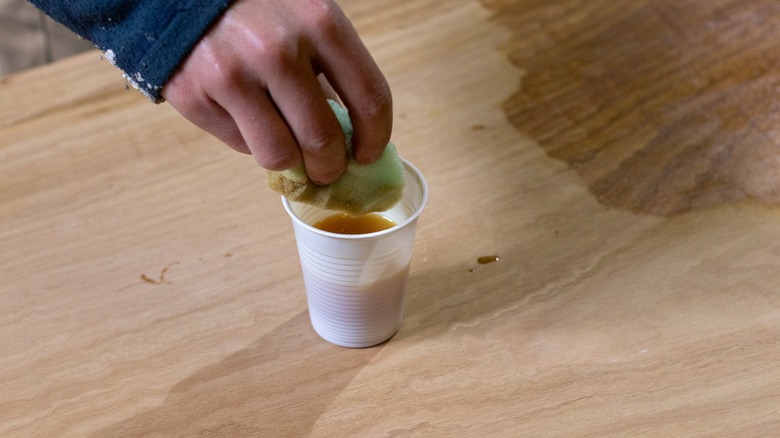
If you were hoping to find a quick and easy way to upgrade the existing finish on your maple cabinet, this isn't it. In fact, if there is a finish, you have to remove it by stripping and sanding, because hardwax oil has to penetrate into bare wood, and it's incompatible with other finishes. Defects show up easily, so I always do a final hand sanding with 150-grit or finer paper to remove orbital sander swirls.
Even stains will interfere with penetration, so if you want to change the color of the wood, you should use a water-soluble aniline dye instead of a stain. Pre-tinted hardwax oils are available, but you can also tint the oil yourself using an oil-soluble aniline dye. Hardwax oil has a great ability to bring out the natural colors in maple and other wood species, however, so you might want to skip the dye altogether.
Hardwax oil is very easy to apply. You can use a foam or bristle brush, but my preferred method is to use a rag, rubbing as I go to help the oil penetrate. After the recommended time has elapsed (it's different for different products, so check the label), you wipe the excess off the surface with more clean, lint-free rags. Because wax molecules are bigger than oil molecules, the wax stays on the surface, so the final step is to buff it up with rags until you get the sheen you're after.