

Is Burning A Tree Stump A Good Idea?
We may receive a commission on purchases made from links.
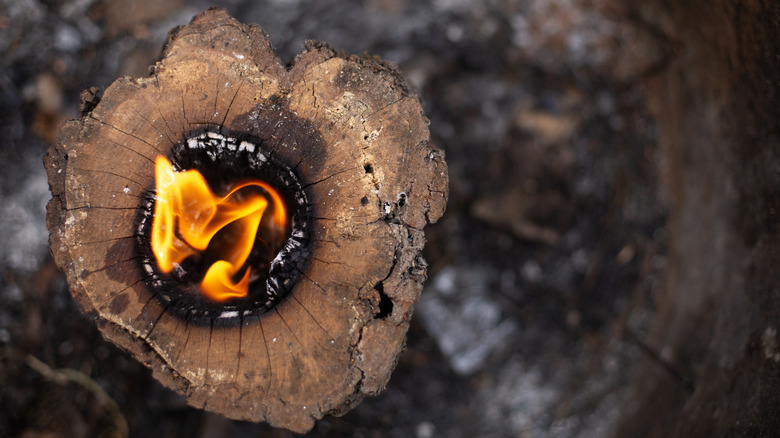
If you have a stubborn tree stump, it's normal to want the quickest, least expensive way to remove it from your yard. Instead of digging it out, you might wonder if burning the stump is a good idea. Is it a miracle way to complete a complicated yard chore or an unnecessary risk by literally playing with fire? In this Hunker exclusive, we spoke with Lisa Tadewaldt, an ISA Board Certified Master Arborist, International Society of Arboriculture Board Certified Master Arborist, and Owner at Urban Forest Pro to find out. The answer is yes and no. "It's not my first choice, but it is a proven effective method to remove a tree stump," says Tadewaldt.
Her reasoning is the risk. Stump burning doesn't just take a few hours; it can take days or even weeks of slowly burning it away to disappear completely. You have to supervise it the entire time, and things can easily get out of hand, even if you do everything right. "The biggest risk of burning a tree stump is fire-related risks, such as the fire getting out of control or reigniting once you think you have put it out," she says. "The Palisades fire in Los Angeles that destroyed hundreds of homes was a fire that was determined to be from tree roots that reignited, and that fire was put out by professionals, so the risk is real." To minimize the risk, she recommends staying home for several days after burning your stump to look for signs of reignition.
Using a stump grinder is a safe and effective alternative
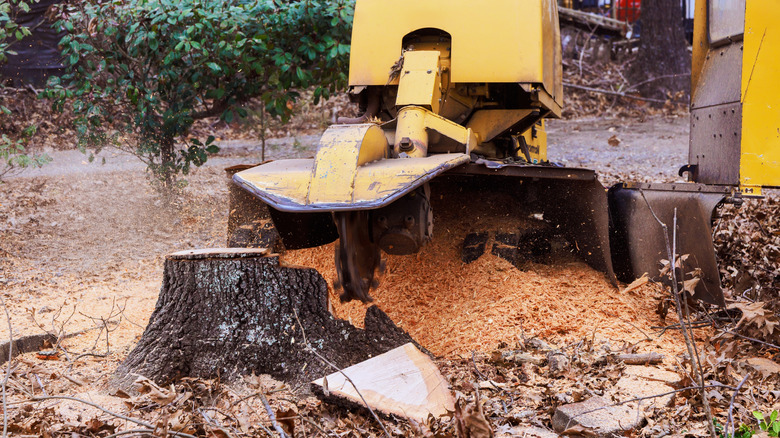
Instead of burning a tree stump, Lisa Tadewaldt recommends grinding it instead. "Stump grinding with a stump grinder is our preferred method for stump removal," she exclusively tells Hunker. As it sounds, the method turns the stump into sawdust. However, there are a few barriers to the technique that might prevent some from making the most of it. "A small stump grinder is usually a tracked machine that weighs over 1,000 pounds and is 34 inches wide minimum," she says. "So it can't go up stairs or up steep hills and will likely damage natural stone patios by simply driving over it. There are some mini versions that weigh about 150 pounds that can be carried into place, but those will usually only work on stumps under 10 inches or so, and it is more expensive to have done that way than a traditional stump grinder."
That said, if you have the patience and endurance, you can mimic the effects of a stump grinder by using a chainsaw to grind the stump instead. The first cut is a horizontal one, to get the stump down as close to the ground as you can get it. From there, you can make grid cuts to further chip away at the amount of wood present. While you can't get rid of the stump completely, once it's quite low, you can cover it with dirt and plant grass seed so it blends into your lawn.
Using sodium is the least risky way to remove a tree stump
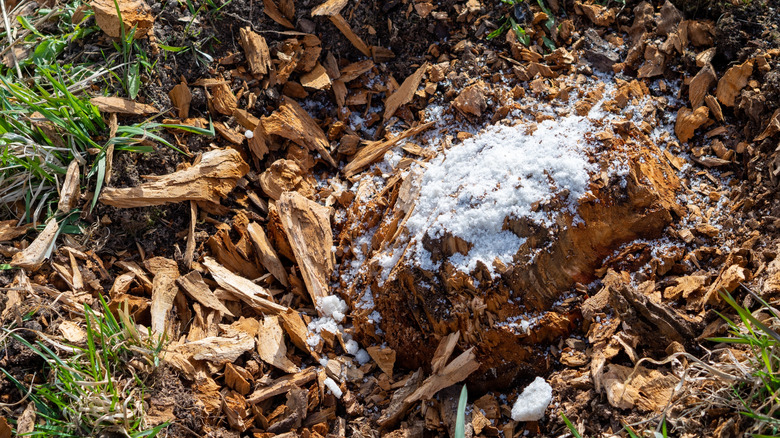
The risk for the previous two methods includes potential damage to both your property and your person. If fire or heavy machinery don't appeal to you, there's still one more DIY way to remove a stump. "The safest alternative to remove a stump is using sodium to speed up the decomposition of the stump," Lisa Tadewaldt exclusively tells Hunker. "I have yet to discover a risk to using this method, but of course there is a downside, and that is it can take several years to decompose a larger stump." If getting rid of your stump in the next week or so isn't a priority, this method doesn't have any other drawbacks, according to Tadewaldt. You just need patience.
While there are plenty of products on the market to take care of stump removal in this way, Tadewaldt recommends Bonide Stump-Out Granules for the easiest go of things. "The product works best if a herbicide has been applied first to kill the stump and dry it out. Otherwise, it is recommended to wait 12 months after cutting the stump to apply the product. My recommendation is that the stump will need to be cut for at least one summer to season." Whether you choose Stump-Out or not, always look for a product that will not harm the plants around the stump. This information should be on the label.