

Forget Concrete Birdbaths: A More Rustic Alternative You Can DIY

TiKTokker @housefulofhandmade kicked off last year's Scrap Wood Summer with a simple project that replaces an old lawn standby, the concrete birdbath. If it seems a strange thing to replace, have a look at her birdbath and take it all in ... the portability, the safety for birds, the proximity to windows, the fact that you can build it yourself. A hanging birdbath made from scrap lumber seems like a worthy replacement for an incredibly heavy old concrete thing that some don't fill due to a lack of visibility.
The birdbath in @housefulofhandmade's video is built around a 14-inch saucer from a large planter. At the ideal depth for a birdbath, about 2 inches, a perfectly cylindrical saucer of that size would hold 1 ⅓ gallons of water, weighing about 11 lbs ... not super-heavy, but not as light as bird seed either. So part of the challenge was to make sure the birdbath is strong enough, which @housefulofhandmade navigates by adding a second octagon of boards to the bottom to support hardware cloth as a backup in case the saucer lip breaks. (Hardware cloth is the welded metal mesh you might use to keep critters out of something or make your own tree guards.)
You could rotate your second octagon 11.25 degrees, offsetting its boards across the joints of the main octagon so the smaller boards can add holding power to the moderately strong end-grain joints of the main octagon. But her original design seems plenty strong, and it looks great ... which might not be as true with a rotated second octagon on the bottom.
How to DIY a hanging birdbath with lumber
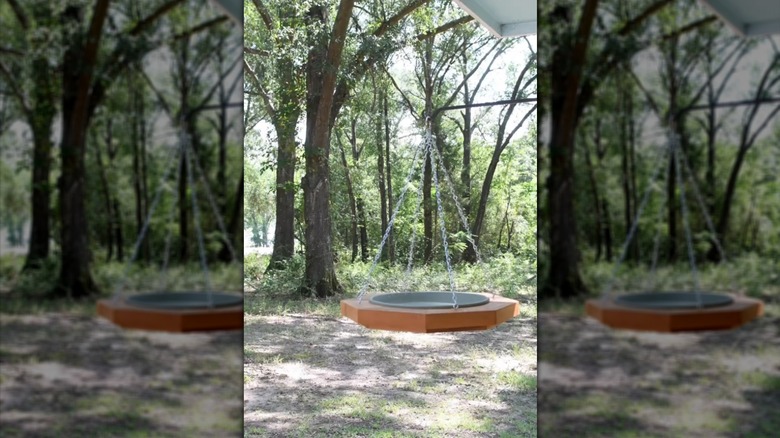
She doesn't give you all the math and measurements in a one-minute video (plans are available on her website), but she does show you the entire process, including how easy it is to get all the cuts right to make an octagonal frame/perch for the saucer.
She starts by using a miter saw to cut eight identical 2-by-4 segments to form the octagon. (The cuts are 22.5 degrees ... eight 45-degree angles divided in half for inside miters, as explained in our guide to calculating miter angles.) The board length is controlled by basic stop blocks that define where the cuts should take place. These pieces are joined with the help of what must surely be the mother of all pocket hole jigs, but you could easily get it done with wood glue and brads. She measures the final side manually against the workpiece, probably to accommodate any cuts or measurements that were slightly off.
Once all that's done, she cuts a circle from the center of the octagon to accommodate the saucer, utilizing a jigsaw. Using a jigsaw for precision cuts in 1 ½-inch lumber is surprisingly difficult, but fortunately, the saucer has a lip to cover any imperfections ... not that she seems to have any. To the bottom, she adds an offset octagon made of thinner stock, presumably to provide extra support for the whole assembly. She then staples hardware cloth to the bottom, attaches chains to hold the unit upright and balanced, and fills it with water.