

Transforming A Vintage Card Catalog From Dewey Decimal To Home Office Storage
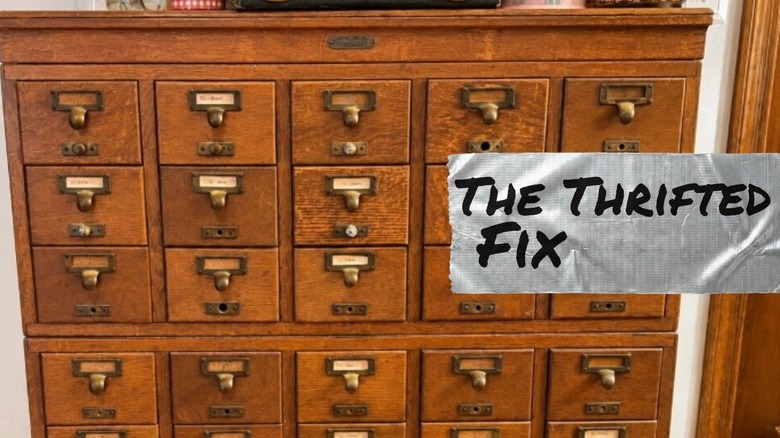
Welcome back to The Thrifted Fix, a weekly column where our writers turn thrift store finds into the ultimate solutions for everyday home problems.
Let's be honest — we all have that one junk drawer tucked away somewhere in the home (or several like me) that seems like an endless black hole for lip balm, nail clippers, and the occasional rogue rubber band. If you're looking for a simple paperclip, you spend a good 10 minutes digging through papers, pens, receipts, and sunglasses. This can be chaotic, frustrating, and a complete waste of valuable time. Luckily, I'm always on the hunt at the thrift store for unique ways to customize my space and sneak extra storage into my home without breaking the bank at high-end container stores.
That's where I found my card catalog, which felt hitting the jackpot. It's an original piece from Gaylord Brothers, a company that began making library furniture in the late 1800s. If you're a fellow bookworm, you probably remember these wooden cases from school libraries before online catalogs and public access computers took over. For just $100, I managed to grab this piece of history, which completely changed the way I organize my office supplies. To me, it's not just a piece of furniture meant for library cards. It's the end of the small-item struggle.
Choosing what to store in the drawers
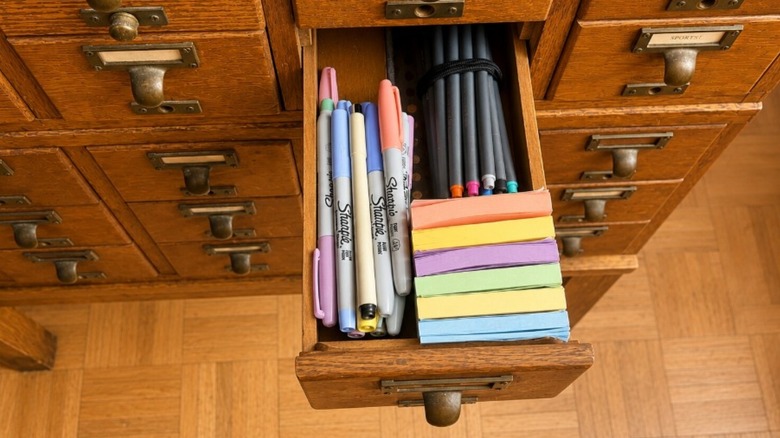
My home office leans a little on the minimalist side. I have a simple desk with plenty of workspace — but it doesn't have drawers, so it offers zero storage. To keep my desktop from looking like a supply closet exploded, I had to think outside the box for small home office ideas and inspiration. That's where the card catalog comes in.
Most drawers in a card catalog are designed to hold 3-inch-by-5-inch cards. Some older models hold slightly smaller 2-inch-by-5-inch cards. In my office, these drawers are the perfect size for Post-it notes, pens, markers, paint supplies, and any other small item you can imagine. The best part? Those little windows on the front of the drawers are perfect for labeling the contents, so you know exactly where your staples or push pins are hiding. Repurposing a thrift store find makes your space feel custom and personal, and you don't need a massive budget to pull off a high-end, well-organized look.
Selecting the perfect card catalog to fit for your space
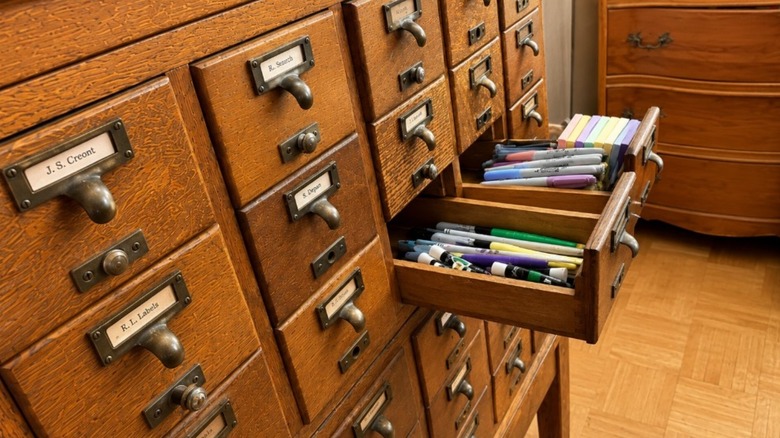
If you're ready to go on your own hunt, keep in mind that card catalog furniture comes in a wide range of sizes and styles, so there's likely one that fits your specific needs, whatever they are. If you have plenty of countertop space to spare, a desktop version is smaller and might be a perfect pick. These compact units vary in size from 10 to 20 inches wide with four to 16 drawers, and sit perfectly on a console cabinet or craft table. If you have a larger wall to fill, medium cabinets, like mine, have between 24 and 36 drawers and stand between 30 and 50 inches tall. For truly bold organizers, the largest antique cabinets are tall and ornate, standing nearly 6 feet tall with over 70 drawers.
Just remember to bring your measuring tape. The taller and bigger the units, the more space it will take in your home, so have measurements ready ahead of time. While I'm currently obsessed with mine for office supplies, the possibilities throughout the home are endless. Move it to the kitchen to hold spices, drink packets, and pantry items, or set it up in the playroom to hold dolls, Hot Wheels, and building blocks. In your front entry, if you prefer to skip traditional cabinets, you could use it as a catchall for keys, mail, and gloves. No matter where you decide to put it, a card catalog is a versatile way to reclaim your home from the clutches of clutter, all while celebrating nostalgic library history.