

I Abandoned My Modern Stove For A 1950s Showstopper (And So Should You)
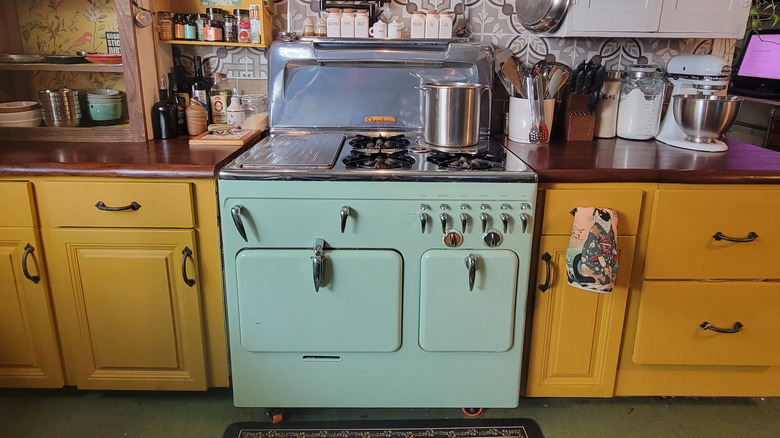
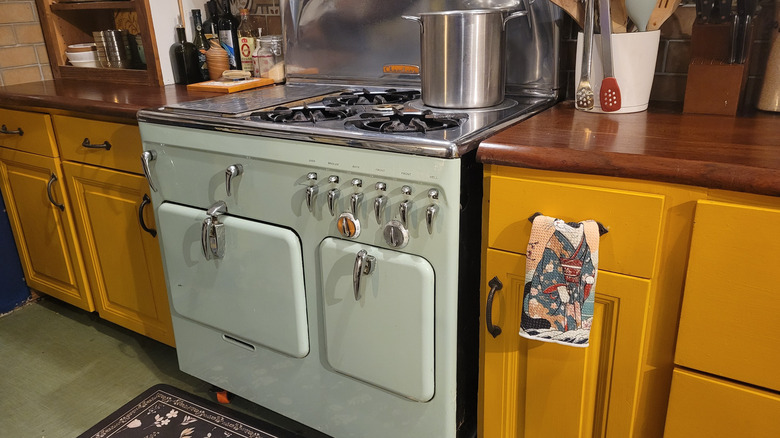
I'm about to encourage you to abandon all modern conveniences and buy a vintage stove. I mostly hope you don't listen, since prices are already a little out of control. And I really do get it. If a typical modern stove is like, say, a Nissan Altima, most people would think an antique stove is like trying to drive home from work in one of those railroad handcars you might use to lug TNT to wherever Roadrunner was last seen — clunky, difficult, and likely to explode at any moment. But on its own terms, my 1951 Chambers Model C stove is smarter, more capable, better-looking, and (believe it or not) cheaper than yours.
We built our kitchen around a few things we thought were important, all of which are gone today: a ridiculous 44-inch Kallista sink, a 36-inch Thermador gas cooktop, and a Dacor double wall oven. The sink was okay, the gas hob was great, and I hated the double oven from its very first beep. All three were replaced with vintage versions in the form of a two-faucet bathroom sink and the Chambers stove. When you first walk into our kitchen, you might notice the sink, which I've described elsewhere as looking like something from a 1920s sanatorium. Or, you might notice the big window over that sink or even the farm table we got for free from a farm (a true worktable that is always cluttered and never refinished, because worktable). But odds are, you'll first notice the stove. You might deny it, but you'll want one. And if you'll hear me out, you might very well decide to get one.
What makes this stove special
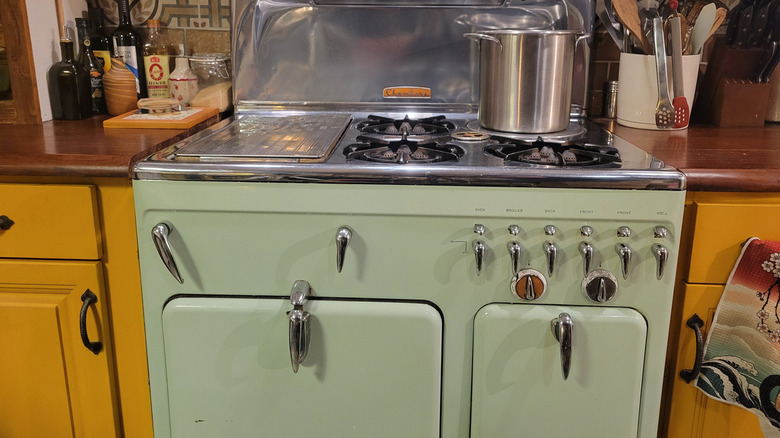
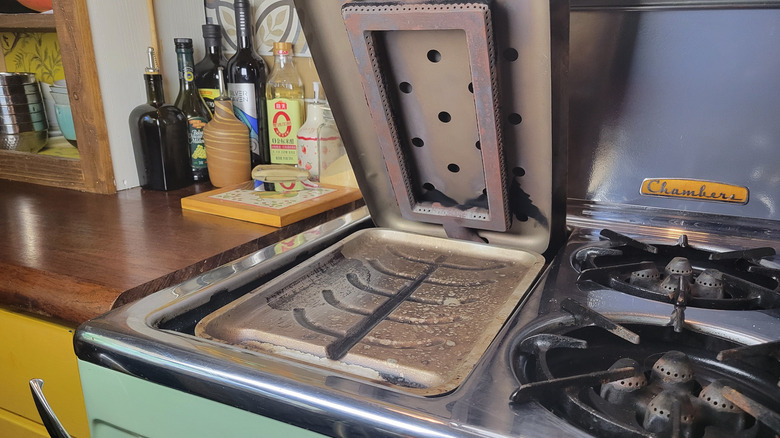
Aside from its looks — which we'll come back to — the Chambers Model C has a lot going for it. The combination griddle and broiler is probably the most remarkable feature, at a glance. The broiler is controlled by three levers. It lifts out of the stovetop with one lever, and a second controls the height of the food (that is, the food's distance from the burner). A third controls the flame itself. The broiler descends below the stovetop when in use, leaving in its place a griddle that can be used simultaneously, as we do almost every day.
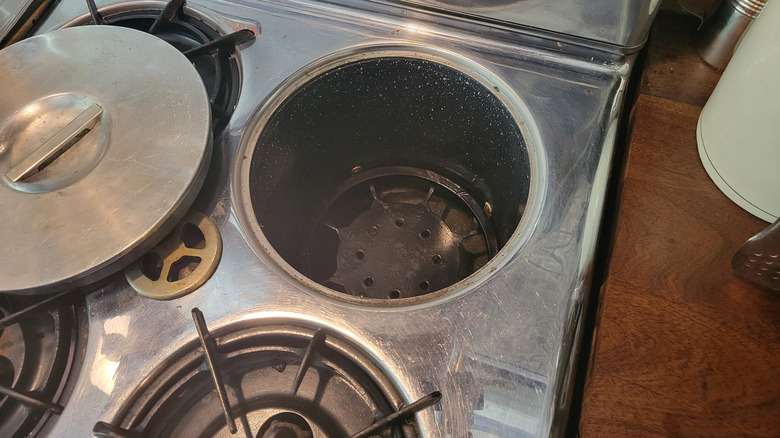
The Thermowell is another notable feature of the Model C. This is essentially a deeply recessed burner that can be used for cookpots, as a slow-cooker, or as a secondary oven. It can be accessorized with pots, racks, and multi-chamber vessels to add functionality. According to William Scheckel of @VintageStoveChannel, a restorer well known in the Chambers community, the Thermowell "completely transforms ownership of a Chambers stove [from] having something that looks nice to having the best stove you'll ever use in your life."
We've owned a vintage electric range with a similar well, but it lacked one of the key capabilities that makes a Chambers special: The oven and the Thermowell can cook with the gas turned off. They're so incredibly well-insulated that their chambers can be heated and then turned off. The heat will be conserved and used to finish cooking the food. This isn't a gimmick; it's how the oven was designed, and there were once entire cookbooks devoted to taking advantage of this capability.
You cannot deny it's got style
For a while in the late 2000s, I owned a PT Cruiser. It was an abominable car in almost every way, including, I would now admit, its aesthetics. But I was drawn to it because every other car on the market at the time looked, to me, like a take on the Nissan Altima. But cars have functional reasons — like aerodynamics – for all looking the same. Stoves all look the same because they're designed to fade into the background rather than stand out. The design language of any such product is plagued with drab homogeneity. And, after all, how can they sell you a new stove if your 75-year-old stove is always the center of attention? They can't.
The Chambers stoves, like many ranges of this vintage, were designed to be showstoppers. They were colorful, curvy, and chromed, like the iconic cars of the era. They had interesting features, and where those features had no specific demands on form, they had looks. Now, consumer products like ovens somehow discount our aesthetic experience in favor of mix-and-match blandness.
Chambers stoves have found their way onto the sets of many movies and television shows, ranging from "Rachael Ray" and "Driving Miss Daisy" to "Everybody Loves Raymond" and "Longmire." I believe that's because they look like something. You'd be hard-pressed to distinguish between a white stove from 2006 and one from 2026 ... or to distinguish either from a white clothes dryer, for that matter. But, once upon a time, they all had style.
Disposability as a feature
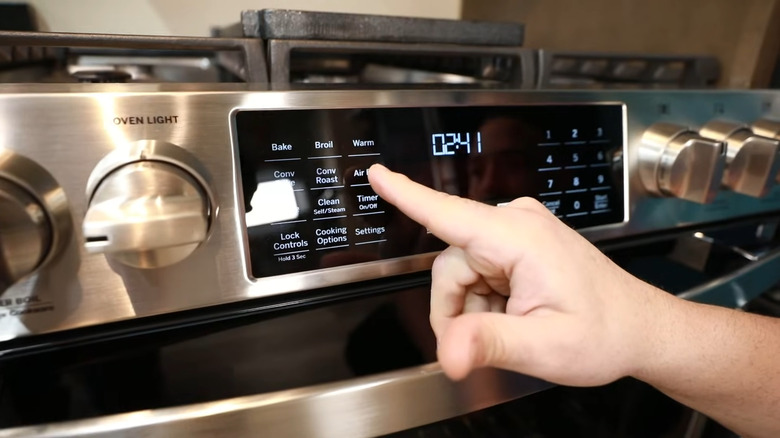
Somewhere along the way, we've traded timeless style for features that are the very ingredients of planned obsolescence. Here's what I mean: The current "most popular" gas range on the Home Depot site is a 30-inch GE stove with four burners and a griddle. As far as I can tell, it has exactly one non-electronic feature that's ostensibly an advantage over my Chambers: You can pour water into the bottom of the oven and call that "steam cleaning." (You could probably do that with the Chambers, too, but to be fair, it is absolutely not a good idea to give vintage stoves any extra reason to rust.)
Sure, that new stove has a few other features by virtue of its electronic control board, such as delayed start and Sabbath Mode. However, control board failure is a common problem in GE gas stoves. When the board fails, the single course of action available to you is to replace it. Not to pick on GE, because I'm sure this is true of all other major brands as well, but the solution for almost every common failure is to buy a new component, be it the bake element, ignition switch, temperature sensor, surface burner valve, element receptacle kit, oven relay board, and many more. For all I know, there are more replaceable parts on a modern GE gas stove than there are parts on a Chambers Model C.
You want reliability?
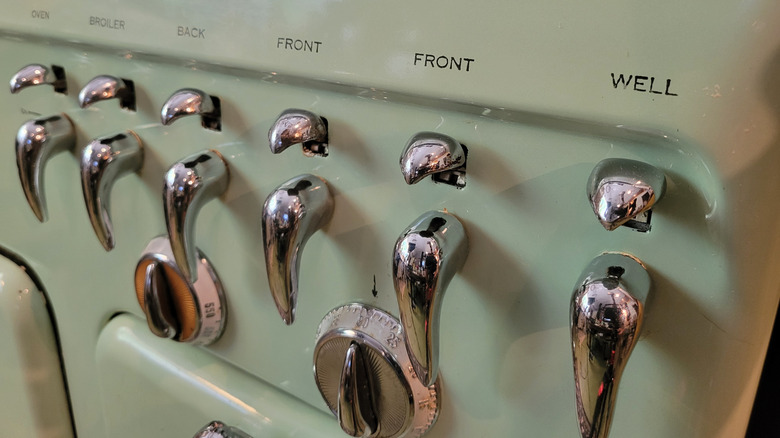
According to Angi, a modern gas stove can be expected to last 10 to 15 years. My stove is 75 years old, and there's every reason to believe it will last another three-quarters of a century. Like most vintage stoves, it has needed some minor work ... though this is by no means a certainty for stoves that have been constantly in use and cared for. Most modern consumer ranges don't come close to the reliability of a fairly ordinary vintage stove. But that's not the tale I want to tell today.
Our Chambers stove was, for a while, not really a stove at all. It was used on the set of a television series, where it was painted, refitted with LED lights to replace the original incandescent lights, and replumbed with plastic tubes, presumably to use butane on set. Reversing all of this was a series of little projects that went surprisingly easily. Reverting back to the original gas pipes and adjusting the stove for propane was simple and didn't cost a thing. In fact, at no point during the restoration did we spend a single dime to buy a stove part. Everything still worked just fine.
My wife removed the paint, revealing the original, intact "pastel green," using nothing but Citristrip and plastic wrap. The work was so thorough and impressive that a few members of her online vintage stove community alleged that the whole thing was faked, despite her having posted progress photos along the way. Then it just worked, and I can't imagine what you'd have to do to keep it from being easily repaired.
Answering some objections about vintage stoves
Let's look at a few of the common critiques about the vintage stove phenomenon and respond to them. One complaint, already mostly addressed, is that vintage stoves lack modern "bells and whistles" like convection ovens and Wi-Fi. I'll grant the point about convection stoves and ovens, but I replaced our much-detested Dacor convection ovens with a Cadco Unox half-size convection oven that we use as a toaster oven; it fills our need for convection just fine. And, not to hurt anyone's feelings, but you can keep the Wi-Fi connectivity and smart features. Those are massive points of failure and, to my mind, serve no purpose beyond further alienating us from the joys of cooking and sharing food.
Others complain that the burners are small on vintage stoves, and that might well be true. But I can't quite see what the problem is. We are a family of seven, including two bottomless teenage boys, and have never had trouble cooking a family meal on half the Chambers' burners.
Some complain that restored vintage appliances are expensive. The best new gas stoves are under $5,000, while a fully restored Chambers Model C can cost upwards of $10,000. But a tenth of that amount and a little elbow grease will get you most of the way there. We "restored" our stove in three days. Aside from some experimental powder-coating to correct some damage done with an angle grinder by a well-meaning former owner, the total cost was a bottle of Citristrip and the cost of the stove on Marketplace: $375.
Cost and the meaning of restoration
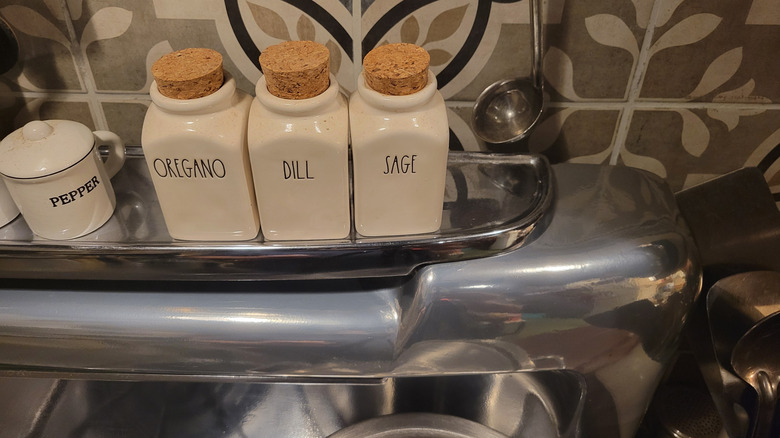
Remember that Kallista sink we got rid of? Some of you might be wondering, "Who is this guy who's too good for the $4,000 sink?" But get this: I picked it up in pristine condition for $100 from a local cabinetry company that was using it in their break room, probably to wow clients. The stove was $375 because the guy we bought it from wanted it out of his way.
We also saved money by skipping any real restoration. Our small efforts paid high dividends because of the low starting point, but they don't reach even the basic level of restoration you'd get from a proper restoration company. Our attempt to powder-coat rather than re-chroming the backguard basically failed, and we still need to replace and paint or re-porcelain a missing side panel. If you're putting a vintage stove in what my dad would have called a "high-dollar kitchen," you can expect a high-dollar full restoration. At a minimum, you must have a safe and mechanically sound stove, so if you're not comfortable with the parts of a gas stove and their functions, you'll need a pro to do it for you.
If you want a working 75-year-old stove that looks pretty good, you can probably do that for $1,000 (plus a little sweat equity) ... slightly more than that disposable GE Model. But the vintage appliance community reports that prices are climbing. The thing about converts is that they have great zeal for converting others, so every vintage stove sold inevitably leads five more people to start looking for one, and prices go up.
But is vintage always better?
It's worth considering whether — especially at this ridiculously low price point — this is an anomaly or if vintage kitchen appliances are always better. I have made a career out of saying both reasonable and outrageous things I can back up with facts, and here's my firm conviction: Yes, vintage kitchen appliances are a better choice for most people and for all DIYers.
Don't get me wrong, I have been defeated by them from time to time. A 1970s KitchenAid dishwasher with a broken, apparently irreplaceable timer still sits in our storage room, waiting for me to figure out what to do about it. I'll probably have to custom-program a microcontroller to make it live again ... heresy to the vintage tribe, but heresy is how you get out of mistaken orthodoxy.
But, in general, what you'll get for your time shopping for vintage appliances is not only the fun of doing that, but a durable, reliable, often energy-efficient replacement for inferior, fragile modern versions. They look better than their modern counterparts and are far easier to repair. To the extent that you need help with them, you'll be supporting small businesses, often local, rather than participating in a perverse multinational con. And, as William Scheckel puts it, "The environmental costs of manufacturing were met decades ago and you're not contributing to the mass-manufacturing of modern trash."