

Sharpen Lawn Mower Blades With An Easy And Affordable Solution From Home Depot
We may receive a commission on purchases made from links.
Some people actually like mowing — not just the results, but the ritual, and the meditative moments alone with their grass farms and some kind of rock electric guitar playing a little too loud in their earbuds. Even those lovers of lawn-lowering, those connoisseurs of the cut, would rather be doing something else if mowing leaves their lawns an uneven mess. And, the reason for this choppy mowing is likely a dull mower blade. All of these problems can probably be solved by a simple pair of tools that you can pick up from Home Depot for $10.56 ... the Arnold Universal Lawn Mower Blade Sharpening Kit. So, let's get you back to your peaceful place, trimming the grass with "Journey's Greatest Hits" in your earbuds.
The Arnold kit comes with a blade-sharpening attachment that works with any ¼ or ⅜ inch drill, and a tool for gauging how balanced your blade is after sharpening. It works with any mower that uses standard blades, whether walk-behind, riding, or zero-turn models. And its mission is to make sure you don't stop believin' in the magic of a properly cut lawn.
A lot of that magic depends on properly sharpened blades. Lawns cut with sharp blades heal faster, since cutting with a sharp blade causes less trauma than the tearing of a dull blade, and it leaves them less susceptible to pests, disease, and moisture loss. The cuts look better than the browning grass-tips left by a dull mower, and you can get the cuts done in fewer passes. And, to some extent, sharp blades improve your battery life if you have an electric mower, since tearing takes a little more energy than cutting. This efficiency is true of gas mowers, too, though you might never notice.
Using the Arnold blade sharpener and balancer
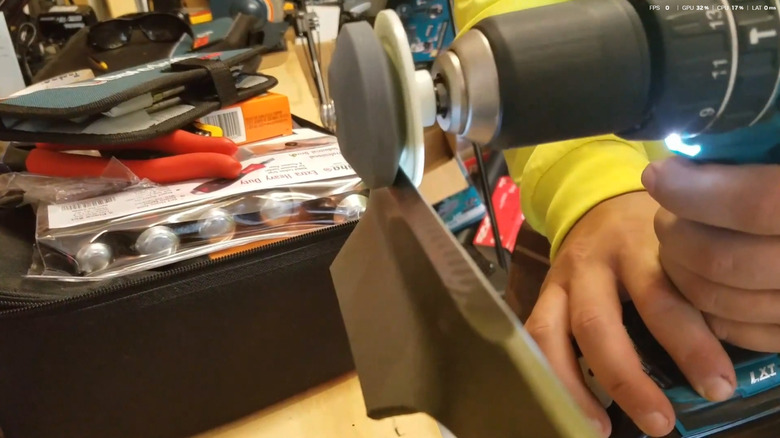
For many of us, the underside of a lawn mower is best left out of view. Whatever goes on there does not seem to be the province of fleshly creatures, but Arnold's goal with this simple device seems to be reversing this avoidance so that you embrace blade maintenance with open arms rather than terror. The sharpener is a simple device consisting of a guide and sharpening stone that mounts to an electric drill. The idea is to clamp the blade down, sandwich it between the guide and the stone, and then grind the blade back to sharpness. You may need to tilt the drill a little if necessary to reproduce the original bevel angle of your blade.
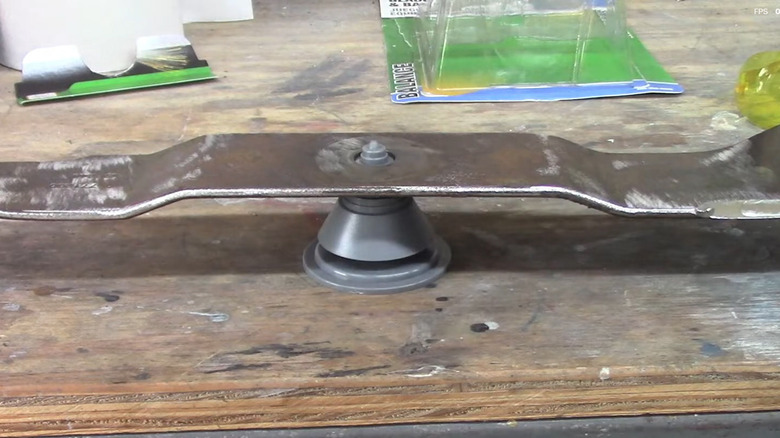
Balancing the blade is also important, and couldn't be easier. Wear heavy-duty, cut-resistant gloves when handling a lawn mower blade, and you'll be safe. Just put the balancing jig on a flat surface (the floor of your garage or a driveway will usually do), and put the blade on top so that it rests on the cone part of the tool, which is graduated to accommodate different blade-mounting hole sizes. If you find that your blade tilts during this balance-checking, just use the sharpener to remove a little more material from the heavy side (that is, the side that hangs lower on the balancer). Faithfully sharpening and balancing your blade should extend its useful life. But once a mower blade can't be adequately sharpened (or balanced), you must go your separate ways and get a new blade. But what's all this business about blade-balancing? Is this something that homeowners actually do?
The importance of balancing your mower blade
You're free to do your mowing any way you want it, but balancing definitely makes the experience and results better. The Arnold kit's blade balancer is designed to help eliminate damaging vibrations in your crankshaft and mower deck. Vibration is fierce when a motor is spinning an unbalanced load. Those toys that vibrate and dance all over a tabletop demonstrate this principle: The load attached to a little electric motor is intentionally weighted more on one side, causing the toy to "walk" all over the place when it's spinning. An unbalanced mower blade works on the same principle, only the consequences are a lot less fun. The weight of the blade and the speed of rotation turn the vibration into a major force that can cause uneven, patchy cuts and scalping, and more than a little vibration that must be absorbed by the human body. The hidden risk, though, is more of a certainty: An unbalanced blade's vibration will cause engine strain and premature wear to your mower's spindles and bearings. It will cause fasteners like bolts to loosen, and components to eventually misbehave or fall off. And it will shorten the life of your mower.
The Arnold balancer is remarkably effective for its price. There are cheaper ways to go about it, like (carefully) hanging it from a nail on your garage wall, and analyzing which side it leans towards. But the nail-in-the-wall method is fantastically inaccurate because you can place the nail off-center and have it held in place by friction, throwing the balance out of whack. Magnetic blade balancers are only slightly more accurate and can cost between $40 and $240.