

These Are The Worst Storage Trends Of The 1980s (Don't Bring Them Back)
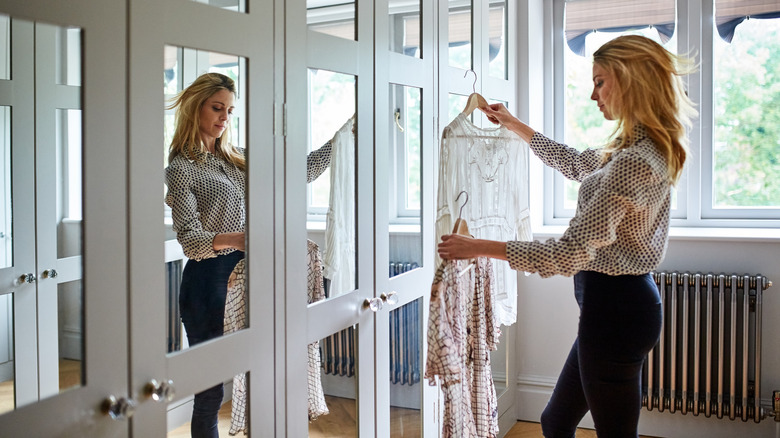
You'd think storage is storage, and perhaps there's only so much a product or interior designer could do to ruin what is, fundamentally, a box. Leave it to the 1980s, though, when everything — kitchen cabinets, closets, and even tackle boxes — was touched by the most indelicate design hands in recent history. And, no, we're not going to harp on about honey oak cabinets and perhaps those imitation wood media storage drawers that contained cassette tapes and the like. Those were actually pretty good.
Trends don't require practicality or success, of course, but normally that kind of quick, widespread adoption signals something good ... a new solution to a common problem. Sometimes, the idea is half-baked — perhaps there are better options, but a marketing machine got behind the idea to create an explosive trend. Other ideas fail on several fronts but are so perfectly, superficially of the moment that they can only succeed for a short time at least. Consider the retrofuturism of melamine cabinets, in which we envisioned what the future looked like to the consumer hive mind of the '60s and '70s and then turned that vision into real but ill-advised life. Still, other trends survived and have even mounted comebacks, like over-sized walk-in closets and the overuse of mirrors, two undeniably popular hangers-on from the '80s. But popularity makes a trend, not a good idea.
Melamine cabinets
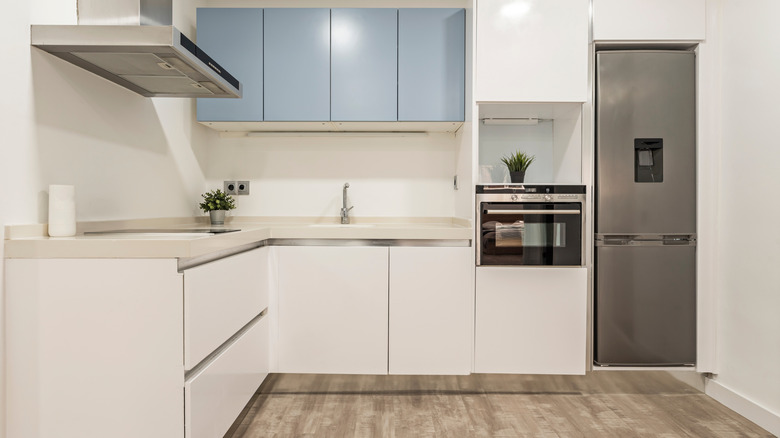
Melamine cabinets brought futurism, or perhaps retrofuturism, to the mainstream by making everyone's kitchen look like a near-future veterinarian's office. The '80s refined immoderation so thoroughly that even attempts to avoid decoration had to become grotesquely aesthetic. The idea of a clean, simple cabinet thereby transmogrified into walls of glossy, undifferentiated, melamine-encapsulated panels that held everything so that your kitchen would appear to hold nothing at all. They also held fingerprints, so you could easily identify the household's most commonly used storage compartments by the number of hand smudges on the cabinet doors.
Fingerprints were usually concentrated at the corners, as family and friends experimented to figure out how to open the cabinets. These cabinets often rejected traditional hardware in favor of push latches that held cabinet doors in place until the correct corner was pressed, whereupon the door would spring open as if you'd found the magic book that made the bookcase slide aside and reveal a secret passageway. But handles, knobs, and pulls manifest affordances — little clues to demystify how to use a thing like a cabinet door. Except for push latches, which are hidden and afford one nothing at all, overcomplicating what should be a simple act of opening a cupboard. Then there's the more troubling fact that melamine is usually used over medium-density fiberboard or particleboard. Compared to other common kitchen cabinet materials, melamine is one of the cheapest but also least durable options. If the melamine layer is ever chipped or cut in any way and not re-sealed, the cabinet material could admit water, almost immediately causing the particleboard substrate to swell and be damaged irreparably.
Cabinets over everything
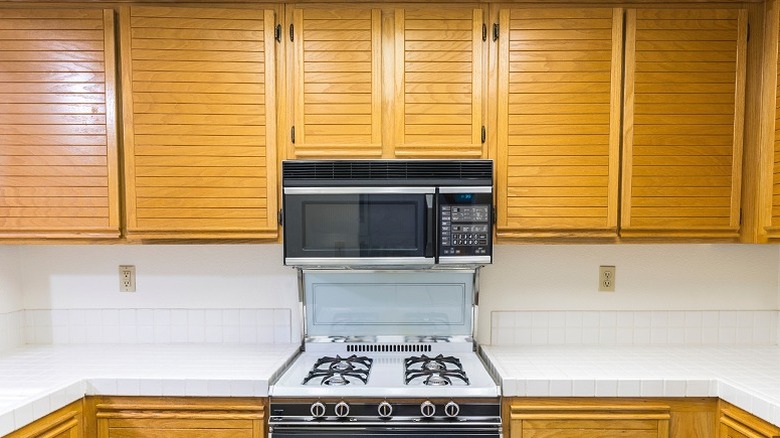
Of course, cabinets in general are a good thing, and even hardware-free wood cabinets can be so stunning that no one cares how weird they are to open. Still, just because a thing is good doesn't mean you want it everywhere. But, apparently, in the 1980s, some folks did want cabinets everywhere ... especially over things like stoves, refrigerators, peninsulas, and even kitchen islands. To fully understand why you want this '80s storage trend to stay in remission — it's far worse than just having to reach all the way over a range hood to grab something — it helps to understand another trend that started ballooning in that storied decade: the open floor plan.
The late 20th century saw the combination of traditionally divided home spaces, like living rooms, family rooms, dining rooms, and kitchens, into open "great rooms" ... a term that celebrated somewhat prematurely. All of this openness took away space formerly available for wall-mounted cabinets while also making storage even more critical ... the same clutter that once constituted a messy dining room was suddenly a messy house. So, we started sticking cabinets in odd places that made them unusable and/or undesirable.
Of course, difficult-to-use cabinets are infrequently used cabinets. Meanwhile, they undermined the whole open-concept thing with visual clutter at best and, at worst, created the impression of a wall where you just removed a wall. Sure, you could see your guests over the peninsula by stooping to peek under the cabinets or leaning to see around them, but that makes dinner guests into something more like an avant-garde dance troupe than conversationalists.
Mirrored wardrobes and closet doors
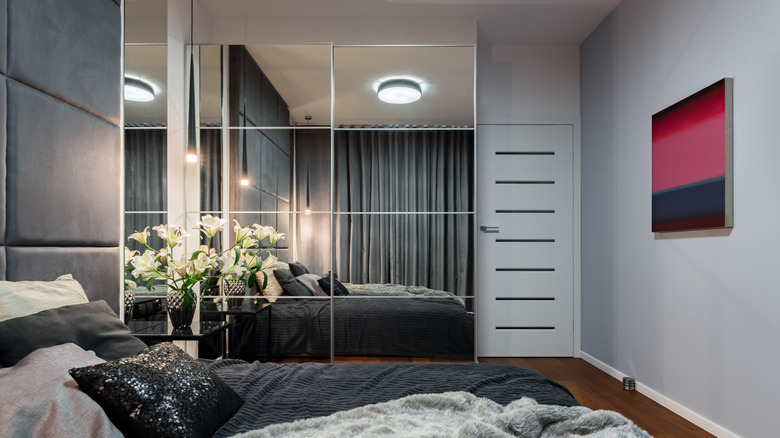
Further complicating open floor plans and exacerbating the loss of wall space is the 1980s habit of covering surfaces with mirrors, adding false depth for shallow reasons. Mirrors brighten and expand the visual space in any room, and this can be a great benefit in an uncomfortably small bathroom or bedroom. They're also practical, within reason. It's possible that hair was so unfathomably voluminous in the '80s that one required a 5-foot-wide mirror and a mosquito fumigation truck full of Aqua Net. But it was probably just a trend, perhaps inspired by the style (and the excesses) of the "Miami Vice" era. All of this becomes relevant to storage in the form of mirrored wardrobes and closet doors.
The trick of making a room look larger has a very limited shelf life, but some of its effects linger in our peripheral vision as discomfiting oddities. Mirrors make windows appear in impossible places ... and people, too, leading to the occasional jump scare. And mirrors, like melamine, require more than a little extra cleaning effort, especially for the true Aqua Net aficionados.
Attempts to revive this trend ignore the fact that you can get inexpensive and more versatile floor mirrors that will make a bedroom look bigger. Even as they return to popularity, many continue to perceive mirrored wardrobe and closet doors dated, but others find them pleasing. Fair enough, though it's not hard for the cynic to see this as a poor reflection on self-image, an egocentric holdover from the '80s we've been trying to escape ever since.
Closet-flexing
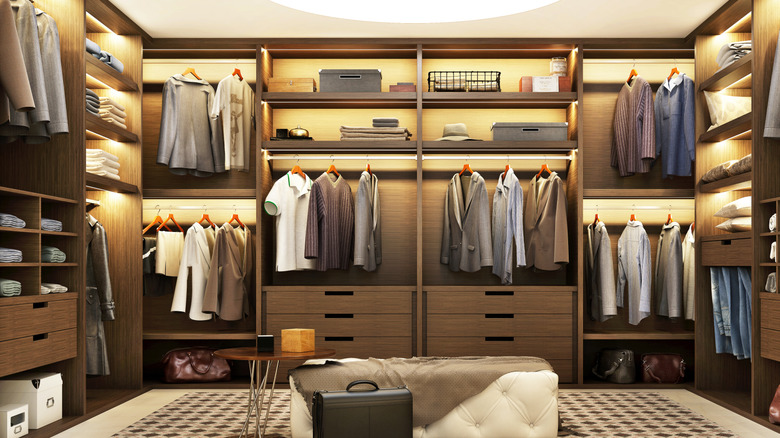
One of the reasons you might have needed your bedroom to look larger in the '80s is that you sacrificed half of it to a ridiculously elaborate walk-in closet, in which one might hold a large tea party, a small Jazzercise class, or a seance to make contact with one's long-dead sense of modesty. It's a particularly strange flex to make much ado about something as private and, presumably, low-traffic as a closet. But the era of McMansions metastasized to the point that everything demanded grandiosity, even if no one saw it. Who wants to keep their little closet in the closet, after all?
Okay, look, walk-in closets are a modern inevitability. One might bemoan the end-of-empire level of consumerism they imply, but even bemoaning is more pleasant in a sufficiently large room. And if you need a huge island dresser to store your sundries, more power to you (not that you need it). But once you've outfitted your closet with the sort of seating meant for a small gathering or a night in front of the TV, you might have misallocated your square footage and set yourself up for some pretty inefficient storage.