

Give Your Kitchen More Cabinet Space With An Old Upside-Down Bookshelf
We may receive a commission on purchases made from links.
Welcome back to The Thrifted Fix, a weekly column where our writers turn thrift store finds into the ultimate solutions for everyday home problems.
Renovating a kitchen can be a nerve-wracking affair, and I know because I've done it four to six times now (depending on how you count that). One of the trickiest bits is dealing with upper cabinets in a mostly unfitted kitchen — standard cabinets look out of place, and everything is challenging to hang on tiled walls like ours. The solution was to simply sit a thrifted bookshelf on one of the homemade lower cabinets and push it up against the backsplash. And that bookshelf worked best upside down.
This stroke of genius was, like most of our genius, all thanks to my wife. She has a knack for seeing things in ways that aren't entirely ordinary. When we found this bookshelf in an area thrift store, I think our original purpose for it might have been some sort of shoe storage. The $10 bookcase was — and, really, still is — a very plain piece, the sort of thing that some thrifters would shy away from because of its sheer ordinariness. But that plainness is why I could convert it into a great countertop cabinet to sit atop one of the surviving built-in cabinets I made when we built the house.
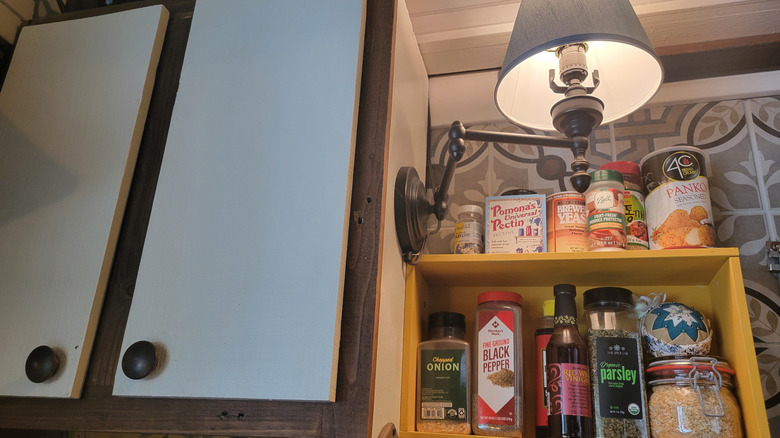
We have a massive farm table, plenty of other counter space, and an obvious indifference to maximalism, so the countertop area we lost to the bookshelf was insignificant. What we got in return was a couple of open shelves and a couple of doored cabinets in a single fixture that looks perfectly at home in our eclectic kitchen. And all we really had to do was turn the bookcase over, put the shelves on the other side of the shelf pins, and paint the doors for a little visual interest.
Making a thrifted countertop cabinet your own
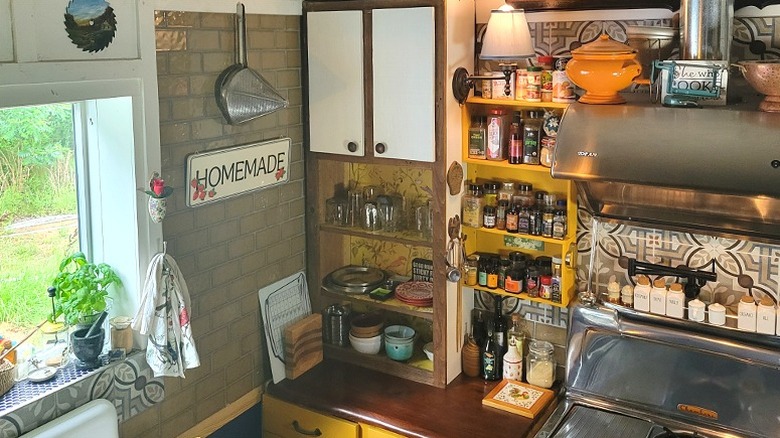
We wanted a tall countertop cabinet to complete a sort of quasi-alcove around our vintage stove. Part of that workspace is the spice rack affixed to the upended bookshelf, which my wife made from three drawers recovered (with permission) from the dumpster of a Home Depot liquidator. Above it, we mounted a thrifted swing-arm wall lamp, operated by a backsplash switch, for additional task lighting. And that's one of the other cool things about repurposing basic thrift-store finds: It frees you to think creatively about how to get where you're trying to go.
The main requirement of a thrifted piece used as a countertop cabinet is that it be less deep than your countertops (the standard kitchen counter depth is 24 to 25 inches). Other than that, your choices are a matter of style and needs. Really, any storage unit that fits is worth considering, including some sideboards and smaller consoles. A piece with the right legs might, perched on your countertop, give you counter-mounted functionality while preserving most of your counter space. And it's not hard to imagine a curio cabinet bringing storage, display options, and flair to your kitchen counter. An old pickle shelf would be great ... and would also preserve more counter space as a usable work surface.
Perhaps you'll get lucky and find an orphaned hutch top. Something similar to this freestanding pantry cupboard from Home Depot would be ideal, if you're fortunate enough to find one in a thrift store. (But don't let me see it first. I don't think I have another kitchen rejiggering in me just yet.) Just remember it's a good idea to anchor any tall piece, and especially shallow shelving, to the wall in a manner dictated by your walls and their coverings.
The art of the thrifted countertop cabinet
Leaving off the upper cabinets in an unfitted kitchen — or one with only fitted lowers — is the sort of thing that creates an airy kitchen that looks more like a room in your home than a sterile food prep space. But this isn't really feasible for a family of six. We need a full complement of dishware just to make it through a meal, and it all has to go somewhere. With a couple of fitted lower cabinets still hanging around from a previous kitchen incarnation, fitted uppers on one side would have made the space look unbalanced. (Currently, it merely makes the occupants look unbalanced.)
Now, there are all kinds of countertop cabinets that can add old-world charm to a kitchen. They're sometimes glass-doored affairs that bring grandeur, accessibility, and storage to kitchens where countertop workspace isn't at a premium. In a fitted kitchen, they usually match the lower cabinets, while in an unfitted kitchen you're more likely to see open shelving above the lowers or freestanding floor-to-ceiling hutches and cabinets.
An unfitted kitchen is generally less encumbered with expectations. Still, just as you could get creative with DIYs like a kitchen island made from stock cabinets, you can make kitchen cabinets using no cabinets at all for any type of layout. If not an upside-down bookshelf, the right piece, now that it doesn't have to be wall-mounted, can be one of those gorgeous architectural plate racks with vertical slots for drying or display, a freestanding Hoosier cabinet-style work center, or simple pantry shelving or cupboards. And, in fact, moving in the direction of Hoosier cabinets — less countertop, more custom flexibility — seems to be one of the main draws of the countertop cabinet.