

Skip The Traditional Subway Tile Backsplash: Joanna Gaines Has A Better Idea

Subway tile has definitely been having a moment. The pattern has a fascinating evolution from below to above ground, and while never completely out of style, it has been a featured mainstay of kitchen backsplashes for the past few decades now. Yet, Joanna Gaines has a twist on the classic style. On "Fixer Upper" Season 5, Episode 19, she mixes the traditional stacked subway tile backsplash pattern with a herringbone arrangement above the stove, creating a unique focal point within the room. This bit of visual interest immediately draws the eye, making the tiles a real stand-out design, instead of just a forgotten background element in the kitchen.
To really make the herringbone pattern pop, she used the same color tile, but not the same length. "This tile has a longer shape than classic subway tile, but it still gives the same clean finish as the original," Gaines wrote for Magnolia, adding, "We installed it in a herringbone pattern behind the vent hood and then framed it on both sides with a traditional pattern. Using these two different installation techniques side by side adds subtle interest to the overall design." This mix and match approach from Gaines creates a look that is timeless and fresh, proving you don't have to abandon classic materials to make something new.
Playing with pattern on your kitchen backsplash
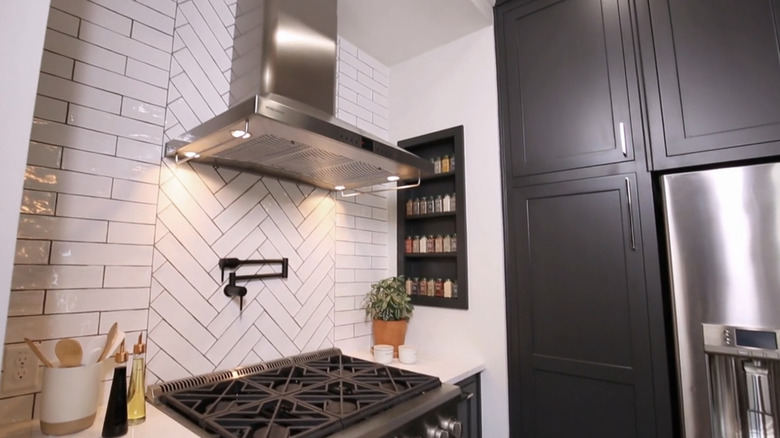
To mix pattern in this same way, install the traditional stacked subway tile pattern as the main part of your backsplash. Next, follow Gaines' lead by pairing the herringbone accent wall with something that's already a stand-out. Selecting an accent wall can be tricky, but she likely chose to accentuate the oven and range hood in this house for two reasons. The first is that there is nice symmetry there already, as it's right in the center of that particular stretch of countertop. The second is that the large appliance already draws the eye, so you might as well add a touch of glamour. Look for hallmarks like this in your own kitchen, so you can make a similar visual impact.
Actually installing the complementary patterns is where things might get a little tricky. Knowing how to measure for herringbone kitchen tile is important, as changing the direction of your tiles halfway through your installation can lead to frustration if everything isn't exact. This is likely Gaines' motivation for choosing tiles that are slightly longer, as they cover more space. If you plan to DIY the look, also be aware that it will involve cutting bits of tile down to size to fill in the gaps. Regardless, remember to choose the same sheen and color for both sets of tiles. This way, the pattern is the only thing that sets them apart.