

The Big Mistake You Should Never Make When Storing Propane Tanks At Home
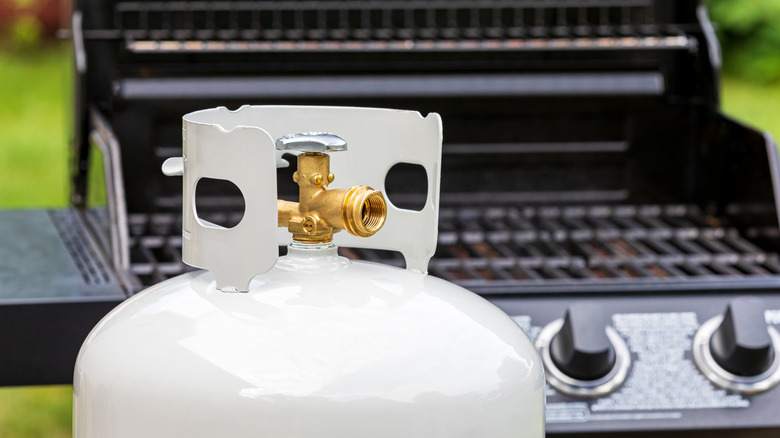
It's probably surprising that one of the simplest ways for a propane tank to start a fire, or even explode, doesn't usually happen indoors and doesn't involve a leak. In fact, it arises when the tank is behaving exactly as it should. When a propane tank gets over-pressurized, a safety mechanism kicks in and vents the gaseous propane until the pressure returns to normal. That vented gas can interact unpleasantly with sources of heat, sparks, and flame. And one of the most likely ways to cause a tank to build up too much pressure is to store it in direct sunlight.
If you've ever grabbed the business end of a garden trowel, touched a steering wheel, or helped a kid down a slide on a sunny summer day, you know what direct sunlight can do. Meteorologists will occasionally make a show of walking around with an infrared thermometer to show you that things get hot enough in the sun to burn you, but it actually takes a lot less to cause a propane tank's safety valve to release gas. Normally we think of inadvertent releases of propane as the result of a tank rupture — what a Journal of Hazardous Materials study euphemistically calls an "abrupt tank unsealing." The study found that the risk isn't usually a failure of the tank, which would require temperatures above 1800 degrees. But direct sunlight is capable of heating tanks to a much lower temperature that can, nonetheless, cause a very dangerous situation.
Excess propane is vented to reduce pressure
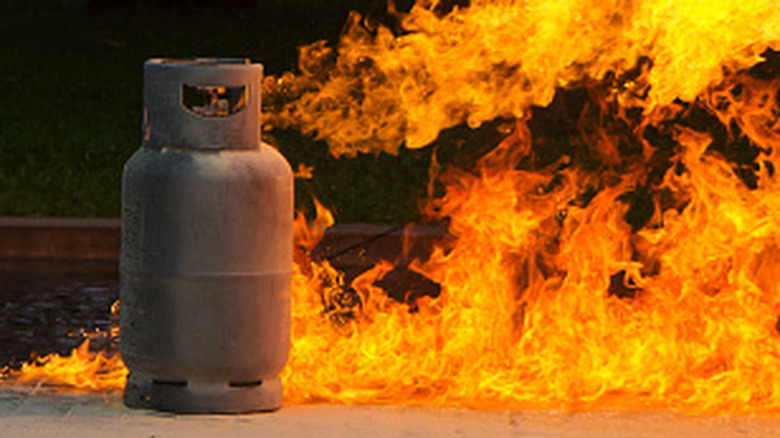
LP gas (or "liquified petroleum gas"), also known as propane, is stored in tanks mostly as a liquid. That's because it takes up 270 times as much space when vaporized, so if you stored it only as a gas, you'd need a seriously large tank. But a tank of liquid propane needs some room for gas (usually a minimum of 20 percent of the total volume in accordance with propane tank refilling regulations). This vapor space allows the propane to be compressed when heated, thereby raising the pressure within the tank. A full tank might hold 145 psi on a 70-degree day but can jump to 172 psi on a 100-degree day, according to the Ferrellgas blog. Because excess pressure can cause a tank to fail, tanks have pressure release valves (PRVs) that dump excess gas when the pressure exceeds a limit — usually around 200 psi.
Exactly what temperature is required to cause a tank to vent propane depends on a number of factors, like the percentage of liquid in the tank and the percentage of butane in the propane. Standard fuel propane contains less than 5% butane, which reduces the pressure of propane in a tank. Pure, refrigerant-grade propane can reach 200 psi at as little as 110 degrees. Whatever the exact temperature it happens at, what's clear is that the heat from storage in direct sunlight can cause excess pressure in the tank, which can result in the opening of the tank's pressure release valve. If this release of propane happens in the vicinity of an ignition source, it could be disastrous.
Store your propane tank in a shady, well-ventilated area to prevent propane release
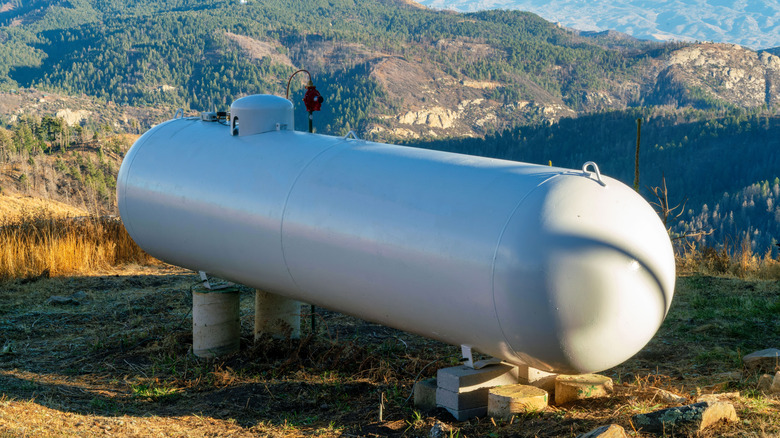
Propane leaks aren't difficult to identify because of the distinctive sulfurous, rotten-egg smell from chemicals added to the gas. But by the time you smell the vented propane, you could have a serious problem. Relying on a pressure gauge reading to manage tank temperature isn't a workable solution to the problem, which is why propane tanks often do not have pressure gauges. You have to be there to do it, you have to remember to do it, and you have to catch the overheating before it triggers a propane release. It's far better to set up your tank so it won't experience these conditions.
The consensus is that the best place to store a propane tank is a shady, well-ventilated area. That shade might come from a purpose-built shelter, but you shouldn't store propane tanks inside your home and absolutely not in a vehicle, where temperatures can climb fast. Tanks stored outdoors should be at least 5 feet from a doorway or other opening to a building. Avoiding direct sunlight is the key rule for storage, but it also helps to make sure your tanks are painted colors that reflect light rather than absorb heat — white is always a good choice. If your tank is in a less-than-ideal location or you have any other reason to suspect its temperature is reaching dangerous levels, you can usually cool it quickly by spraying it with a garden hose.