

An Electrician Says Forgetting To Unplug These Things Before A Storm Is A Big Mistake
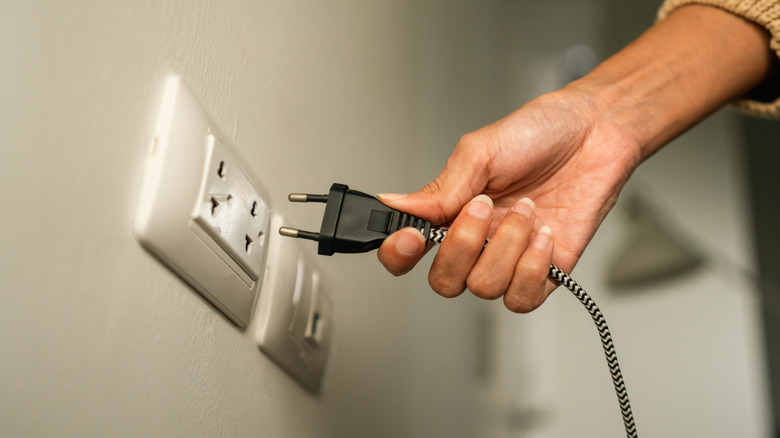
Preparations like shutting all your windows and ensuring your doors are properly weatherproofed are important steps to protect your home during major storms, but it's easy to forget about what's going on in your home's interior. Storms and lightning can put your home at risk of experiencing power surges, where the electrical current running through your wires has a stronger voltage than it should. Carl Murawski, a licensed electrician who runs a YouTube channel aimed at blue-collar tradespeople, spoke exclusively with Hunker about how to protect your household electronics during a storm. The main way Murawski suggests is unplugging your devices. "The simple rule is this: if you can unplug it before the storm, unplug it. It takes a few minutes and can save you from replacing hundreds or thousands of dollars' worth of equipment," he said. "A nearby lightning strike or power surge can travel through your electrical system and damage anything with a circuit board, even if the power only flickers for a second."
Since power surges can permanently ruin electronics, Murawski suggests thinking about what devices are the most valuable to you. Though necessary appliances like your refrigerator have to stay plugged in, Murawski encourages everyone to pull the plug on their unneeded devices before a nasty storm hits. "I would prioritize unplugging anything you would be upset to replace," he said. "That means TVs, computers, gaming systems, monitors, routers, modems, printers, sound systems, smart home devices, and chargers." Even if these items are plugged into surge protectors, Murawski cautions that they sometimes fail, making unplugging the best option.
Expert advice for protecting electronics from power surges
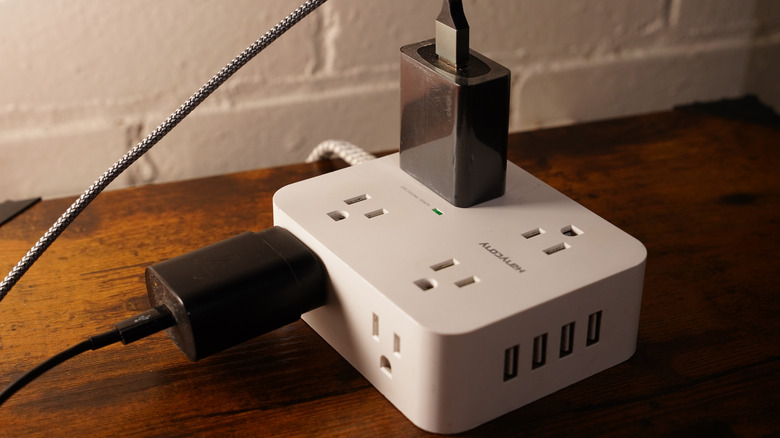
Though unplugging your electronics is the best way to keep them safe, let's face it, few of us do this whenever a storm is on the horizon. You might not even arrive home in time to unplug before the storm starts. Speaking exclusively with Hunker, Murawski explained that surge protectors are still helpful even if they're not foolproof. However, knowing what a surge protector is and how to tell one apart from a regular power strip isn't something that comes naturally to every homeowner. "One big mistake is assuming a power strip is the same thing as a surge protector. A basic power strip only gives you more outlets. It does not necessarily protect your electronics," he said. Luckily, most surge protectors come with an indicator bulb that illuminates when surge protection is enabled. If you're not sure, find your device's specifications or invest in a new product that provides peace of mind.
To further keep your electronics safe, Murawski recommends charging them prior to storms. He also suggests not using electronics that have to be plugged in while the weather is raging, opting for wireless devices until the storm clears. Alternatively, there could be a way to install more thorough safeguards for every electricity-reliant appliance in your home. "For better protection, homeowners can also talk to an electrician about installing a whole-home surge protector at the panel. It will not make your house immune to lightning, but it adds a strong layer of protection before a surge reaches your electronics," he said. If your area experiences a lot of storms and surges, looking into the cost of whole-house surge protector installation could be worth it.