

How To Make Your Exposed Basement Ceiling Look Like A Million Bucks On A Budget
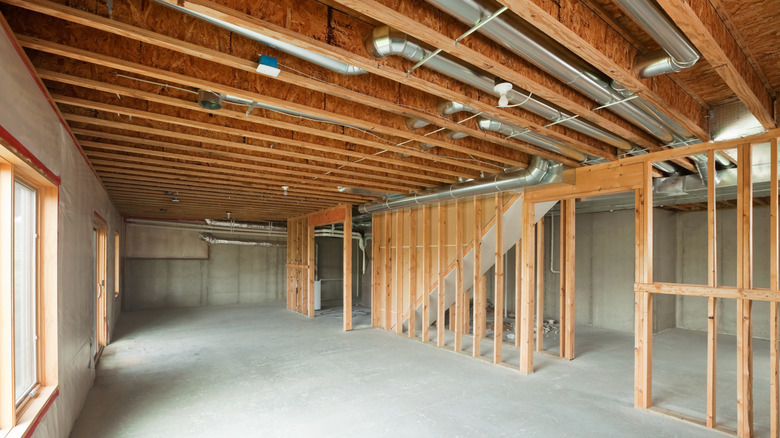
When you build or move into a house, an exposed basement ceiling might seem kinda cool — it's probably one of the last places where you can still see the wiring, pipes, and other bits that make a home work. But eventually, you'll likely want to use that space for something that looks less like a construction zone. There are many good ideas for covering it up, as well as one great idea that creates a polished basement ceiling look: making the exposed joists basically function like part of a faux drop-ceiling grid but without the expense.
That expense can be large. Assuming you installed a drop ceiling yourself, you'd pay around $1 to $7 per square foot for acoustic tile, or $4,000 for 1,000 square feet at the median. By contrast, you could try a clever workaround, as TikTok channel @collins.country did, that costs only around $500 for the same ceiling. Rather than screw anything down, the creators cut drywall pieces to rest on the lips of the exposed ceiling I-joists. Adding paint to blend it all, they gave it a chic paneled look.
Of course, traditional drywall is an option, and in some areas, because of building codes, the only option, even though it will cost you easy access to the electrical, plumbing, and HVAC systems. As a result, some of the best-looking basement ceiling ideas leave the overhead area open. In older homes, for instance, staining subfloor boards and ceiling joists can take a rustic basement design from dark to smart. You might paint everything black for a modern look or simply add statement lighting that looks at home in an exposed ceiling. However, if you don't want to compromise on a truly finished look, this idea covers all the inner workings while leaving them accessible.
A great-looking non-dropped drop ceiling
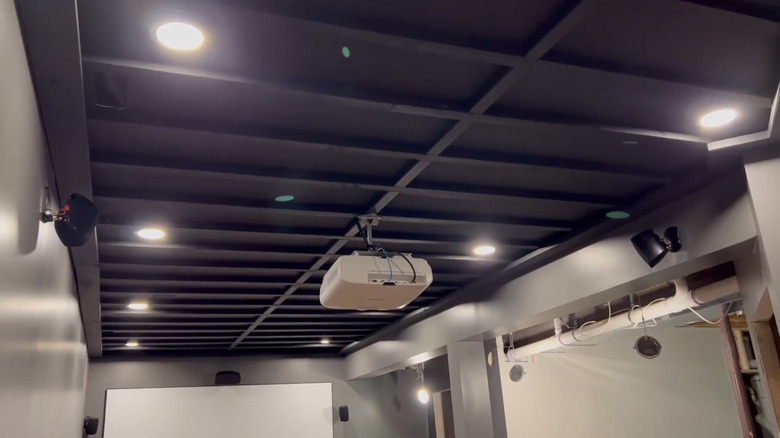
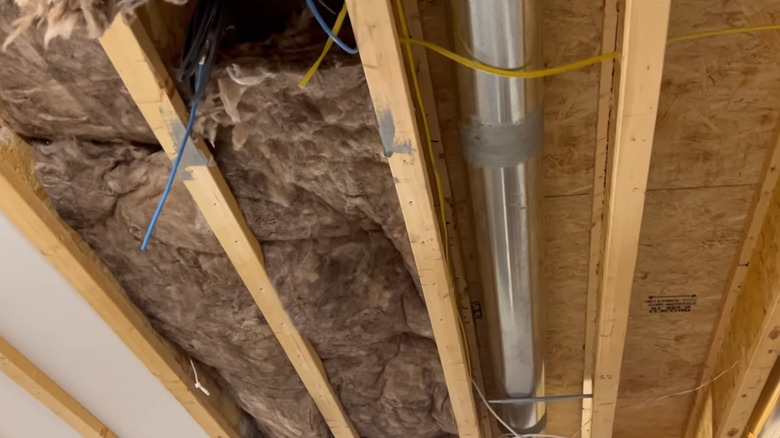
The purpose of a drop ceiling is to create a space for electrical, data, plumbing, and HVAC infrastructure. The Collinses used the bottom flange of the I-joists — engineered wood I-beams that function as floor joists for the space above — as part of a grid, above which they suspended rectangles of drywall. 2-by-3s bridge the bottom flanges between drywall panels; each is measured and cut to length, then toe-nailed in with a finish nailer. Measure the drywall panels by measuring the hole, then adding the width of an I-joist lip (often around 1 1/2 inches) to the length and half the width of a 2-by-3 (1 1/4 inch) to the width. The finished look is board-and-batten, but better. The approach mimics a drop (or suspended) ceiling without the expense of a grid and ceiling tiles, and without the commercial look.
While drop ceilings shrink the air-conditioned space and improve sound absorption, the faux look achieved the same effects by insulating the "plenum" space above the drywall panels without the extra cost. Based on the midpoint of Fixr's $55 – $85 cost per 4-by-8 board of installed 1/2-inch drywall, a square 1,000-square-foot basement (the average size of a walkout basement) can cost $2,187.50 to sheetrock.
The Collinses' DIY method costs only $507.63 after you factor in the cost of 2-by-3s — about 23% that of standard installation, owing to the lack of labor, tape, drywall mud, and fastener expenses. The look of the finished basement is quite modern in spite of the board-and-batten approach, owing to the black paint job. The removable drywall panels make lighting and electrical work a cinch.
Key considerations for a board-and-batten faux drop ceiling
Since the Collins family intends to use their finished basement as a home theater, the black ceiling makes sense. Normally, you'd think twice before committing to a black ceiling in a space with little or no natural light, and it's usually a good idea to put some thought into the reflectivity of your paint choice just to keep the brightness up.
Basement ceilings are sometimes lower than usual. Another advantage of the faux drop ceiling is that you don't lose additional height to the drop. You should also consider adding some soundproofing via an insulation product like Rockwool's Safe 'n' Sound Stone Wool insulation, to keep noise from flowing freely between the basement and first floor spaces. Rockwool Safe-n-Sound insulation is also fireproof (in that it won't burn), which raises an important issue. Other aspects of the project might run afoul of local building codes if you're not aware of the requirements.
It varies from area to area — not all municipalities or counties require fire-rated basement ceilings — but code can demand certain materials be used (⅝-inch fire-resistant Type X gypsum drywall is usually okay, but the 2-by-3s might give an inspector pause). Code might also specify fastener spacing or require fire blocking and sealing air gaps and ceiling or floor penetrations, both of which might make the faux drop ceiling approach challenging. In some localities, these requirements are triggered by the presence of an appliance like a furnace or water heater in the basement, which increases the potential for a fire that could spread to the floors above.