

I Turned Wood Pallets Into A Budget-Friendly Workshop Floor – And So Can You!
We may receive a commission on purchases made from links.
Wood pallet projects are often a matter of trading your labor for a few dollars saved. I've tried a few, and confess that I dislike breaking down pallets into boards so much that I'm often unwilling to make the trade. But when I had the idea of using pallets rather than joists for a workshop floor, I quickly did the math and changed my tune.
Three things happened at once: My wife agreed to a freestanding metal workshop in order to get the noisy, dusty workspace out of her new house. Second, we ran across a source of $10 5x10ish pallets, and a gentleman near our home began converting some of his wooded land into pasture and milling the pine on-site himself for 75 cents per board foot. Third, I had just written a check for this metal shell with a dirt floor and was dizzied by the additional cost of 500 square feet of concrete and footings — not to mention the prep required for a monolithic slab. Then, I connected the dots and devised my pallet-tarpaper-pine flooring system.
How much savings are we talking about here? A concrete slab — the most likely approach to a freestanding garage floor — averages about $8 per square foot, or $4,000 for my shop. It's a little harder to figure out a wood floor since no one is going to build one this way, but the cost of replacing floor joists is probably similar. To keep the comparison with pallets fair, I estimated 2x4 joists sitting on the ground (OSB subfloor, 12 inches on center, blocking every 6 feet, no hangers) at $2,034.30. Instead, I paid $544.94 for my floor.
How to build a pallet floor
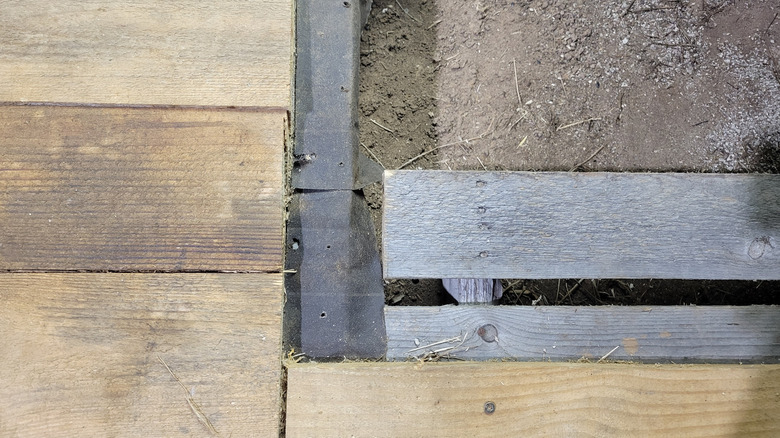
When I say that no one would build a floor this way, I mean that no professional would build a wood floor that sits directly on the ground. So, the keys to this project were dryness and levelness. A 5x10-foot pallet is going to be unforgiving if the grade isn't perfectly level. For me, dryness came from an elevated site and just enough overhang from the metal roof to shed water away from the base of the walls.
Luckily, the dimensions of the pallets fit nicely within my metal shell, leaving only one 3x3 corner with no floor structure at all, which I currently use to store scrap metal. That 3x3 corner exposes the three layers of my flooring system as seen in the photo above: pallet "joists," a tar paper vapor barrier, and rough-sawn pine floors.
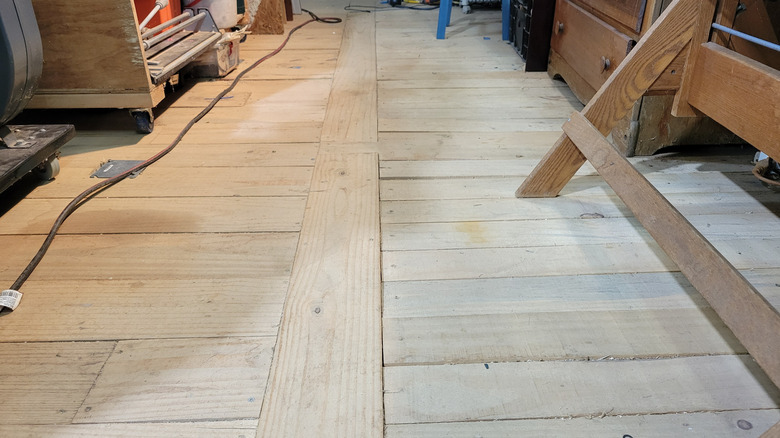
On top of the pallets, I tacked down tar paper, then laid the pine row by row and screwed it to the pallets wherever the pallets' stringers fell. My amateur sawyer stacked and stickered (placing sticks between boards for better airflow) the lumber for air-drying, and I stacked and stickered it at home, too, but I had hours rather than months to dry this pine lumber. It went in very green and was already more than a little crooked (that is, warped toward the board edges), so I had to pull almost every board into place with ratchet straps and screw them down a few feet at a time. But it worked: Five years later, there's no sign of rot, and the floors are still going strong.
Doing it differently, and perhaps better
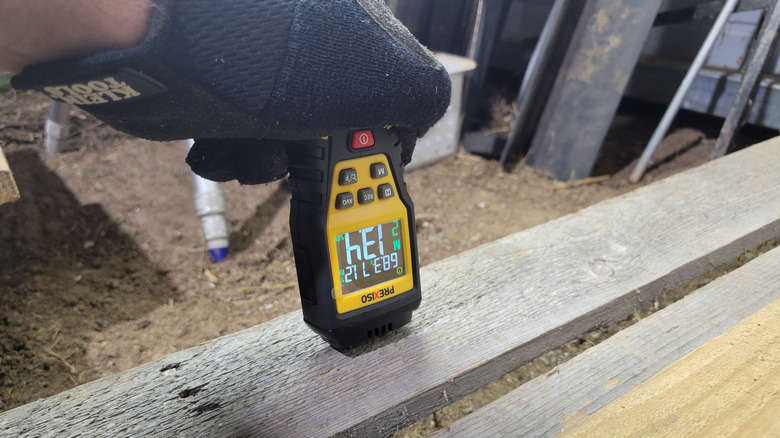
This floor has handled things like overloaded hand trucks concentrating heavy loads into two tiny contact patches, as is their wont. And then there's my toolboxes: rolling units, extensions, and large chests. I have no idea what they weigh, but a basic Husky cart at capacity is close to a ton, so I figure all mine weigh four times that, full as they are of decades of tool redundancy.
Still, you could make a floor like this easier or better — though probably not both. Pallets are a given in a pallet project, of course, but remember when you're shopping around that there are heavy-duty pallets, including plastic ones, that would make a great starting point. I used an asphalt-saturated felt vapor barrier to protect the green pine, but there are lots of vapor barrier options for under 20 cents per square foot, and with lower VOC levels. The best place for a vapor barrier might be underneath the pallets if you can be certain water won't pool on it, if one is even necessary.
In hindsight, I'd do the pallet part of this project again, but maybe not the rough-sawn flooring. Instead, plywood would have been expensive, but I once bought a few cheap pallets of engineered walnut flooring blanks (no tongues/grooves/click-lock edges) that were basically strips of super-high-quality plywood, which would have been perfect. OSB with dirt-cheap commercial vinyl tile (occasionally as cheap as 10 cents per square foot) would also be practical. Think creatively and cast a broad net, and you'll connect the right dots for your pallet workshop floor.