

Goodbye Boring Blinds, Hello Gorgeous Kitchen Windows That Feel Brand New

Blinds are just one of many kitchen window treatments for your cook space. They're not ideal, however: They require frequent dusting, and, in a kitchen, greasy spatter may cling to them, making cleanup even more of a chore. If you don't want to deal with all that — or even just the bother of opening and closing your blinds every day — one simple solution offers privacy while still allowing natural light to brighten your kitchen.
Decorative window cling film can give your kitchen window the look of stained glass, flowers, a colorful diamond grid, or just about any other design that might look good in window form. On top of that, privacy film that uses static cling or water as the "adhesive" allows you to take it down if you decide to change the aesthetic. There are plenty to choose from, too: If you live in an older home and want to stick with a more rustic kitchen aesthetic, for example, a design with a leaded glass effect may fit right in.
One fun factor about window films is that you don't have to cover the entire window with them. For example, if the film features a repeating fan tail design, you can trim it along any row of fan tails to cover just the top or bottom of your window. This allows for more creativity than you might get by replacing the entire window with a patterned glass pane.
Updating your kitchen window with decorative film
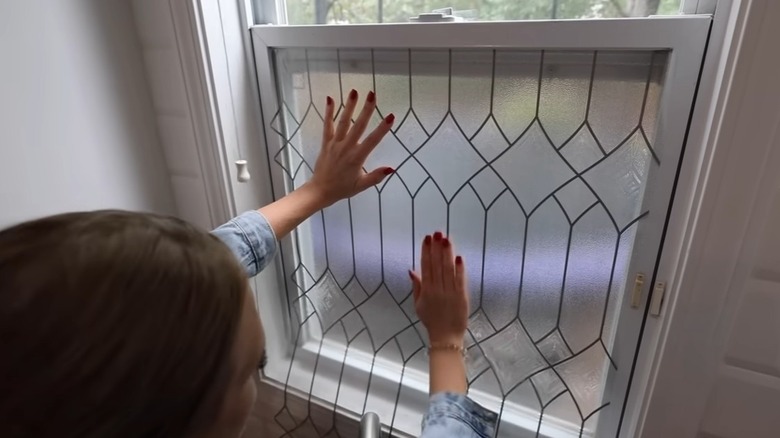
When you're buying the film for your window, make sure the sheet is larger than the area you'd like to cover; if it's a tad too small, it'll be obvious that your decorative window is actually a fake. To begin, clean the window thoroughly. If the film is a lot larger than the area you're covering, cut it a little larger than you think you'll need — you can trim it while it's up. Before you install your window film, you should read the directions specific to the kind you've purchased, because it likely has a peel-off backing that needs to be removed before putting it on the window. Once you're ready, spray some water over the window, center the film over it, then press the film into place. Some films can even be repositioned, if necessary. Next, use a squeegee or an ice scraper to push air bubbles out the sides.
If you just want to screen the lower part of your window from view, use the film to cover that area. In some cases, you might want to cover just the upper part — if an upper floor next door has a window facing yours, for example. Or, you can cover the whole thing; in this case, make sure the film you've chosen allows at least some light in. If desired, add a tension rod with cafe curtains for a little texture and an extra pop of color. And if you have leftover film after treating the window over the sink, you can also use it on other windows in the kitchen for a more cohesive look.