

Flex Tape Vs. Gorilla Tape Vs. T-Rex: Which Waterproof Tape Can Stick It Out Through Our Intense Testing?
We may receive a commission on purchases made from links.
When Hunker asked me to investigate three popular brands of waterproofing and repair tape, I'd like to think it's because of my reputation as a thorough and thoughtful consumer. In hindsight, it seems more likely that someone's been talking to my wife about leaks. Along the path of building our house — which included adding a new bathroom, re-plumbing the kitchen to accommodate a new double sink, adding gray water diverters to drain lines, and installing a prep sink and reverse osmosis filter in three different places — there have been a few leaks.
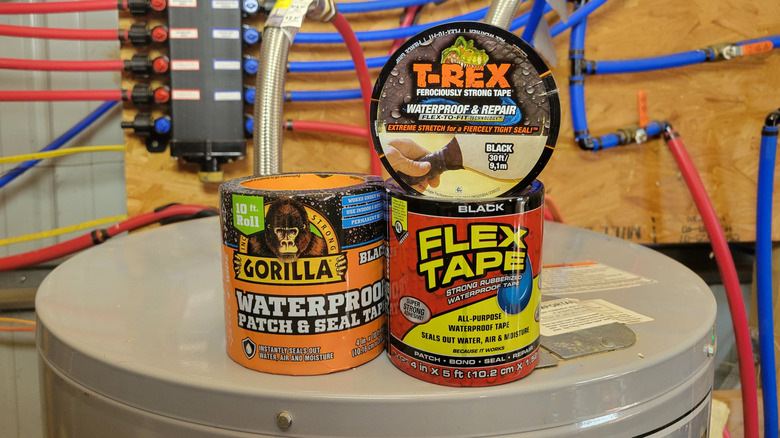
Hey, leaks happen. You could get easily get one in a 3-inch drain pipe or the ¼-inch poly tubing draining waste from a filtration system. Things get crashed into by lawn mowers, seals spring leaks, drains get clogged, and occasionally, someone forgets to crimp the PEX line to the new bathroom, creating a spectacular fountain-like indoor display. Hypothetically speaking, of course. But many of these little mishaps are exactly why we have waterproof patch tapes like the ones I was asked to compare: T-Rex Waterproof and Repair Tape, Flex Tape Rubberized Waterproof Tape, and Gorilla Patch and Seal Waterproofing Tape.
Faucets, hose bibbs, and their associated drains obviously aren't the only sources of water. In fact, I'd venture to guess that it mostly comes from other places — not least, from the sky. So, you might, from time to time, need to temporarily waterproof something against this generous offering, like when you have to mend vinyl siding or repair a shed roof. In some of these cases ... maybe even most ... you might get away with slapping a bit of waterproofing tape over the leak before you head to the hardware store. But which tape will it be?
Water, water everywhere ... but not behind waterproof tape
Waterproof patch and seal tapes have a heavy-duty composition compared to most household tapes. Two of the tested tapes, the T-Rex and Gorilla tapes, use a butyl rubber adhesive that's common in construction. (All three might be butyl — Flex Seal jealously guards its tape recipe.) Builders have lots of uses for butyl tape, like sealing cracks, gaps, joints, and seams in concrete, roofs, gutters, ductwork, and metal roofing and siding. It's commonly used for flashing windows and doors and as a protective sealant for deck structures.
Butyl tape usually has three components: a carrier sheet, an adhesive, and a release liner that keeps the tape from sticking to itself on the roll. T-Rex had no release liner except on the first winding of tape around the spool. The adhesive side of butyl tape is thick and gooey, and overall, it tends to be flexible, strong, and waterproof. It adheres to most surfaces and does so quickly. A few other telling uses for butyl tape: It attaches windshields to cars, and it's used to seal seams in boats and aircraft.
The Gorilla and Flex tapes are both 4 inches wide, while the T-Rex is only available in a 1.88-inch width common to many construction and painter's tapes. I did find a listing for used 4-inch T-Rex tape, but even I'm not optimistic enough to buy used tape. My guess is that T-Rex reserves the 4-inch width for its Extreme Strength Waterproof and Repair Tape.
Methodology overview
Testing products can often seem a little over the top and artificial. But it might be because one doesn't create a real water leak for a tape review, and one certainly doesn't put off fixing a real leak until a tape review happens along. My plan was to put these tapes through a variety of trials that roughly mimic standardized industry laboratory tests. Labs measure many tape characteristics, from how much force is required to unwind them to how quickly they grab onto things. I was mostly interested in testing the adhesion, tensile strength, elongation, and pressure resistance (specifically, resistance to water pressure). These qualities are often interrelated, as we'll see, and combine to describe how well a tape can stick to or wrap around whatever you're taping without breaking or leaking. Taping a leak in the roof of an RV, for example, will require performance in all of these categories.
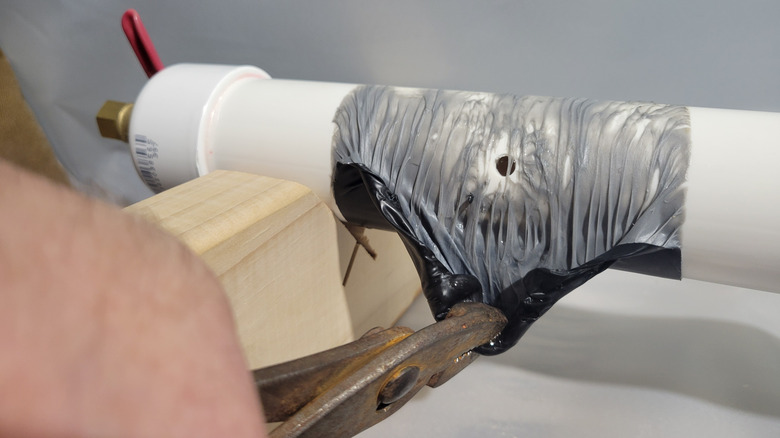
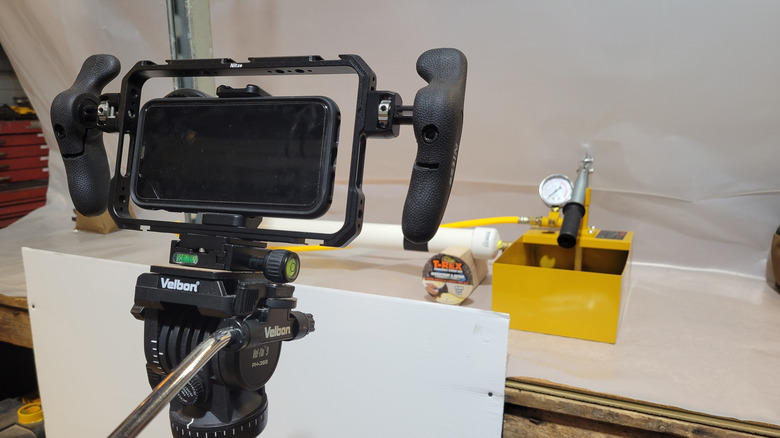
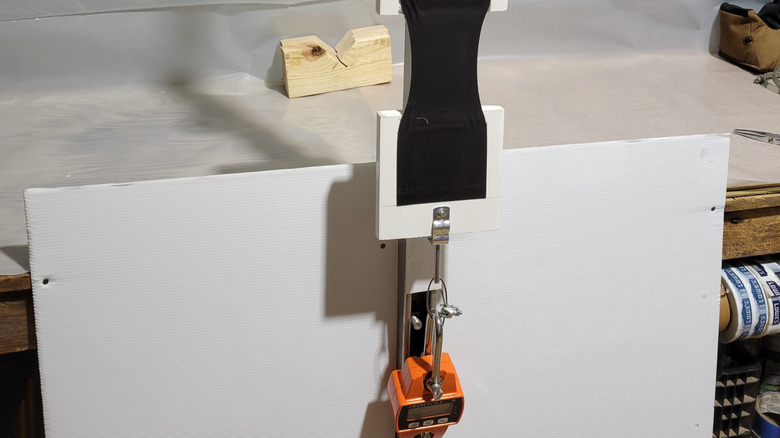
Testing tensile strength is a matter of clamping the tape at both ends and measuring the force required to break it. Since the tensile grips used for ASTM D3759 tensile strength testing look like the business end of ratchet straps, I simply used ratchet straps. I applied sawdust to suppress the adhesive without weakening the tape. To test adhesion, I adapted another standard test (ASTM D3654). This looks somewhat like the tensile strength test, except you rely on the tape's stickiness rather than clamping to secure it. This is also how I tested elongation, or how much it stretches before breaking. For pressure testing, I drilled ¼-inch holes in a PVC pipe, sealed each with tape, and used a hydrostatic pump to see how much pressure was required to break through.
A comedy of tape-testing errors
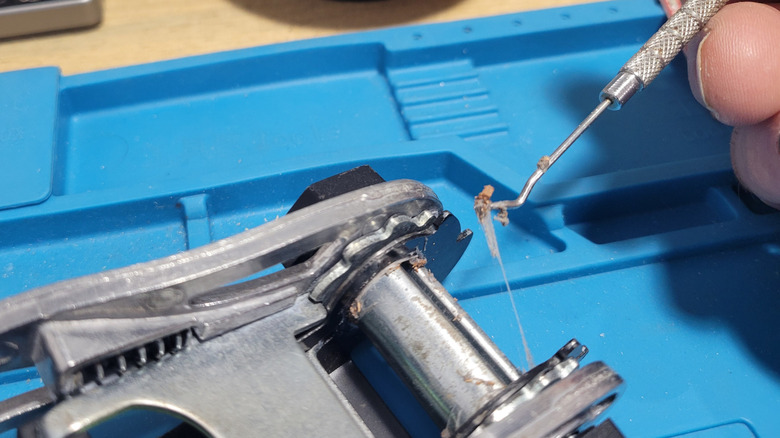
Many of my tests turned out to be tales of defied expectations. I would run into a number of difficulties with my testing, mostly caused by expecting too little (and occasionally too much) of these tapes. But one learns from mistakes, and what I learned was that the adhesives used by these tapes are extremely powerful and persistent. The Gorilla tape gummed up the ratchets I used to test tensile strength so severely that I had to disassemble the ratchets and clean them with carburetor cleaner.
I eventually got it all off, but this was a portent of troubles to come. For example, the adhesion tests never really took shape because the tapes almost never let go of whatever they were stuck to, which meant I couldn't reuse PVC and wood blocks. But cleaning butyl tape off of anything is challenging; the residue was essentially permanent, since I didn't have a solvent that would break down the adhesive without also dissolving the PVC.
The tape-removal problem resurfaced during my water pressure tests, meaning that I had to cut out the used section of pipe after each test. This isn't bad news if you're planning to use these tapes for a semi-permanent fix. The stuff is just ridiculously strong — so strong, in fact, that I had to abandon my original hand-cranked tensioning system and replace it with a 2,000-pound utility trailer winch screwed to the workshop floor.
Measuring adhesive strength
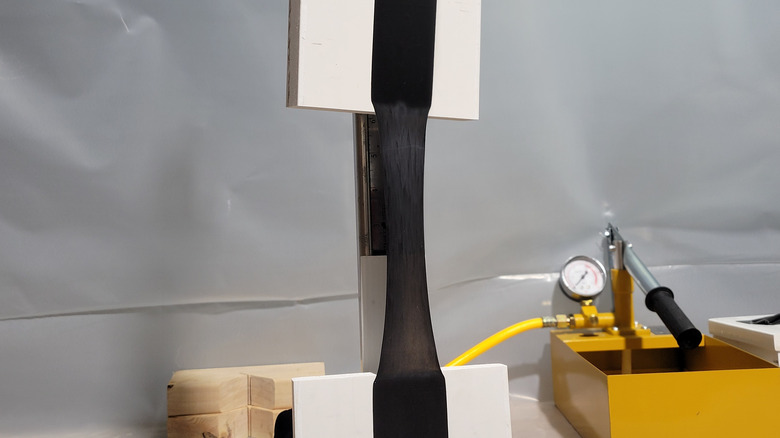
Adhesion is a measure of how likely tape is to fail ... that is, to lift off a surface or allow liquids or gases to seep under the tape. Imagine for a moment that you slap the tape on the outside of a leaking water tank, like in the Flex Tape commercials you're probably thinking of right now. The adhesive strength of your tape matters quite a lot in these situations, and this is exactly the kind you'd find if you stick a piece of tape on a leaky drain pipe: If there's any pressure at all, you must be confident that your tape will continue to stick.
But testing these tapes' adhesive strength turned out to be essentially impossible. My test was modeled on a method for measuring shear adhesion in pressure-sensitive tapes. (The T-Rex tape is billed as "initially repositionable," which suggests that it might be pressure-sensitive in some sense.) I stuck the tape to two 5 ½-inch-wide plates cut from a PVC trim board and similar-sized plates of wood. These were pulled apart so that lateral force is applied along the plane of the tape's surface.
The trouble was that, in every case except one, the tape broke before the adhesive let go! The stubbornness of these adhesives would become a theme. For reference, the T-Rex tape claims its adhesive is capable of handling 320 ounces per inch. I don't know if that's per inch of tape or per square inch, but it doesn't matter much if the tape itself can't withstand that much force. Suffice it to say that these adhesives are ridiculously strong.
Measuring tensile strength
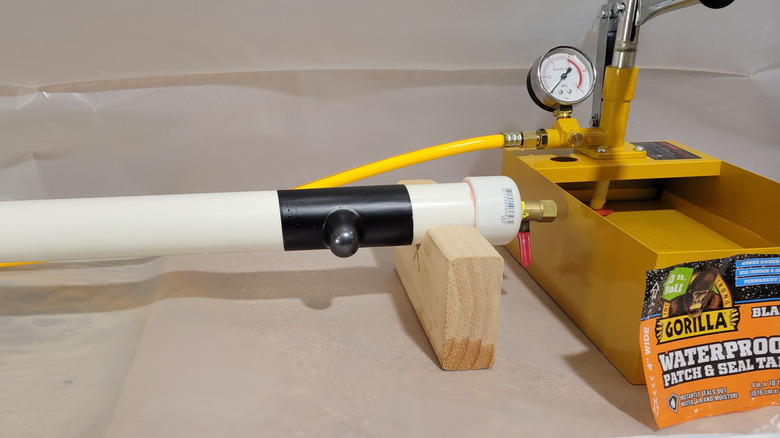
Tensile strength might not seem like the most important characteristic of waterproof tape, but this quality, combined with its elongation, helps determine how well it wraps and how much water pressure a tape can stand before breaking. It matters if you're wrapping a pipe or trying to hold multiple things together. And since all three brands claim to be extremely strong, it was worth investigating. So, I did, and I found some surprising results.
My first attempts to test tensile strength involved inserting a 1-inch strip of tape into ratchet strap mechanisms of the sort you'd use to secure plywood to a trailer or a mattress to the roof of a Nissan Sentra. I recorded the scale's screen with a camera phone so I could track its highest reading. I also tracked the tensile strength when doing elongation tests, using the method for testing adhesive strength (pulling two PVC/wood plates apart).
When testing full-width tape, the narrow Flex Tape proved the strongest at 22.52 pounds and Gorilla the weakest at 10.05 pounds. T-Rex came in between the two at 14.2 pounds. These would be extremely low numbers for a tape with no ductility. But the highest figures given here were generally reached in the first 20% or so of the Gorilla and Flex tests, while the actual breaking point took place much later, and at a much lower force, when the tape was stretched dramatically. T-Rex had a fairly consistent strength measure from start to finish. I also tested tensile strength with 1-inch wide strips of tape. In this round, for whatever reason, Gorilla took the lead with 5.65 pounds over Flex (4.95 pounds) and T-Rex (3.75 pounds).
Measuring elongation
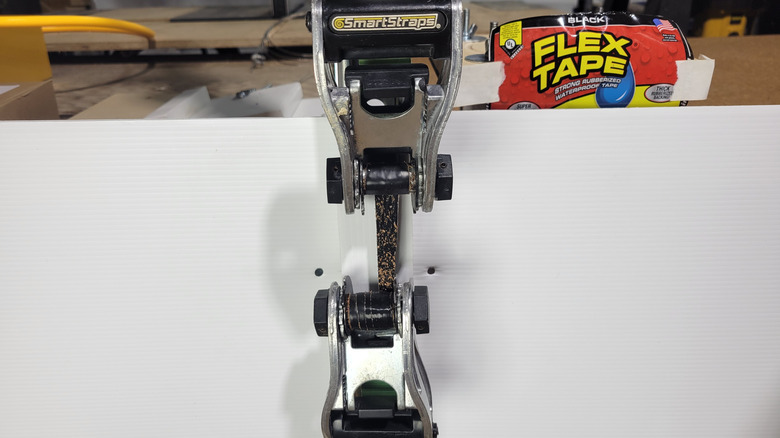
There are two varieties of elongation, plastic and elastic. Plasticity, as I understand it, is when an elongated material assumes its new shape permanently, while elasticity is the ability of the material to return to its previous dimensions after elongation. Obviously, if you're wrapping a leaky pipe in tape, some elongation is required to make it snug, but too much elasticity might tend to pull the wrap loose over time ... to the extent that anything at all can pull these tapes loose. We've also learned that the tape is stronger before it's elongated and, of course, tape will generally withstand less pressure if it's stretched too thin. But picture this: if you're wrapping a pipe under minor pressure — say, a garden hose with its sprayer turned on — the cohesive aspect of elongation can help the tape give a little without breaking and leaking.
Ultimately, it ended up not mattering because I discarded the first elongation tests using full-width tape in favor of tests with all tape measuring 1 by 4 inches. According to ITS technical specifications for the T-Rex tape, the only one of the three for which I had a figure, it should elongate by 700%. T-Rex blew that away and dominated this comparison, with an average elongation of 18.5 inches versus 4 inches for Flex and 11.1 inches for Gorilla.
Measuring durability under pressure
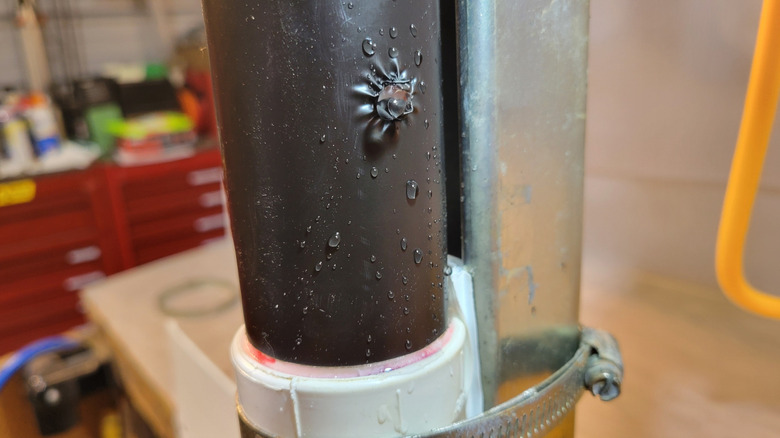
Thus far, I was impressed with these tapes ... albeit in the most irritable, dyspeptic way possible, because they were breaking my test rigs. But what seemed to matter was the pressure test, and it turned out to be completely different. Under pressure, the T-Rex and Gorilla tapes bulged momentarily and then popped before the pressure gauge needle even moved. Only the Flex tape withstood enough pressure to register, making it to around the 2 psi mark.
It turns out that this is probably the wrong scale for measuring the pressure that can be handled by such tapes. A pressure rating is partly a measure of the ability to withstand certain shocks, and Peter Yost of Building Green explains, "Three psi is what you might expect a building to experience at ground-zero in an F4 tornado or a Category 5 hurricane." Of course, you can get a lot more pressure than that in a pipe, and these results were so disappointing that I stopped to test my pressure gauge. But the problem wasn't my rig — it was that these tapes (unlike self-fusing silicone tape) weren't designed to handle that kind of pressure.
While the T-Rex tape had the largest "bellows" (Yost's term for the bulging caused by air or water pressure), neither it nor Gorilla tape could handle nearly as much water pressure as the Flex. It is possible that multiple wraps could hold standard household water pressure of 50 to 60 PSI for a little while, but you'd be better served — not to mention drier — if you just turned off the water and called a plumber.
My overall impressions
These tapes all have some things going for them, and success is a matter of choosing the right tape for the right job. For this trio, that job seems to be waterproofing things that aren't under any substantial pressure. They are also good at being strongly adhesive, which isn't necessarily related to the property of being waterproof. (Though, certainly, it's related to how long tape remains waterproof.)
If I weren't too afraid of heights to stand on a picnic table, I might allow myself to be stuck to the belly of an airplane with the Flex Tape, with no concern that I'd fall. I'd be far more worried about the future prospects of the plane after being coated in this sticky nightmare mess. All of the tapes were gloriously sticky, but the ambient temperature had a substantial impact on the results. When I attempted tensile strength and adhesion tests in a cooler workshop, none of the tapes fared nearly as well as on a warm day, and the Gorilla tape actually released before the tape broke ... but I ended up discarding all cool-day tests. From my experience, Flex Tape and Gorilla waterproofing tape are more like marriage than being strapped to the undercarriage of a jet, to the extent that there is a difference. You don't enter into this relationship with any hint of indecision knocking around in your head, because you're not going to extricate yourself from this bond easily.
Choosing a tape
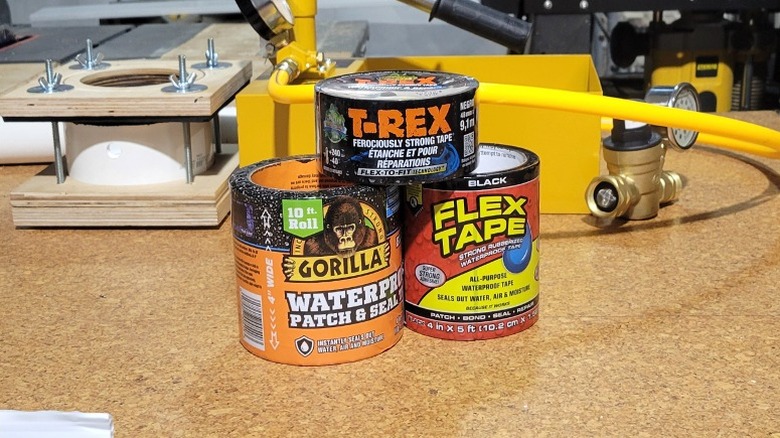
What these tapes seem best suited for is repairing drain lines and keeping rainwater out of things one doesn't want to put rainwater in. Heaven knows how such a thing could get cracked, but if you were to develop a crack in a DWV line, for instance, you could do worse than to put Gorilla or Flex Tape on it and deal with it later. Probably much, much later, in fact. The T-Rex I'd be more reserved about since it was notably weaker in my tests, though it still performed better than I expected.
All things being equal, I'd choose Flex Tape for most tasks, since it did well on the tensile strength testing and better than the others with water pressure. But all things are not equal, and Flex is dramatically more expensive than the other two. At the time of writing, Flex costs 6.2 cents per square inch, Gorilla costs 2.7 cents, and T-Rex costs 1.1 cents. That probably means I'd choose T-Rex for daily household use and Flex for specialized waterproofing emergencies. But, ultimately, you'll be okay with any of the three for the tasks this type of tape does well. When it comes to pipes in walls, however, once I've managed to actually find a hidden plumbing leak, I'm probably going to opt for a permanent repair.