

Don't Overlook This '80s Art Deco Lamp If You See It At A Thrift Store Or Estate Sale

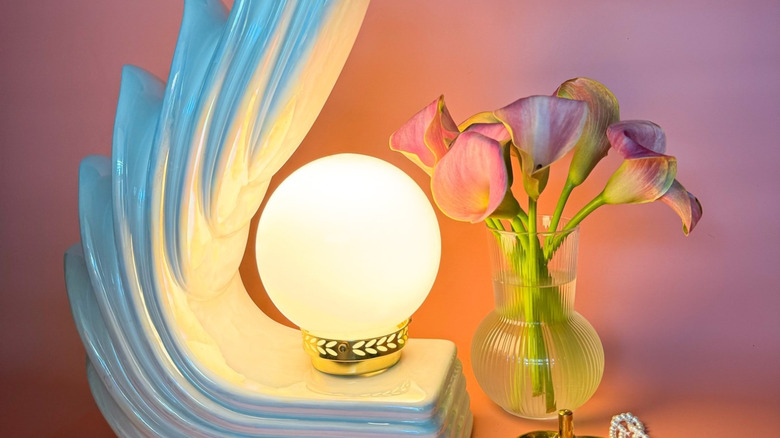
Rolling your eyes at the return of 1980s design and fashion? Understandable, but there are a handful of hot items for which you should, umm, attenuate your roll in the thrift store or estate sale. One of those items might not strike you as very eighties at all at first, since it represents a side of the decade that can get lost in the glare of the era's loud colors and louder graphics. That the Deco Revival "cascade wing lamp" should rise again from the ashes is fitting for a piece of decor that's half feather, half flame.
The lamp, which first strikes one more as a sculpture, is an orb that plays light off of the contours of the cascading wings, or feathers, or flames. It's quite striking, and it's not hard to also see the curves of Art Nouveau's influence — in the cascade wing lamp, particularly with the globe lighted and properly accessorized. Whatever thrift store price you find is probably a steal, because these lamps are currently going for $350-625 on eBay and $1,390 on Chairish.
To understand how this sort of thing made sense for the '80s and works for today, Hunker spoke exclusively with Sarah Stafford Turner, an architecture and design historian, curator, and editorial board member for the "Journal of Design History." Turner, naturally, points to the past — particularly the origins and evolution of the Art Deco Style — as a source of inspiration when the present seems primed for a change. "The wave of maximalism sweeping luxury homes today is again pulling on the design threads of the past," she said.
Why the 1980s, and why a Deco revival?
That maximalism might be a reaction against the recent fixation on minimalism, but then, almost anything that's not minimalism can be described as a reaction against minimalism. The Art Deco revival of the '80s was certainly not minimalism, which is obvious from the name. (In fact, the original movement was partly a reaction against some of its own proto-minimalist influences.) Design historian Sarah Stafford Turner told Hunker exclusively that, similarly, "The 1980s love for bold, expressive geometric forms in design was born out of a rejection of midcentury modernism's cleaner, simpler lines and organic color palettes."
Deco's goal was to promote luxury and artistic decoration, and this was particularly true of grand, often sculptural Art Deco light fixtures. "In response to the economic boom of the period, 1980s art collectors and interior designers began to amass sculpture-inspired furniture and lighting pieces by designers like Gaetano Sciolari," Turner explained. Mass production made the same experiences available to everyone. "Lighting and furniture from the Art Deco age experienced a resurgence in popularity, and mass market companies like Vitrex produced widely accessible versions of Art Deco-inspired lighting."
The Deco movement focused on intricate geometry, striking colors, and the innovative use of materials, and you see this echoed in the light, iridescent, and even black finishes that the cascade wing lamps were made of. Contemporary lighting tends toward minimalism, but Deco Revival lighting was also largely about what light could do with the fixture itself, and with the right finish in the right room, it can be a remarkably effective way to add Art Deco style to your home.
Shopping in Memphis
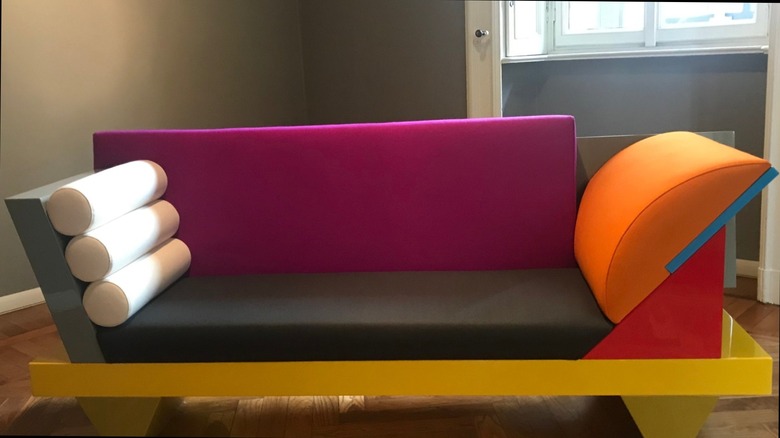
So you've found your cascade wing lamp at an estate sale. What else can you look around for as another '80s lighting investment? For design historian Sarah Stafford Turner, the question almost answers itself. She told Hunker in an exclusive interview that the Memphis Design movement transmuted Deco Revival forms into iconic 1980s decor. Just as the Deco Revival reacted against minimalism, Memphis Design picked up characteristics of Deco — bold colors, geometric shapes, and some amount of disregard for what came before — and reacted against nearly everything, arguably including its own influences. This is probably what comes to mind when you conjure up the 1980s — the Memphis-Milano style of colorful geometrical shapes and waves sort of haphazardly strewn about a canvas, or perhaps a Trapper Keeper. And some interesting lamps, too.
What was once famously described by Bertrand Pellegrin as "a shotgun wedding between Bauhaus and Fisher-Price" (as quoted by PORT Magazine) seems positioned to, once again, follow Deco into stylish homes. Memphis-inspired furniture does well in affluent secondhand markets. And lighting in particular might be in a position to serve this new generation well. "The 'wave lamp' is more art deco in taste than Memphis – but in the '80s and '90s the popularity of expressive, sculptural forms in decoration transcended both styles," Turner told us. "From the more nuanced, linear, organic forms of art deco to the technicolor shapes of Memphis ... they were simultaneously popular and often collected by the same people."
"Memphis-inspired furnishings in bold colors are big sellers, and these mass market lamps are now higher in value than ever before," Turner concluded.