

How Often To Mow If You Want The Greenest Lawn On The Block

Maintaining your lawn and keeping it looking lush can feel like a full-time job. Mow your lawn too infrequently, and you just might see rogue invaders and common lawn weeds like crabgrass and dandelions take up residence across your grass. But if you mow your lawn too frequently, you could run into problems that could take it from gorgeously green to yellow and patchy. So, what's the solution to a flawlessly green lawn? You need to mow using the one-third rule, which will dictate both how often to cut your grass and how much you should take off the top of the blades to ensure a lush lawn.
The one-third rule is this: Never mow more than one-third of your grass's blade length. If you know how tall your grass should be, you can use the one-third rule to help you decide when to break out your lawn mower. For example, if you want your grass at 4 inches tall, you'll need to mow it once the blades reach 6 inches tall. If you prefer shorter grass, you'll need to mow more often. Additionally, in the springtime, when most types of grass start to thrive, following this rule means you'll likely need to mow your lawn more than once every week.
The right mowing frequency depends on the type of grass
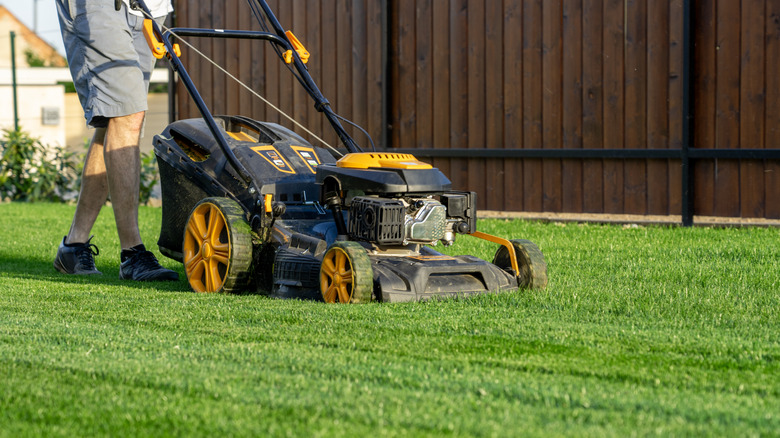
The one-third rule can help you determine the best mowing cadence for different types of grass (even golf courses use the rule). This will help you keep your lawn green by avoiding damage to the grass from over-trimming. If you mow off more than one-third of your grass's height, trimming grass too short may hinder its root growth and slow its overall ability to grow. Over time, if you repeatedly cut your lawn's blades of grass too short, you'll weaken it and potentially put it at risk of turning yellow in heat and periods of drought. Too-short grass can even be more vulnerable to diseases and weeds that pop up, too.
In addition to keeping grass height and cutting limitations in mind, it's important to remember the frequency you should mow is really dictated by the exact kind of grass you're growing. Grass varieties flourish at different heights and grow at different rates. For example, if you have a fast-growing variety like Bermuda grass, you may need to trim it more often to keep it healthy and green.
Regularly mowing your grass can provide denser coverage and encourage its blades to keep growing. Infrequent mowing, on the other hand, could contribute to shock, causing that unsightly transformation from green to yellow. Just keep in mind that while infrequently mowed grass can be a problem, opting to grow your grass a little taller isn't necessarily a bad thing. It will help you keep your mowing schedule to once every week or two and keep your lawn looking green, as taller grass is typically healthier overall.
Don't forget to factor in the season (and weather)

Your grass can change throughout the year along with the seasons. So, as you're keeping the one-third rule in mind, you'll also want to note when your exact grass type tends to see more growth, such as spring and summer — and when it typically slows down for colder fall and winter weather. As a general rule of thumb, you can expect grass to grow faster in the warmer temperatures of spring and summer, so you may need to mow your lawn more frequently from March through September than you will during the rest of the year.
But, just like the exact kind of grass you're working with across your lawn will determine how frequently you mow, it'll also dictate the seasons in which you may want to mow more often and when you can cut back. Cool-season grasses like bluegrass, for example, will grow faster in spring and fall; warm-season grasses like Bermuda grass thrive in summer heat and after plenty of rain. You also may want to let your grass grow a little longer than usual if you're preparing to mow it for your first round of spring lawn care; if it's not yet back in action, mowing could wind up scalping the grass (or removing more than one-third of its height) and stressing it in a way that takes it from green to not-so-green.