

The Forgotten '80s Home Gadget That Younger Generations Probably Haven't Seen
We may receive a commission on purchases made from links.
It's a testament to the breathtaking progress of technology that much of what was considered trendy and innovative in the 1980s is obsolete today. Take the portable cassette player, the floppy disk, the VHS player, and even the first desktop computers. Many of these were invented in the '60s and '70s and rose in popularity during the '80s, but one peculiar invention was both devised and popularized during that decade. It's the Clapper – and while you can still buy a new Clapper The Original for a little over $20, it's nowhere near as popular as it once was. Few younger people have likely ever heard of it.
The Clapper was (and is) an electronic switch you control by clapping your hands. It measures 2.5 by 6.3 by 8 inches and has one two-prong polarized male plug, two female two-prong polarized inlets, and a microphone that monitors sound in the room. When you plug the Clapper into a wall receptacle and a device into one of the inlets, it allows you to turn the device on and off by clapping your hands. Traditionally, the top inlet responds with two claps while the bottom one needs three, but modern Clappers can be customized to respond to various sequences of claps. They also include a remote control for those who don't want to clap.
How the Clapper became popular
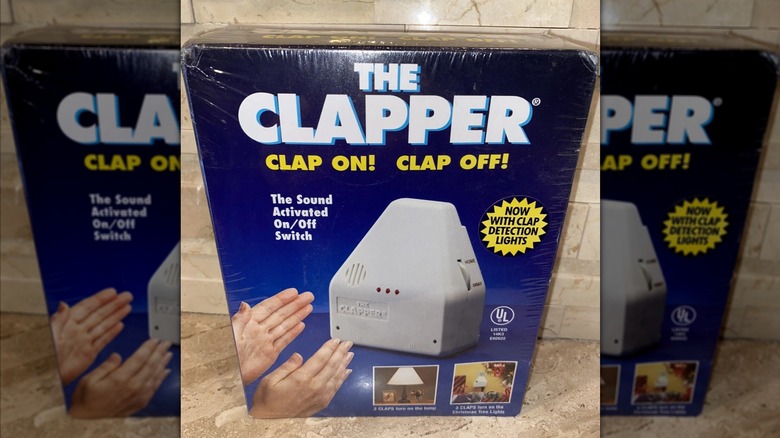
The secret to the Clapper's popularity was effective advertising. Originally brought to market by Futronics Electrical Systems, a company owned by a pair of Canadian entrepreneurs, the original name of the Clapper was the Great American Turn-On. That device, with its kitschy name, didn't work very well, and the company soon went bankrupt. It was then acquired by Joseph Enterprises, the company that marketed such '80s gems as Chia Pets — a product that also caught the public's fancy, and still does, as evidenced by a modern trend of turning furniture into Chia Pets.
Joseph Pedott, the company's founder, hired experts to improve the performance of his new product; he also changed its name to the Clapper in 1985, before heavily advertising it. At the heart of the promotional campaign was a 30-second television ad that introduced television viewers to the slogan "clap-on, clap-off." This slogan proved to be an ear worm that worked its way deep into the subconscious of the viewing public.
The idea of being able to turn off lights, appliances, and especially televisions with just a clap of the hands appealed to seniors and disabled people — and that, in fact, is who the ad campaign specifically targeted. However, kids and couch potatoes alike were also intrigued by the device; by 2018, Joseph Enterprises had sold seven million Clappers.
Its popularity may have faded, but the Clapper isn't gone

The Clapper of the '80s had its problems, however. Its microphone had a filter designed to allow the switch to respond to frequencies generated by clapping hands, but other sounds, such as a dog barking, could also set it off. Not only that, but claps had to be timed precisely to get the device to work. The Joseph Company was even brought to court by an elderly user who claimed she'd injured her hand by clapping too loud. Besides that, early Clappers were rated for only 250 watts and couldn't be used with heat-generating appliances. Moreover, an obstacle placed in front of the microphone could prevent the device from hearing the clapping, and the earliest versions could short-circuit televisions.
The company resolved most of these problems in later models, and the device may have regained popularity but for the rise of better technologies. Today's smart home solutions are widely available, inexpensive and convenient, and include devices you can operate with your voice, mobile device, or wireless remote control. In this environment, the Clapper has only limited usefulness — specifically for the elderly and disabled. However, as a precursor to the modern technologies we use every day, the Clapper has its own place in history, which is why the Smithsonian has included it in its collection of iconic American products.