

We Put Crep Protect Water Repellent Spray Through The Gauntlet Of Home Testing
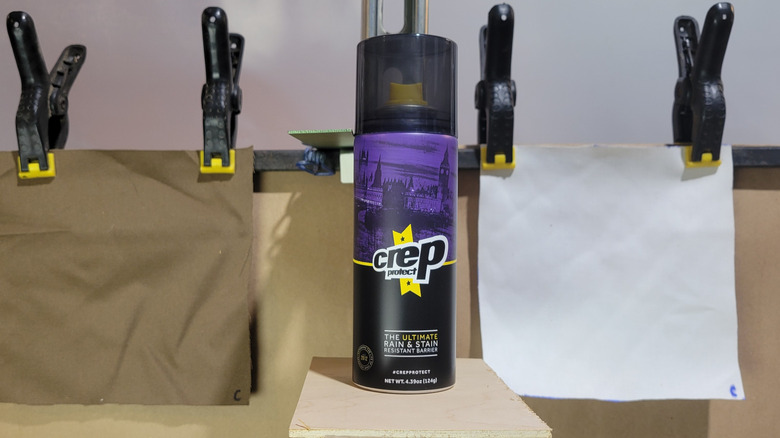
Many things that are designed to be wet on one side are meant to be dry on the other. Sometimes the distinction is critical, as with submarines and fried foods. Sometimes, it's just really important, as with work gloves, shoes, and parson's chairs. As I write this, before the hijinks below ensue, I am hopeful that I've found a solution for the gloves, shoes, and furniture (though definitely not the subs and fried chicken): a durable water-repellent spray called Crep Protect.
Love-hate is my default relationship to many things, and work gloves top the list. As I type this, I have a thumb dramatically swollen from a wasp sting, a fingernail that's falling off after being crushed by a collapsible — and, indeed, collapsed — generator handle, and two other fingers shortened by childhood and adulthood accidents. I am the type of person who needs to wear gloves, but I detest the damp feeling that sometimes comes with them. I'll occasionally wear nitrile gloves when sanitation demands it, but in general I'd rather spend 10 minutes scrubbing grease off my hands than wear what feels like a balloon.
This is, I hope, where Crep Protect comes in with its promise to add or restore waterproofing to shoes and other fabric and leather things with no more than a quick spritz from a spray can. It's a little pricey at $16 a can (the price is printed right on the can). But if the stuff works, I'd probably pay twice that for it. But don't tell the fine folks at Crep I said that.
The methodology process used for this review
To know if Crep Protect works, I need to know a few key things. Does it actually make things waterproof, or just add some water repellency to the fibers you treat with it? Does it prevent stains, as Crep promises in their madcap collection of YouTube vignettes? Can it stand up to the abuse I deal out to gloves and shoes, or that my children and dog deal to furniture?
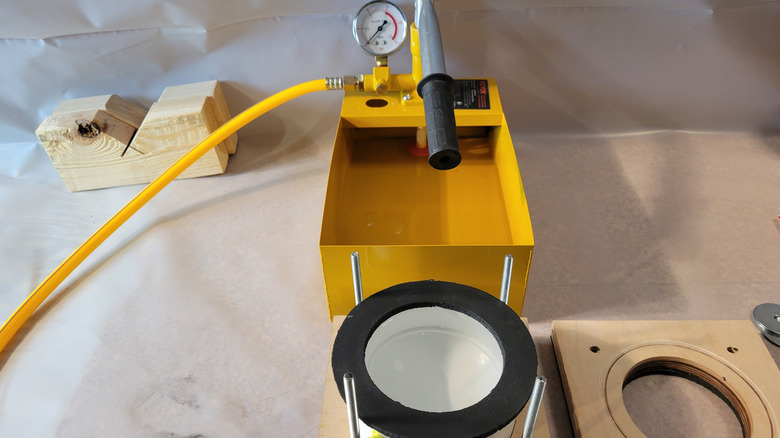
I have undertaken an extremely scientific regimen designed to answer at least some of these questions. And by "some," I mean the first question, which I will answer with a gadget called a hydrostatic head tester. This measures a fabric's resistance to water penetration by attempting to pump water through the fabric and seeing what it takes to do so. (Okay, so it's not exactly quantum mechanics, but this is how the industry tests fabric waterproofing.)
I will further make use of a makeshift colorimeter (also known as a camera phone) to determine if the spray discolors fabrics. I will subjectively gauge the efficacy of the hydrophobic spray by putting water on it, and test its real-world waterproofness by applying the technology to a device known as a puddle. Then, I shall determine if its rejection of water extends to other substances you might not want coloring your shoes. And at some point I shall, without cause or explanation, begin to write like a member of the Royal Society, circa Isaac Newton's heyday.
How Crep Protect works to protect work boots (and sneakers, of course)
Around 1992, I bought a pair of Vasque Sundowner boots that, at the time, cost two-thirds the price of the car I was driving. Around 28 years later, they were still in great condition, and then I built a house. Within two months, the boots were in such comically bad shape that I tossed them. I am hard on shoes. This is not the road everyone takes, and some eschew work boots and wear New Balance sneakers to avoid the narrow path. These are the participants in sneaker culture, for whom Crep Protect was created. ("Crep," it turns out, is British slang for sneakers.) This is a subculture that views sneakers as fashion objects to be worn once or twice and then retired to a display case. The idea of Crep Protect is to keep them from getting stained or otherwise damaged during those few outings.
It accomplishes this by application of coconut-based treatments somehow deployed in conjunction with "nano technology." The idea is that treated leather and fabrics reject water and any water-based stains so that they can be quickly and thoroughly rinsed or wiped clean. Such DWR (durable water repellent, not the outlet where you can find midcentury modern furniture and decor) treatments are nothing new, and can be traced back to the late 19th century, through their pairing with performance fabrics like Gore-Tex, to the DWR sprays of today. And the cool thing about DWR is that you don't have to put it on sneakers, or even clothes. It's an alternative to Scotchgard, and it should work great on many fabrics, including upholstery of most sorts.
Making your own hydrostatic head tester at home
Manufacturers test the waterproofness of performance fabrics with a hydrostatic head test. There are two main ways of accomplishing this test — by exposing a fabric to a head tester as mentioned above, which measures how much pressure the fabric can withstand; or by exposing the fabric to an increasing number of inches of water column in a clear tube. When the fabric leaks, you note how many inches of water it took. It's very low-fi, but effective.
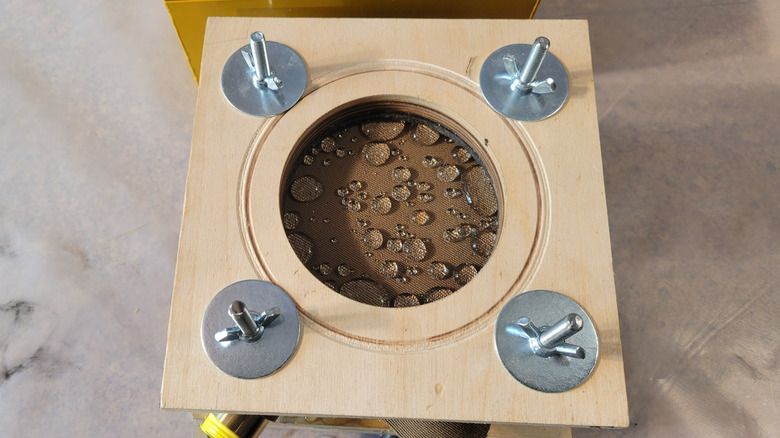
A hydrostatic head tester of either type is laboratory equipment, and well outside of my budget and cleanliness constraints. Fortunately, it's relatively trivial to make a DIY head tester using a hydrostatic pump with a pressure gauge (similar to devices used to recertify a propane tank, and somewhat common in the plumbing field) and a sample-testing assembly. My sample assembly was fabricated using some plywood, a 4-inch PVC cap tapped to accept the pump's output, and a watertight clamping mechanism devised from another bit of plywood, some neoprene, and a handful of threaded rods and matching wingnuts.
The inner diameter of the PVC cap happens to almost perfectly match the standard 100 square centimeter sample size required for head testing, and by clamping in a fabric sample and applying pressure using the pump, you can watch for droplets of water that tell you the point at which the fabric has surrendered its waterproofness. A fully waterproof fabric will resist about 10,000 mm (around 32 feet) of water column ... which is rather more tubing and ceiling height than my workshop has. Thus my use of a pump instead.
These were the initial results on my DIY hydrostatic head tester
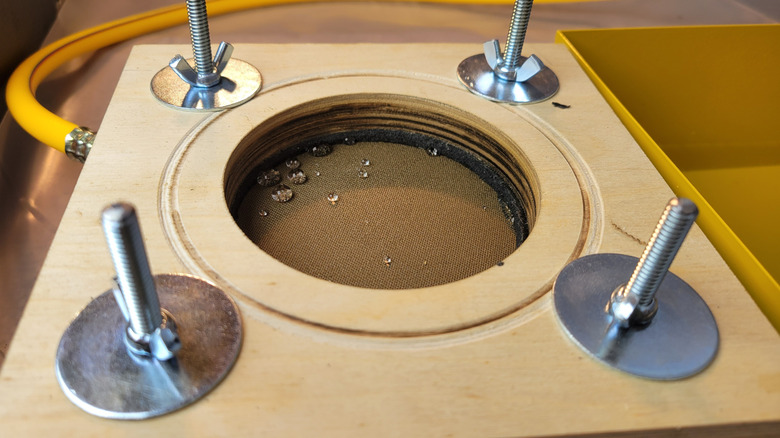
For my pressure testing, I treated two fabric samples — two cotton broadcloths, one that is an outdoor fabric — with two coatings of Crep Protect, and I left two identical samples untreated. I had low expectations for the head testing because, as I understand it, Crep Protect isn't meant to introduce a new waterproof-breathable membrane to treated fabric, but to coat and make hydrophobic whatever fibers or materials are already in place. This is why the company's website notes that mesh cannot be waterproofed using Crep Protect; the open weave will admit water, even if the fibers themselves are waterproof. Both of my samples were broadcloths with relatively tight weaves, so I thought they might resist pressure to some degree once treated.
It takes a substantial amount of pressure to move the gauge's needle off of zero. And, as expected, the untreated fabric started showing drops (three drops is usually the point at which you can say a fabric is no longer waterproof) in profusion immediately. And the treated fabric only resisted slightly longer ... certainly not enough to register on the pump's gauge.
It's important to note that Crep Protect is not necessarily a waterproofing product in the sense of keeping moisture on one side of fabric. Rather, it's designed to make the fabric's fibers themselves hydrophobic and, therefore, temporarily waterproof. Crep says the spray generally lasts for about two weeks. So failing to register on the hydrostatic head test isn't really the result of a product failing, but of my disappointment in finding out that the impossible (turning things truly waterproof for a few bucks) has stayed impossible.
Stepping into a puddle for even more research on Crep Protect spray
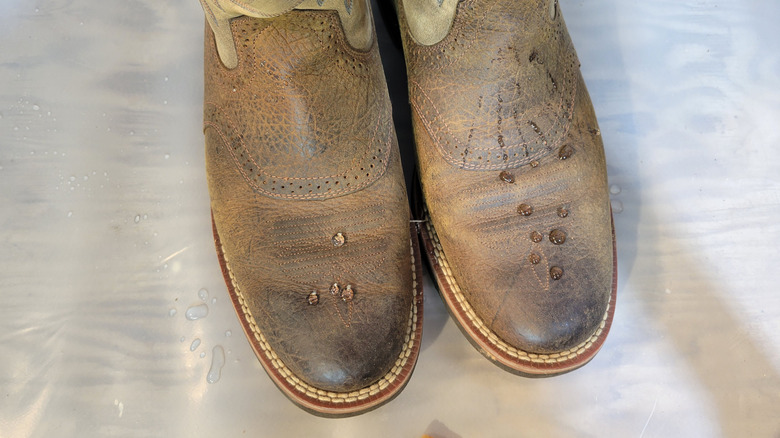
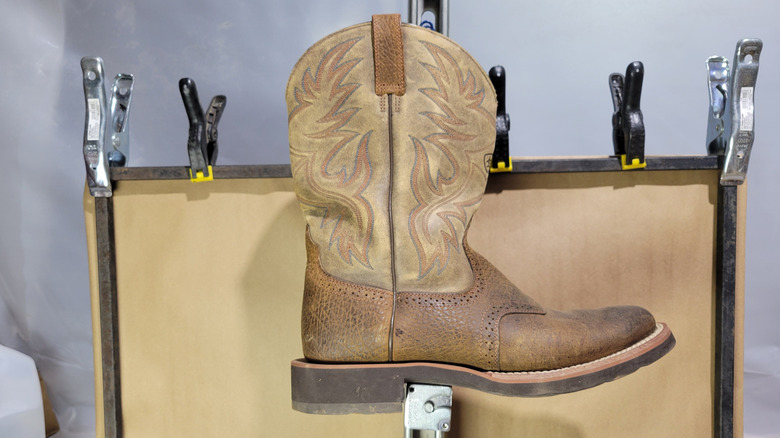
I gathered shoes — some of my own, some of my oldest son's, and some of my daughter's — and conducted a few experiments before deciding that what I really cared about wasn't shoes at all, since I try to buy waterproof work boots and shoes. But, since Crep is a shoe-protectant product, I did test the effect of the spray on a pair of cowboyish work boots of mine, a pair of my Merrell sneakers, a pair of Jordans that my son once lovingly cleaned but doesn't really wear anymore. The boots were treated mostly to see the effect on leather. I treated one of the Merrells and left the other untreated so that I might get something like a fair comparison in a real-world test of the spray's ability to promote water resistance. This I would accomplish by donning the shoes and standing in a puddle of somewhat muddy water.
The mud was incidental — it was the puddle I had handy — but I figured it would make it possible to compare the ease of cleaning of treated versus untreated shoes. What I really wanted to know was whether the spray slowed water down, because I'm almost as averse to sloshy shoes as to squishy gloves. This is a bit subjective, of course, but I did detect a difference of probably 30 seconds or so during which only my Crep-protected foot stayed dry. The mud washed readily off both treated and untreated shoes, probably due to the high compost content and low dirt content of the soil that produced the mud.
Okay, but how does it hold up against condiments and other liquids?
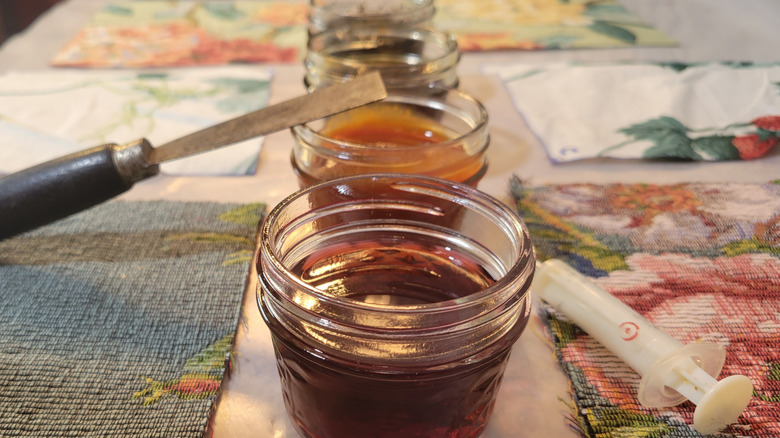
For whatever reason, Crep seems determined to illustrate the stain resistance offered by the Protect spray by having people squirt ketchup on their shoes, then clean them off. It must have to do with eating outdoors (no table to protect your shoes), so I guessed that this must be an artifact of eating hot dogs from street vendors. I decided to continue the tradition, but I added a few other substances to the mix, including: water corrupted with a colorful flavoring, espresso, mud, and, on one fabric, small engine motor oil. I tested six fabrics I have bolts of, for reasons beyond my comprehension. Some are very thin, gauzy fabrics, some broadcloth, and at least one is a heavy-duty floral-printed affair that can only be thought of as couch material.
For each fabric I cut two samples of the same size, and treated one with Crep Protect, most with only one coating and some with two. I exposed both the treated and untreated swatches to the test substances either by spraying them on with a syringe or slathering them on with a scraper. Then — again following the lead of Crep's promotional videos — I rinsed away the substances with around 1 ⅔ cups of water squirted from what you might recognize as a restaurant condiment squeeze bottle. These fabrics were not washed before testing, and a couple showed evidence of sizing, a temporary water-repellant treatment added to some fabrics that's similar to DWR sprays in effect.
Sizing up Crep Protect's performance on treated and untreated fabrics
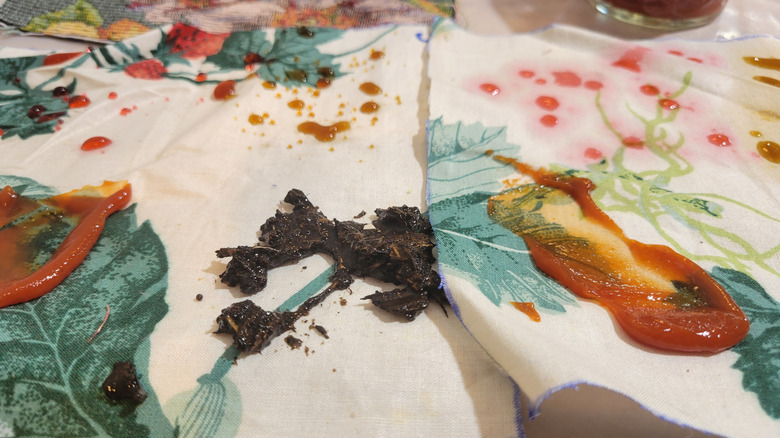
The coffee and flavored water beaded up on these, and on all of the Crep-treated samples, but were absorbed by the other untreated fabrics fairly quickly. The Crep spray seemed to outperform the sizing to some extent, but the difference was not remarkable. This might suggest that you don't need to use Crep Protect on fabrics already treated with sizing, though you must ask yourself how you would know.
The two-treatment samples did notably better than the single-treatment swatches. Sometimes the rinsing processes seemed to drive the stain-causing substances into the single-treatment fabrics, but this effect was less noticeable for fabrics sprayed twice. The mud and ketchup — water-based like the flavored water and espresso — seemed to stain all the fabrics more readily. The mud's makeup probably defeated the spray's effect of causing water to bead up by reducing its surface tension. That might be true of the ketchup as well, but in any event, it seemed to soak in more quickly. In both cases, the untreated fabrics stained far more quickly and thoroughly than the treated ones.
If Crep Protect has any efficacy against oil stains, it did not demonstrate that when confronted with small engine motor oil (unused). It soaked into all samples readily, and seemed particularly vulnerable to being pushed into the fabric fibers by the force of rinsing. The appearance of these samples was effectively, and almost instantly, destroyed by the oil. Don't put motor oil on your upholstery, y'all.
Testing my boots for residue and color changes
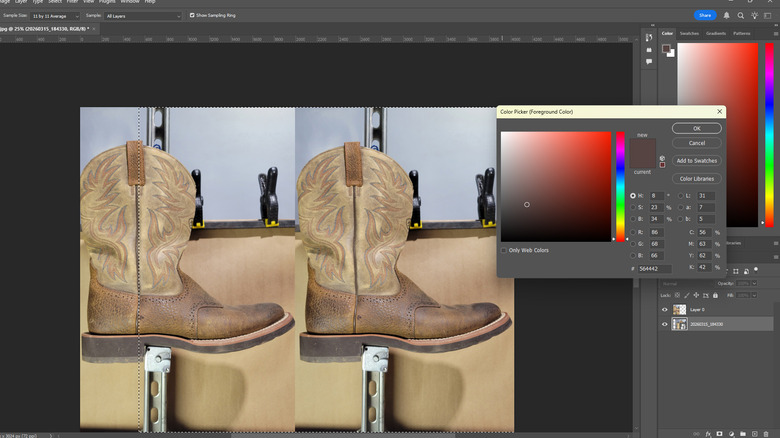
Now to the computer for some high-powered image analysis. I opened the before and after photos of the cowboy boots and fabric samples in Photoshop and compared their colors. All of the photos were shot using identical ambient and studio lighting, as well as the same Samsung Galaxy S21 camera phone.
I didn't know exactly what to expect here. Crep and its fans claim that the spray, properly applied, will not discolor most fabrics, leather, and suede. I instinctively felt that it might make the materials very slightly darker, but I'm not sure I can articulate why ... perhaps just the sense that oil and wax, things often associated with water repellency, tend to darken fabrics. But I had also read that over-application of Crep Protect could lead to a white residue that could be softened and spread around with an additional coating of the Protect spray. So it was possible that the spray wouldn't darken the materials at all, but rather would lighten them a bit.
I found a barely perceptible difference in some fabrics and a slightly more noticeable effect on the cowboy boots. This was borne out by a very slight difference when I sampled the boots' before and after images (averaging 11x11-pixel areas) in Photoshop. The brightness channel in the HSB colorspace showed an average of 59% brightness in the "before" image and 48.75% in the "after" image. The fabrics also showed very small differences, but sometimes lighter and sometimes darker, even within the same sample, which I took to be within the margin of error.
If you can scuff the shoes, you can scuff the protectant
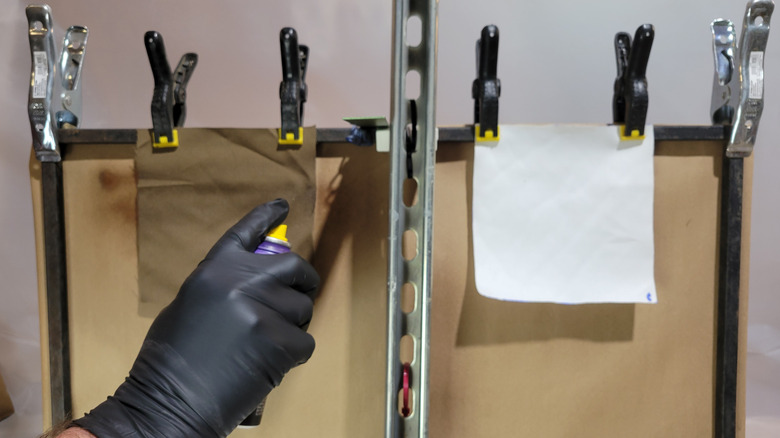
The last thing I wanted to test was not exactly a claim by Crep about the Protect product, but a logical need of my own. It's fine to say that the spray lasts two weeks on average, but of course that means practically nothing in the gloves or on the feet of someone as prone to abusing gloves and shoes as I am. I wanted to know how the spray would fare after the testing to which it had already been put on my fabric samples, plus some intention abrading. The abrading was accomplished by vigorously rubbing half of each fabric sample against a scrap of medium-density fiberboard. (This is, of course, a formal invitation to splinters, so I wore gloves. Untreated gloves, not that it matters.)
I then tested the fabric by dropping water onto it gently with a pipette. My reasoning was that the amount to which water continued to bead on the surface of the fabric would indicate how much of the protection was still in place — some, it turned out, but not all. In both cases, the abraded side formed slightly smaller droplets than the unabraded side. But I didn't notice any seepage through the fabric, which suggested that it was still somewhat protected by the spray ... at least against water from a pipette.
Final conclusions on the Crep Protect spray
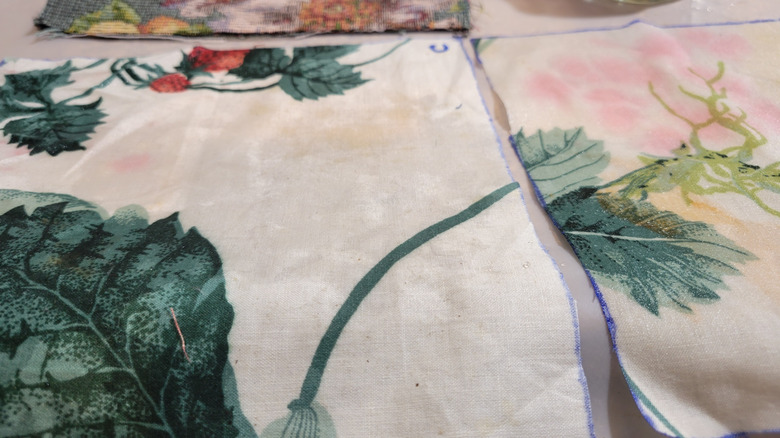
Crep Protect delivers on its promises as a durable water-repellent spray, and there aren't really any grounds on which I can take issue with the product's performance as I experienced and tested it. I do confess, again, to some instinctive disappointment that the spray didn't somehow actually waterproof the tested fabrics ... but that isn't something that Crep claimed, and isn't a reasonable expectation. What the spray does — that is, what it claims to do — it seems to do quite well, and that is making leather and fabrics repel water. The small amount of spray that is left in the cans will be put to good use, probably on gloves. And maybe on the couch where my dog insists on sleeping on cold nights.
One of the things Protect can do is to renew an existing (but failing) waterproofing membrane. I suppose the spray or its mysterious nanotechnology makes use of whatever physical structure remains in, say, a Gore-Tex jacket and is able to waterproof it sufficiently, and Crep says that the spray will maintain the fabric's breathability. This seems promising not only for performance clothing, but also for tents, sunshades, and that sort of thing. I'll probably use the stuff occasionally to keep the dry on one side and the wet on the other of whatever.
Care to see discover how Crep Protect fared against dog poop, a pool, and other extreme testing? Our friends at Extreme Reviews have you covered.