

This Smart DIY Hides Outdoor Electrical Boxes And Creates An Elegant Yard Feature
A couple of eye-catching privacy screens stole our attention on TikTok recently, but these aren't meant to keep your nosy neighbor from checking out your lawn-striping or steak-grilling technique. Instead, the kind of privacy these screens provide might be the most common of all... hiding away unsightly bits that you don't want your family, friends, or neighbors to see. In this case, you're hiding outdoor electrical equipment like your power meter. It turns out that you don't have to stand in your front yard and yell "Holy moly, look at that!" to every passer-by, while pointing away from your electrical service infrastructure and vaguely toward... well, nothing, probably.
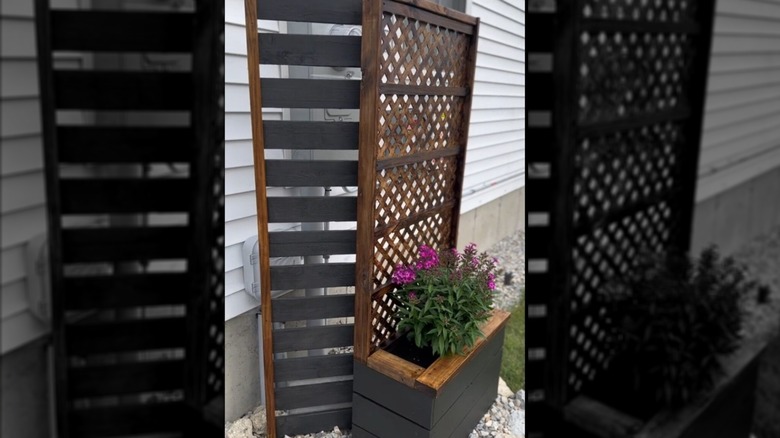
There are a few of these equipment screens out there, and most involve that friend of trellis-climbing plants and enabler of under-deck storage, the lattice panel. TikTokker @dad_life_diys took his a little further and added some very distinguished horizontal slats made from pallet wood, along with a planter. This screen sits at the corner of his house and hides his meter base, buried service entrance cables, and a cable or telecom junction box. It is made of two panels — one lattice and one slats — at a 45-degree angle to each other. The lattice panel has the planter at its base, which is sensible since lattice gives plants something to cling onto.
The planter also gives screens something to cling onto, and @dad_life_diys probably didn't need any other support for his screen panels since they're attached to a weighty planter. Without the planter, it's probably best to drive a post or two to support the panels, or attach them to your house, or both.
Hiding the equipment and the screen itself
Hang on, did we say these screens were eye-catching? That's not quite right, because in some ways eye-catching is exactly the opposite of what you want. That's because your screen can't completely obscure electrical equipment from every angle, for reasons we will explain below. So a dramatic — and particularly out-of-place-looking — privacy screen is likely to draw more attention to the equipment and the fact that you're hiding it, not less. The trick is usually to make it look like your screen belongs, that it fits your home's vibe, or at least doesn't stand out. And, just as there are lots of creative ways to hide an indoor breaker box, there are many ways to hide meters and other outdoor electrical equipment.
TikTokker Victoria Senger (@filmedwithvictoria) found a genius way to create a lattice equipment screen that will suit just about any home, provide more privacy, and look perfectly seamless. She manages this by attaching what looks like artificial boxwood roll panels to the backs of standard lattice panels, creating a screen that truly undermines prying eyes. Meanwhile, the greenery backdrop creates the impression that whatever's behind the screen is natural-looking and agreeable. Senger has her screen at a back corner of her house, and it appears to already be mostly concealed from the street by a chimney, so she's probably hiding the electrical gizmos from backyard guests.
Incidentally, there are a lot of options for a more bespoke version of Senger's screen. There are decorative screen panels, metal privacy screens, lattice with faux greenery already covering it, and many varieties of greenery you could integrate.
Is hiding electrical equipment a code violation?
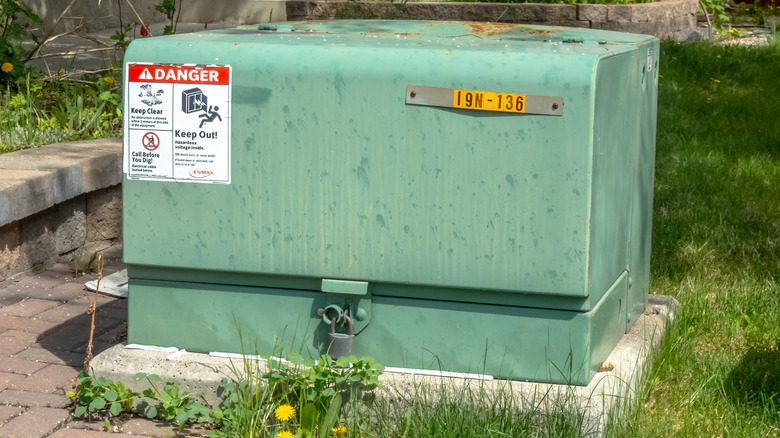
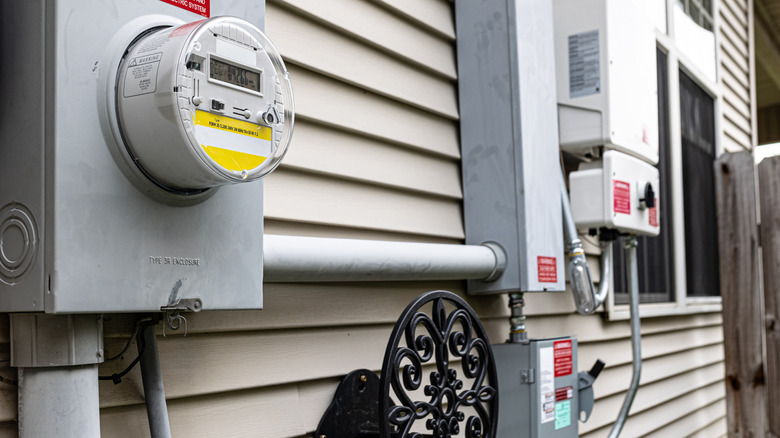
Now, you might be trying to play down one of those freestanding, pad-mounted transformers that are usually hidden with landscaping or a meter base attached to the exterior of your home. Even the simplest meter base typically has various things attached to it: the meter itself; a weather head and mast for aerial cables or conduit for buried service entry cables; a main disconnect that lets you shut your power off before your breaker box; and perhaps a circuit breaker panel or sub-panel. While it's no surprise you'd want to hide all these components, you still need to be careful. Covering electrical equipment can be dangerous, but with a bit of attention to a few rules, it's pretty easy to make your equipment screen NEC-compliant. This is especially necessary for company-owned equipment like transformers and meter bases, which require certain clearances for working space and — in the case of transformers — for cooling.
Power companies aren't always fans of attempts to hide electrical equipment, with placement rules usually supported by building codes. Typically, according to the NEC, equipment should have 3 to 5 feet of working space on one or more sides, depending on the circumstances. The working area should also be as wide as the equipment or 30 inches, whichever is larger, and a clear space from the ground to the equipment's height or 6.5 feet, whichever is larger. Because there are a few other rules specific to particular outdoor equipment, it's worth a read before you get started, and a call to your local code compliance or zoning office.