

Light Up Your Indoor Space With This Creative DIY Using An Old Cooking Pot
We may receive a commission on purchases made from links.
One of the great mysteries of the universe is why more people don't make their own light fixtures. It's easy, you can make a lamp out of almost anything, and all the electrical stuff is done for you if you choose to buy a lamp kit.
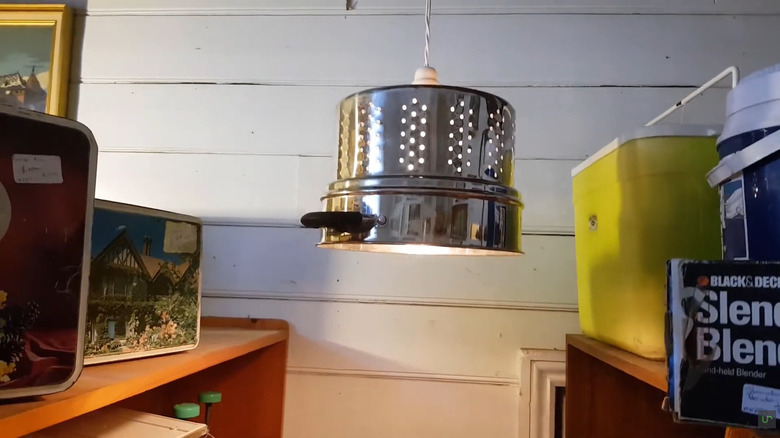
For this project, we'll repurpose an old cooking pot as a pendant lamp, which means you'll need a pendant light kit — like this Edison Retro Pendant. You can use just about any pot you want — or, more to the point, no longer want — as long as you can put a large hole through it. That said, there are a couple of practical matters to remember when choosing one. First, a symmetrical pot will hang straighter than one with a long metal handle sticking out of one side. Second, an aluminum pot will be much easier to work with, since the softer metal is easier to cut and drill into.
A note about bulbs: You're probably using LEDs for this project, but if you have a storehouse of inefficient incandescent bulbs somewhere, note that your pot might get hot near the bulb. This is unlikely to be dangerous unless the pot is somehow enclosed, but it would still be safer to stick with LEDs.
Turning your pot into a lampshade
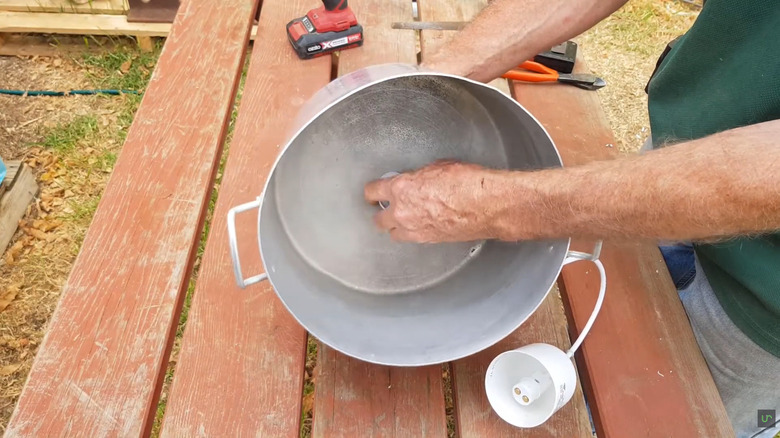
To begin, you'll need to find the center of your pot. There are many ways to do this, but the easiest here is to use the two chords method. You'll need a flat, L-shaped framing square and two colors of permanent marker (which should come off with rubbing alcohol). Using your square as a straight edge, use the first colored pen to draw two straight, non-intersecting main lines across the bottom of the pot, touching the circumference of the pot at two edges. Adjust the position of the square so that the lines are lengths that can be easily divided by two. Then, from the midpoint of each main line, draw a perpendicular line toward the other main line. These lines should intersect in the center of your pot. There's a fair chance something will be off, however, so switch colors and do it again to verify your finding.
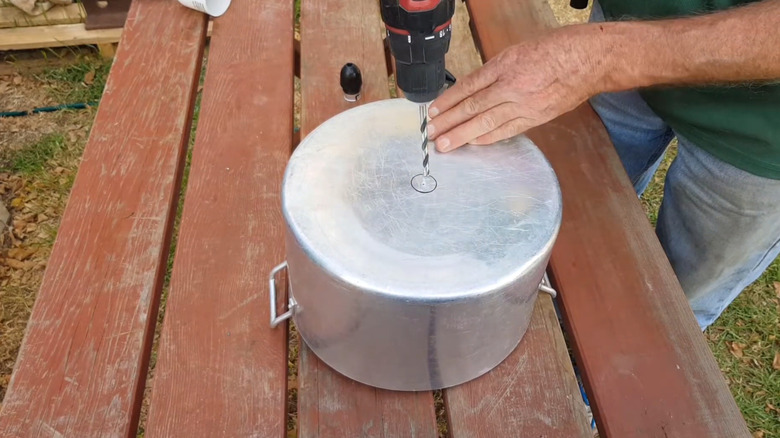
You have some options when it comes to putting the hole in the bottom of your pot. You can do as The Ultimate Recycler did on YouTube and use a metal-rated drill bit to make a lot of small holes, then clean it up with side cutters — or you can use a metal-rated hole saw. Cutting stainless steel can be challenging, and you'll probably need a tungsten carbide-tipped hole saw to do so. Also, make sure to use sandpaper or a file to smooth the metal around the hole where your light kit will be inserted; this will ensure that there's as little chance as possible of the metal cutting into the lamp kit. Once you have the hole cleaned up, all that's left to do is attach your pendant light kit as per the package directions.
Bringing your hanging light down to earth
Grounding is a serious matter when working on a project like this one. If there's any opportunity at all for the pot to come into contact with a broken wire or any metal part of the pendant light kit assembly, you must use a grounded connection to your home's wiring, and you should always attach the ground to the pot. Luckily, the materials in pendant light kits are usually non-conductive ... but that's only if they aren't damaged by the sharp metal of a swinging pot. Be sure that your light is properly wired and, if it's a plug-in rather than a hard-wired light, check that the plug is polarized — that is, that one prong is wider than the other.
DIY plug-in light kits tend to not be grounded, but hard-wired pendant lights often are. So, another option is to thrift a cheap grounded pendant light and scavenge whatever components you need, including the ground wire. Then, you'll have to connect the ground wires in your light fixtures.
Again, the need for grounding is extremely unlikely, just as it is with your washing machine or your desk lamp. The odds are extremely long of accidentally electrifying a pot that has cut through the insulation in the light kit, subsequently been hung from the ceiling, and somehow been touched by a person before its circuit breaker is triggered. Then again, the odds of most accidents are long — but that doesn't mean you shouldn't protect yourself anyway.