

Cut A Bolt That's Too Long In Minutes With This Drill Trick
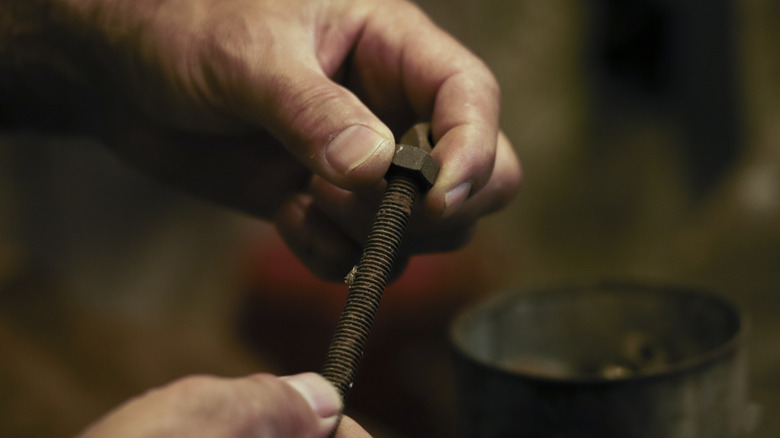
Bolts can be frustrating. After taking the trouble to measure a bolt's thread size and making sure you have the right nut, it's still possible to end up with a bolt that's too long for its job. Sometimes, that's just fine, and an overlong bolt works without creating any difficulties. But often, the additional length interferes with something on the other side, prevents you from adding a nut on the threaded end, or might simply not have enough room to be installed at all.
The traditional solution is to cut the bolt down to size with a hacksaw, but a better solution is to chuck the threaded end of the bolt into a drill and hold it against a hacksaw blade while the drill motor does the "sawing" work for you, saving you time and energy. Sawing through from one side of a bolt to the other with a hacksaw tends to damage the bolt so that it can't be used without repair. The drill method, on the other hand, is easier and cuts around the bolt from the outside in.
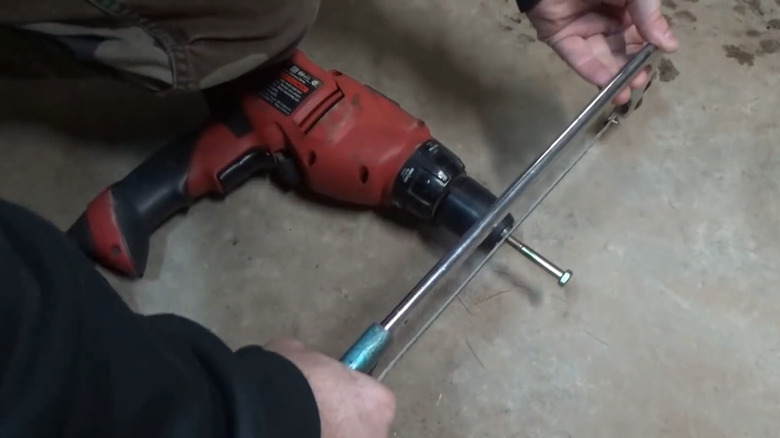
Lock your drill into its "on" position with your long bolt securely in the chuck, and lay the drill on its side, holding it steady. While most types of hacksaw blades will work, it's best to apply the cutting edge of an 18-24 TPI bimetal hacksaw blade to the bolt at the point where you want to cut it, as it will work best with the metal. Stop short of cutting fully through the bolt, and remove the tip by bending it back and forth with pliers. This keeps your high-speed drill from flinging the (possibly very hot) bolt across the room in a random direction.
Some considerations to be on the lookout for
This all sounds very easy, and it is. However, there are, of course, always practical matters and safety issues to be aware of when you're using a power tool, a blade, or both. Obviously, your drill chuck must accommodate the size of the bolt you want to shorten. Most drills have either ⅜- or ½-inch chucks.
The orientations of your drill and hacksaw matter quite a lot as well. Most hacksaw blades are unidirectional and cut on the push stroke, so be sure the drill is turning in the direction that is against the blade's teeth. For a drill in forward, this would mean holding the hacksaw handle on the right-hand side of the drill (from the user's point of view) with the handle down, in the same position as the drill's handle. This orientation will also cause the blade to follow the threads and stop against the jaws of the chuck, resulting in a cleaner cut and less risk of causing damage that must be repaired before you can thread a nut onto the bolt or the bolt into a threaded hole.
Snugging two nuts against each other on the threads can also give your saw blade a surface to ride against, ensuring a consistently placed cut where the jaws can't reach. Using a drill press rather than a standard power drill simplifies this process considerably, in that you free up a hand to help steady and guide the blade, and it's probably a little safer as well. This can be particularly important with hard grade 8 bolts, which can be time-consuming to cut through.
Dealing with thread damage after cutting a bolt
While the circular cutting motion of the drill method minimizes the risk of damaging your bolt, it's still entirely possible to find yourself in the position of having to do additional work on the bolt before you can use it. Cutting metal this way is much like drilling through metal, which generates heat that can dull your blade, so use a few drops of a lubricant like thread-cutting oil, applied directly to the blade when cutting.
Manually sawing with a hacksaw tends to leave a bur in exactly the position to prevent a nut from being threaded onto the bolt. Cutting from the outside of the bolt inward instead is a better approach for minimizing damage. To further improve your odds, use the snugged nut guide mentioned above. Removing the nut after cutting will tend to clear the threads in a direction that leaves the bolt ready for another nut to be screwed on.
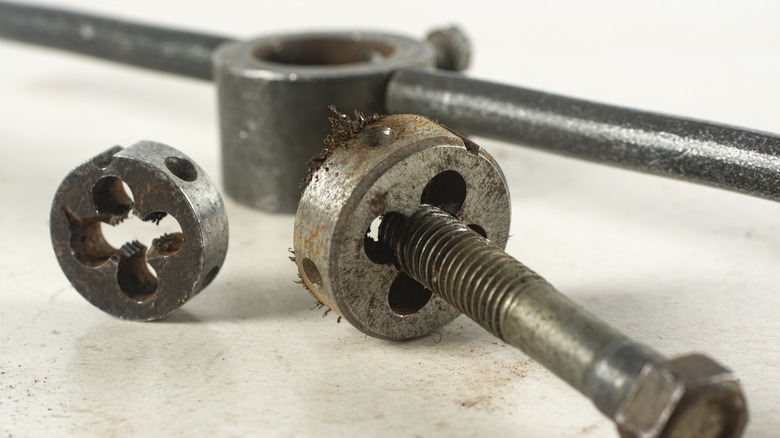
If you didn't screw a nut on before cutting, it's sometimes possible to screw on and then remove a nut and restore the threads' functionality. This mimics the re-threading action of tools like "thread-chaser" cleanup kits, which, like thread-cutting dies, can be used to re-thread a bolt. You can also use a thread file, which has various cutting edges that match various threads, like a threading die turned inside-out. Usually, though, it's sufficient to manually file the tip of the bolt from the outside in with a flat file or directly clean up a thread root using a needle file with an appropriate profile.