

Turn Old Wood Pallets Into A Backyard Shed That Changes Your Outdoor Space
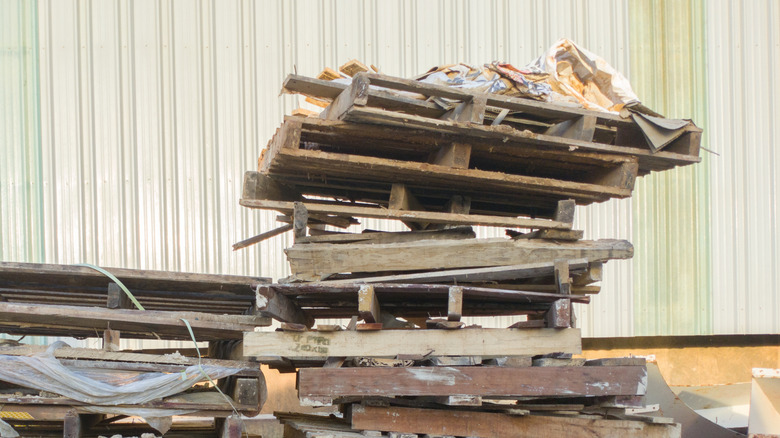
Let's be honest: Once you've seen enough pallet build fails, a certain amount of cynicism creeps in. You see a pallet backyard shed, for example, and immediately start looking for the algorithm-friendly keywords that might be taking priority over the practical usefulness of the thing. But every now and then you get a nice surprise ... a table or bench or DIY garden shed that's done well but is still authentically a pallet project made from scrap wood that doesn't require $22,000 worth of Festool power tools and a structural engineer. This is what micro-influencer @A_moura has managed to do, as shown in her three-part TikTok series — a shed that's functional and affordable and, perhaps most importantly, do-able.
A_moura is the crafty type who isn't intimidated by living off-grid, breaking mirrors into stylish shapes, or even doing carpentry with a jigsaw. But, most impressively, she's undaunted by the challenges of working with pallets. Her backyard shed is made with 14 or so pallets, cut to accommodate the roof slope before they were raised into place. The walls use pallets in a way similar to the structural insulated panels (SIPs) found in some modern buildings.
The pallet panels get their structural support from the 4x4 corner posts they're secured to with metal L-brackets as well as from each other via scrap lengths of pallet deckboard used to hold the pallets in place horizontally and vertically. The structure sits atop a poured concrete floor and has a metal roof.
The brilliance of the build
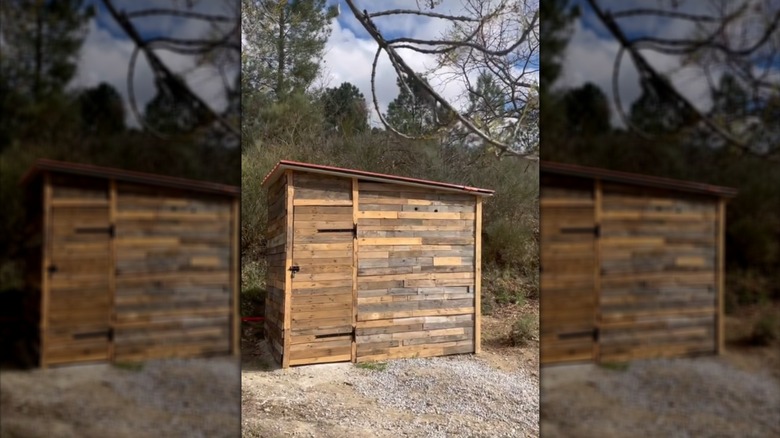
There's a lot to like about this pallet-wood shed, stemming from good, straightforward choices made during the build and its planning. The scrap boards, for example, work like SIP splines to ensure the pallets are aligned to each other. Anywhere but the Portuguese countryside, the mix-and-matched pallet scraps used as siding might look like a halfhearted YouTube set or a wood pallet accent wall. But in @A_moura's build, it looks like what it is ... a shed built with care and no little precision.
A good shed is a dry shed, and the roof looks like tongue-and-groove decking topped with corrugated metal ... perfectly sufficient to its job as a shed roof. The exterior is varnished for weatherproofing, and @A_moura mentions in the comments that expanding foam was later used to insulate and provide for a drier interior. (She also mentions a second concrete pour to smooth out the floor.)
The craft applied to this build is obvious in how tightly the wall covering boards are fitted together and in the assembly of the shed's door. A few construction details make the door much stronger than it otherwise might have been. Its vertical stiles are notched for the horizontal rails for more mechanical support than any sort of edge-joining could provide, and she adds diagonal bracing for extra support. She drilled holes at the vertical joints between the rails and stiles and glued in dowels, which might provide some slight improvement in strength because of the larger gluing area.
Pallet shed pitfalls to avoid
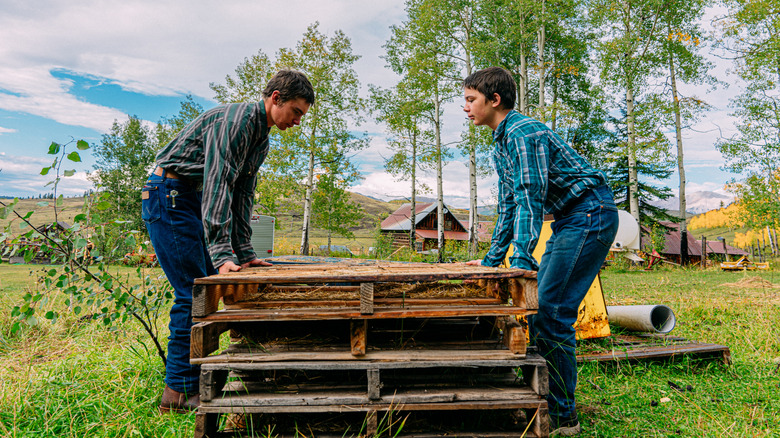
Pallets are often difficult to work with and can even be hazardous. Between 2014 and 2018, PennState Extension found more than 30,000 cases of pallet-related injury, many from deconstructing pallets. Pallets use screw-shank nails that are difficult to remove, and many pallets are just plain heavy — especially heavy-duty block pallets. Some pallets are marked to indicate that they've been chemically treated, and pallets with sulfuryl fluoride and, especially, methyl bromide should be avoided. Since scraps of unknown provenance might come from pallets treated with highly toxic methyl bromide, @A_moura's use of broken pallet scraps for the exterior wall probably isn't ideal.
There are a couple of other things to be on the lookout for when building a pallet shed. One is airflow: @A_moura's construction is unusually tight for a pallet build, which can lead to airflow problems and mold growth ... especially when paired with the expanding foam insulation. Any wood in contact with the ground or concrete should be rated for ground contact to avoid rot, and pallet wood isn't.
Finally, remember that your city or county's building, zoning, or code enforcement departments have as many reasons to require building permits as there are types of backyard storage and garden sheds, and homeowners associations (HOAs) don't even need a reason to impose limits. The need for a permit can be based on square footage, height, the inclusion of utilities, proximity to a fence or property line, or its intended function. If @A_moura were building in certain places in the U.S., for example, the permanence of the concrete foundation would likely trigger the need for a permit.