

Why You Should Attract Owls To Your Yard — And How To Do It
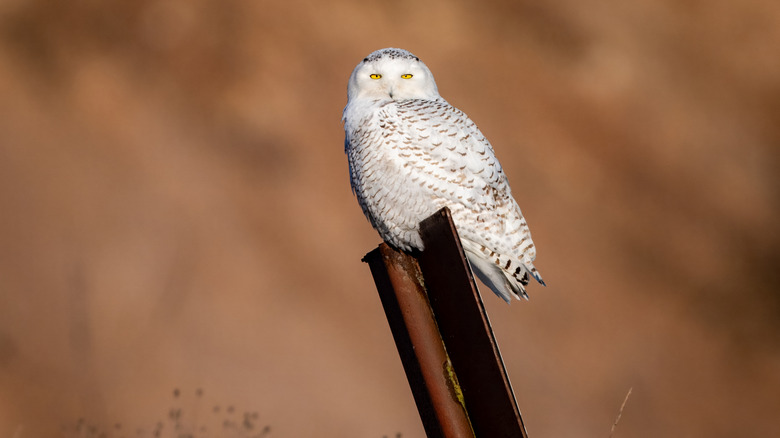
Take one good look at an owl, and you'll probably see why they're described in the lore of many world cultures as grave and powerful creatures, often tending toward dark and deadly prophecies and portents. But what owls are exceptionally good at is really much simpler and less intimidating: They're really good at being birds and are supernatural in the sense of being super at the things they naturally do — silently stalking their prey in the dark, for example. This skill means they're quite good at being mousers, leading some to conclude that owls are a great form of natural pest control. Getting rid of owls (to protect other birds, for example) is easy enough. But enlisting an owl is more challenging, like hiring a CEO or a preacher. If you want to keep them around, you need to make everything suit their preferences ... and free housing doesn't hurt.
Like some CEOs and more than a few pastors, owls often look as if they're only just tolerating you and that it might not last much longer. Unlike CEOs and preachers, owls are very quiet. That makes it easier to hunt voles, mice, rats, gophers, and insects, so they're particularly valuable on farms where a family of owls can consume around 10,000 rodents during a single breeding season. A study by the University of California found they can do this at about 4 percent of the cost of trapping pests like mice, gophers, and voles.
How to attract owls
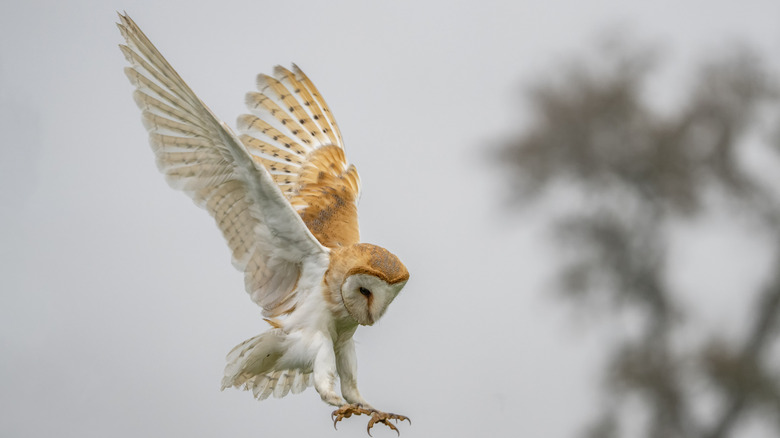
The first step in attracting owls to your property is to figure out which species you're likely to have around. While some of the 19 North American owl species are threatened or even endangered, others – screech-owls and barred owls, for example — are fairly common. Use a resource like the Owl Research Institute's identification guide to familiarize yourself with the calls of different species and their geographical ranges. Once you've figured out which owl to attract, you must discover if you can provide them a safe place to do their thing. The key to keeping owls safe is distancing them from highways, pesticide-laden farmlands, and anyone who's using rodenticides to control pests, unintentionally causing the secondary poisoning of owls. If you can't keep the birds safe, you can always try attaching a plastic owl to your roof.
When trying to draw owls to your property, emulate their preferred habitat. Leave trees, even dead ones, standing if possible, and don't prune horizontal branches that might be used as roosts. Turn off outdoor lights and limit noise after dark. Minimize landscaping and leave things as natural as you can. Also, keep any pets indoors at night; cats can prey on young and small owls, and large owls can prey on small dogs and cats.
Many experts say it's important to attract rodents to your property (by creating a brush pile habitat, for example) as a food source for owls, but this is obviously not an ideal approach if your goal is getting rid of mice. If you're trying to control pests, chances are you already have a food source for owls.
Building an owl nesting box
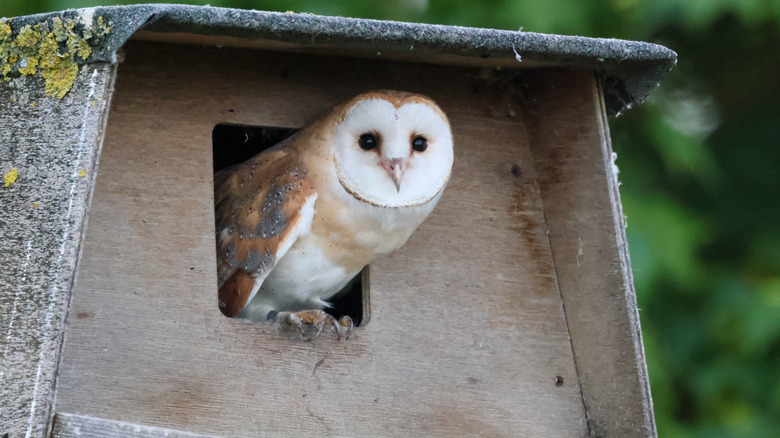
The fact that owls are really good at being birds doesn't mean they're perfect at it. For example, they aren't generally great at building nests. During breeding season (mating usually begins in late winter), many owls take over the abandoned nests of other bird species or use hollowed-out tree cavities for their homes. So, if you have cavity-nesting owls (or barn owls) in your area, your best bet is to build a nest box for them. Nesting boxes, which often double as roosts for the feathered predators, vary by size and placement according to the species you're trying to attract. In general, you'll want to choose a location that's 10-20 feet from the ground, has a flight approach that's clear of obstacles like tree branches, and can be situated so that a nest's opening faces away from the dominant wind direction in your area.
While things like the size of the box, distance from the ground, and entrance hole size will vary by species, there are some rules of thumb that apply to most nesting boxes. Use around ¾-inch wood for better insulation, and interior walls should be rough (or grooved with shallow saw cuts) to help young owls when climbing around inside. A slanted, overhanging roof helps keep the interior warm and dry, and an extended overhang can discourage predators like squirrels.
Additionally, the Wildlife Center of Virginia offers guidance on nest boxes and links to sources for box plans. And Cornell University's NestWatch is always a good resource for bird nesting plans and information.