

Say Goodbye To Ugly Washer Hookups And Hello To Extra Storage With This Clever DIY
We may receive a commission on purchases made from links.
This is not a hot take: The outlet box through which hot and cold water and wastewater flow to and from your washing machine is a uniquely hideous blight in a room dedicated to cleanliness and order. (Many people with non-influencer laundry rooms are chuckling at "cleanliness and order," no doubt.) This sort of mechanical mess is usually hidden away in a cabinet, inside your walls, or behind a door. Fortunately, TikTok home design influencer @anewgo has a simple and effective solution for you: Turn it into a storage shelf.
@anewgo This scrappy little solution I came up with to hide our laundry hookups turned out to be one of my favorite DIYs that I've done! It just feels more polished in here and it was cheap and easy to do! For those who are curious, YES, the washing machine lid opens all the way without removing the shelf. Credit: @homewithjanny #laundryroom #laundry #newconstruction #laundryroominspo #newhome
Additional laundry room storage and organization is always welcome, and this shelf provides quite a bit. The TikTok creator describes it as a "scrappy little solution" to the laundry hookup-hiding problem. The project requires only four pieces, not including screws, wall anchors, and the like. The "scrappy" designation might be there to suggest you can do much of this project with scrap wood left over from previous projects.
The shelf is about the width of the washer and dryer combined. A vertical board attached to the bottom of the shelf parallel to the wall is used as an apron to conceal the lower half of the washing machine outlet box where the washing machine's drain standpipe connects. The top half of the outlet box is concealed by a functional and decorative basket which she placed on the shelf.
The secrets of successful shelf-shrouding
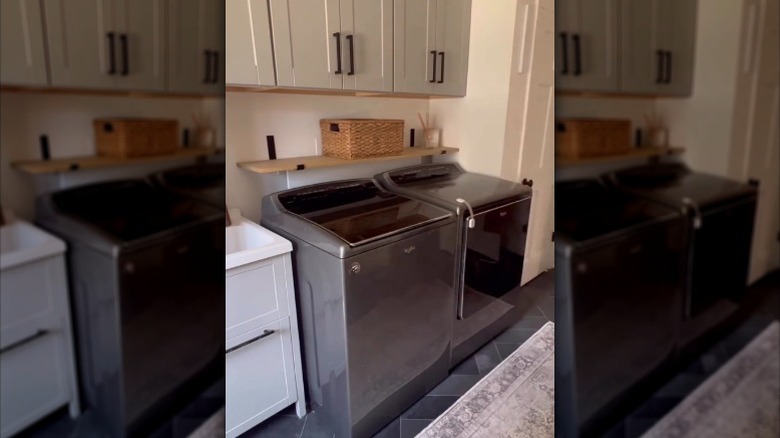
Even simple projects can be done better or worse, and this laundry hookup shelf is no exception. Although exact lengths will depend on your specific situation, there are some general guidelines to follow if you want to imitate the shelf's design. First, while the apron only needs to be wide enough to conceal the washing machine outlet box, it makes sense to follow the video's lead and make it about as wide as the distance between the two brackets. This will allow you to automatically and easily position it every time and will cover as much backwall as possible while also holding the shelf in place.
The shelf is supported by two brackets with an upturned, 90-degree angle at the end to hold the shelf without fasteners. This makes it possible to remove the shelf quickly. You can find similar heavy duty shelf brackets online or at your local home improvement store. For a long shelf, or one holding particularly heavy items, you might need more than two brackets.
Since the apron's joint with the shelf will only ever support the weight of the apron itself, gluing and clamping the boards together should be sufficiently durable. Because of the instability of edge-butted joints like this, the glue is pretty much non-negotiable. The video shows a natural wood shelf and a white apron, but it's sensible to paint the apron to match the wall paint behind your own washer and dryer.
Mounting the washing machine shelf
Mounting the shelf and its brackets deserves a few moments' attention, as well. Water is supplied to washing machines via flexible supply hoses in case the washer moves a little when spinning clothes. That means the hoses themselves will also be moving occasionally, so be sure to provide a little clearance between the shelf components and the water lines. This will minimize vibration and friction that might cause whatever's on the shelf to relocate unexpectedly to the floor behind your laundry machines, or worse. Also make sure your shelf doesn't interfere with the ability of a top-loading laundry machine (if you have one) to open fully. Note that poor clearance might interfere with your ability to get your washer and dryer closer to the wall, should you want to.
There are a few relatively minor code issues to keep an eye on, as well. Typical plumbing codes require that waste lines, slip-joint connections, and air admittance valves (AAVs, which are an alternative to tying drains into your home's plumbing vent system) remain accessible at all times for inspection and cleaning. So, your shelf assembly needs to be quickly and easily removable, which his design excels at.