

2 Easy Tips To Make Your Cramped Bedroom Feel Much More Spacious
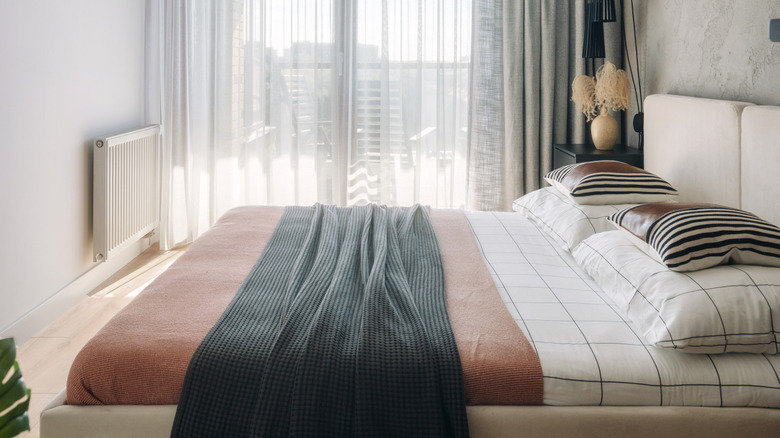
Not everyone is lucky enough to have a bedroom with room to spare — many of us are doing our best to make smaller spaces work. But just because your bedroom is undersized doesn't mean it can't be both functional and stylish. I'm here to share, as an interior designer, two simple tips to make your small bedroom live large (and look it too).
In my experience, one thing that often makes tiny spaces feel claustrophobic is filling a room with too much small-scale furniture. Logically, it may seem like an undersized space needs undersized furniture, but all this does is highlight your room's size. Additionally, the unfortunate reality is that people often end up purchasing many little pieces to fill up space. The result feels cluttered, visually distracting, and unfortunately still small. So while it may sound counterintuitive, one of the best ways to counteract this is to avoid undersizing your pieces and aim for function. Being conscious of furniture scale makes all the difference.
The other issue I see time and again is when people forget to take advantage of vertical space, leaving the bedroom looking squatty and underwhelming because their eyes stop traveling well before the ceiling. This can be remedied by drawing the eyes upward with visual interest, as well as keeping them moving by avoiding choppiness and visual barriers.
Both of these are accomplished with tall design elements and paint tricks (for those able to apply paint). Without further ado, let me break down all of the — mostly renter-friendly — ways to properly scale your furniture to avoid visual clutter, and how to use vertically-oriented design elements to make a space feel grand.
Don't skimp on furniture scale and avoid overcrowding a small bedroom
A large rug is a great place to begin making a small bedroom feel bigger, as it will unite the space. Floating an undersized rug is likely to make the room feel choppy, and therefore tinier. In contrast, a large rug that spans most of the room will establish a more spacious feel from the ground up.
The bed is next, and while you want to allow proper passage around it, you also don't want to shy away from using queen, king, or California king sizes. In fact, as long as you have about 36 inches around all sides (you can go as low as 24 inches on one side if you can make up for it on the other), the bed will feel right at home and the room will give off an impression of spaciousness — it's obviously large enough to comfortably fit a big bed! Also, unless it's a kid's room, avoid shoving your bed against the side walls whenever possible, opting instead for the largest bed you can properly float for a roomier, open vibe.
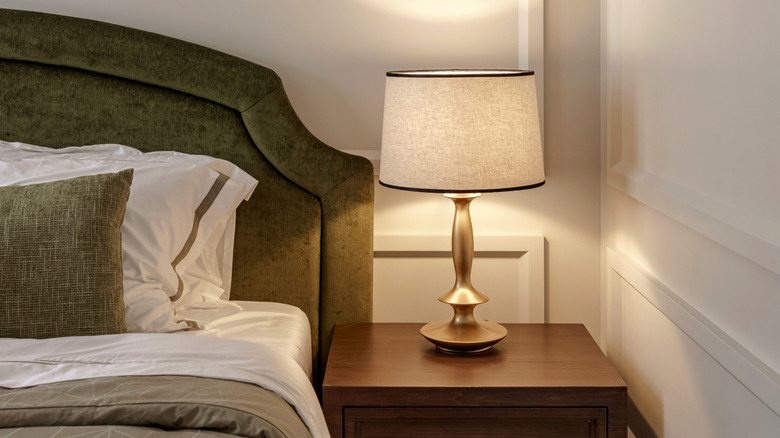
Flank the bed with substantial nightstands (as large as possible, for a seamless built-in effect that expands the room's visual size), which will give you essential storage as well as anchor that cozy, nested feeling. If you have room for a dresser while maintaining clearances around the bed, fantastic. But if you don't, consider a double-duty piece like a storage bed, or nightstands with drawers, rather than creating an overstuffed, cluttered space with small items that ultimately won't get the job done.
Draw the eyes up to give an impression of height in a small bedroom
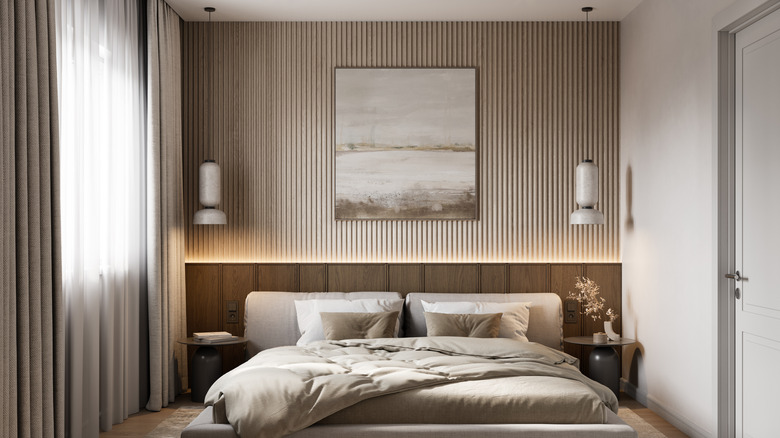
Another issue that plagues small bedrooms is that even average height ceilings feel low. The trick to creating a spacious vibe is to draw the eyes up and create a vertical visual impact. A great way to do this is to install floor-to-ceiling drapery. On top of providing a cozy softness and texture, that vertical line also gives the impression that the ceilings are taller than they actually are.
Install drapes roughly 6 inches from the ceiling (give or take, depending on your window height and trim) to maximize this effect. Another trick I love is to showcase hanging pendants to draw the eye up, or wall-mounted sconces to leave nightstands feeling uncluttered. Even if they're plug-ins for renters, the extra height of the light and the open space below helps everything feel more spacious. This works particularly well with low sloped ceilings, too.
Lastly, to blur the hard, confining lines of the walls, I love using a color-drenching effect with a muted earth tone paint in a small bedroom. By painting the walls, trim, and ceiling all the same soothing, subtle hue (light, medium, or moody — your choice!), it creates a restful space that envelopes you and helps to remove the visual ceiling in the bedroom. It lets the eye keep moving without hard visual stopping points, so the room feels more expansive.
There you have it — by properly scaling the size of your furniture and drawing the eyes up to give the illusion of more height, you can easily make a small bedroom feel roomy and chic.