

A Popular Kitchen Style Julia Child Always Strayed Away From
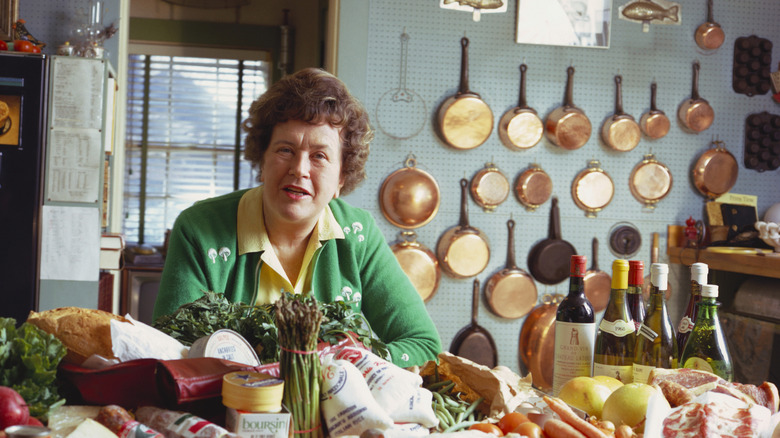
Julia Child's kitchen — perhaps one of America's most famous kitchens — was so out of step with the country's shiny, uncluttered, efficient kitchen design sensibility that it's easy to misunderstand what she was trying to do in that dense, chaotic, beautiful 20-by-14-foot space. Child's house at 103 Irving Street in Cambridge, Massachusetts, actually featured her ninth kitchen, and the one in which she cooked for her husband, for television cameras, and for culinary luminaries like M.F.K. Fisher and James Beard. Designed by her husband, Paul Child, the heart of their home stood in sharp contrast to sleek, modern kitchen styles throughout the 40 years Child lived on Irving Street.
"People always expect me to have a decorator's kitchen, but I wanted a kitchen for cooking," Child told "Boston Magazine." Real life happened around her kitchen table. It was a space for gathering, talking, and enjoying food. "We intended to make it both practical and beautiful, a working laboratory as well as a living and dining room," Child said of her iconic kitchen. In the process, Julia and Paul Child rejected the streamlined and uncluttered, but this was less of a reaction against popular kitchen design than a positive affirmation of what Child wanted in a kitchen.
A home kitchen for a cook, not a glamorous chef
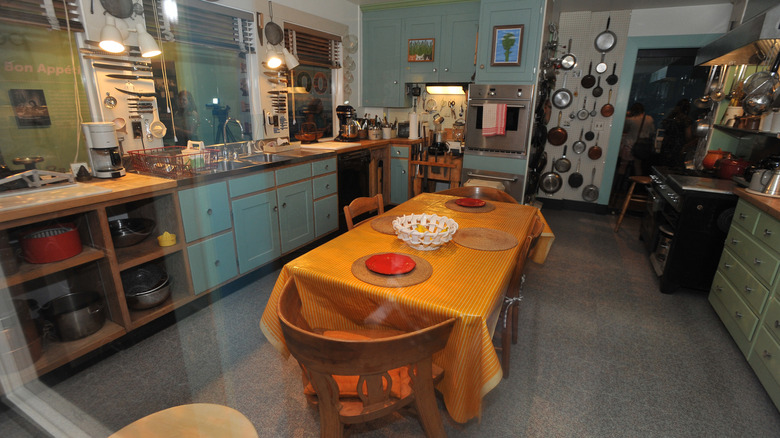
Julia Child's kitchen was not glamorous, in the same way that some have argued that she was not herself a chef. What did Child need with glamor, anyway? She was arguably the most famous cook in the world, and she filmed four TV shows in her home kitchen. Child was certainly not averse to any modern amenity that actually made her cooking better. She just didn't bother with the shine of polished Formica countertops, the sleek look of steel cabinets, oversized kitchen islands, or the strange pretense that no cooking happens in modern gourmet kitchens.
But her kitchen was not (yet) a museum piece, nor was it a monument to old ways of doing things. As "Provence, 1970" author Luke Barr put it, "Child was ready to turn the page on the retrograde attitudes and old-fashioned ideas." If a newfangled appliance or single-purpose gadget met with her approval, Child didn't hesitate to incorporate it into her kitchen. She loved to use a food processor and owned many electric appliances, including a microwave. Most of her appliances, like most of everything else, stayed within reach on her countertops. "Since we rejoice in the shapes of tools, cooking utensils become decorative objects, all carefully orchestrated by Paul, from pots and pot lids to skillets, trivets and flan rings," Child wrote in Architectural Digest Celebrity Homes. Because Julia Child considered her kitchenware objects of great beauty, she made no attempt to store most things out of sight.
She didn't hide her tools away, but she had a junk drawer
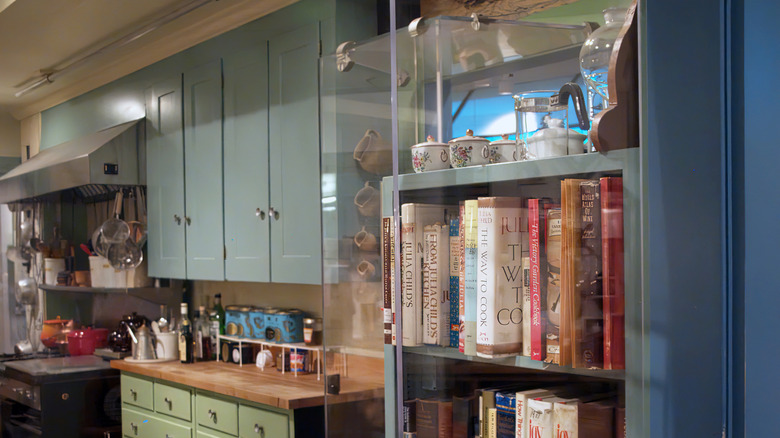
Julia Child's kitchen featured copper and cast-iron pans hung on a pegboard, an endless array of knives on magnetic holders, and a built-in bookcase given equal presence to her refrigerator. Paula J. Johnson, a historian at the Smithsonian National Museum of American History, described her first visit to Irving Street in her book "Julia Child's Kitchen," saying, "...the kitchen itself was practically alive with things." John Ota, author of "The Kitchen," said Child's kitchen was "the exact opposite of the white, clean, austere kitchens of today, where everything is hidden away behind cupboard doors."
If Child's preferences conflicted with the hide-everything trend of her day (and of today), it's not because she valued chaos. The TV chef told the "New York Times Magazine" in 1976, "...one must make a careful plan for this kind of arrangement, or the kitchen will look like a junk shop." For Child, organization meant being able to put her hands on what she needed; putting things out of reach was the very definition of disorganization.
That said, Child's space was hardly purely utilitarian. What Johnson describes as "Julia's layered, lived-in, colorful, and cooked-in kitchen" was orderly and professional, to be sure, but "with a dash of whimsy thrown in." There were paintings, chicken-shaped coin banks, and other personal items. What she hid had little to do with cooking or entertaining, as evidenced by the two mirrors in her kitchen. One, mounted inside a cupboard, was used to check her makeup before she went on camera. The other, kept in a junk drawer, was a World War II emergency signaling mirror from her time with the Office of Strategic Services.