

5 Tips And Tricks For Spotting Valuable Vintage Pyrex At The Thrift Store
We may receive a commission on purchases made from links.
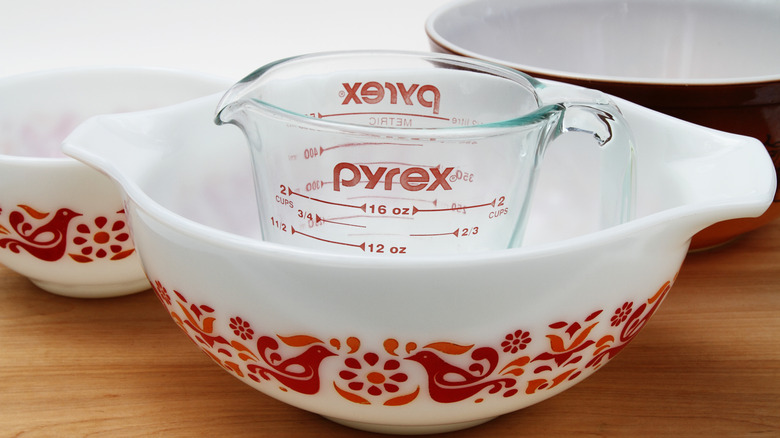
If you hear the word "Pyrex" and think only of the ubiquitous clear glass measuring cup — one of the most iconic kitchen products of all time — you might have been missing out on some collectible vintage Pyrex thrift store finds. Starting in the mid-1940s, Corning Glass Works shifted from the original clear Pyrex to colorful, mass-produced, and affordable machine-made cookware. And Pyrex became a hit all over again.
Corning had great success with its borosilicate glass bakeware, originally developed for use in battery jars, selling millions of Pyrex pieces between 1915 and 1919. When that early patent expired, the company banked on a few strategies ... most notably by merging with a maker of colorful tempered soda-lime glass opalware and applying the color to its own heat-proof cookware. The era of collectible Pyrex came to an end when World Kitchen (now Corelle Brands) licensed the pyrex (lowercase) cookware brand from Corning in 1998 and started making some Pyrex from less heat-resistant soda-lime glass, creating a big difference between the PYREX of old and current Pyrex. But vintage Pyrex has endured and become more sought-after over the years, and you can still find valuable bowls and cookware at the thrift store if you follow essential tips like checking backstamps and researching different color and pattern sets.
Earlier Pyrex bakeware is collectible because of its quality and durability. The cookware had an identifiable mid-century modern vibe that remains timeless, to some extent due to a sense of familiarity and nostalgia. It's hard to say how many designs and patterns of Pyrex were produced over the years, but there were well over a hundred physical designs and almost 200 screen-printed patterns that graced Pyrex baking dishes, mixing bowls, chip and dip sets, custard cups, egg dishes, and many other pieces.
Get to know the vintage Pyrex colors
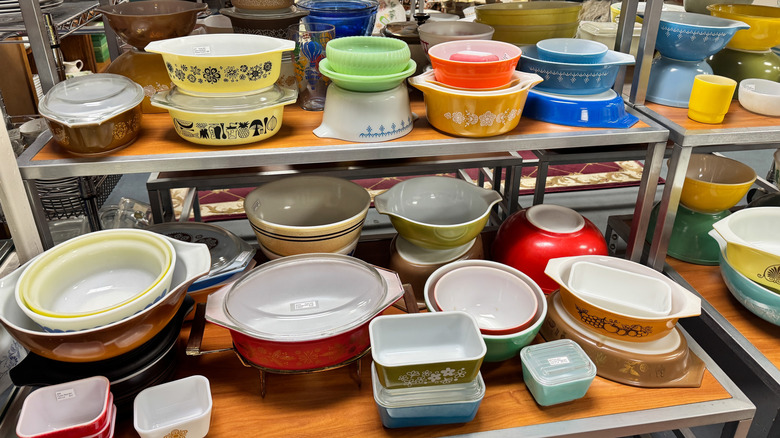
Pyrex experts often say that you get a feel for spotting Pyrex that comes from perusing and handling the cookware year after year. You become familiar with the shape of Cinderella nesting bowls or Pyrex percolators, but of course this is also about the colors. When Corning began enameling the outside of Pyrex cookware with solid blue, green, red, and yellow, it was as eye-catching as the designers had hoped, but that's not even close to the full rainbow Pyrex would bring to kitchens worldwide.
Early Pyrex had a yellow tint, thanks to peculiarities of its manufacturing process. In the 1930s and 1940s, Pyrex Flameware for the stovetop was intentionally tinted blue so it wouldn't be confused with Pyrex bakeware. Once solid colors entered the picture, they evolved over the years somewhat predictably ... in the 1950s, pink and turquoise were added to the primary colors of the 1940s. White and brown marked the 1960s, and the 1970s inevitably brought earthy tones like avocado green and butterscotch that you're having no trouble picturing.
Of course, color can also help you spot cookware that's not Pyrex, like Anchor Hocking's Fire King glassware and McKee Glass's Glasbake kitchenware. Today, Pyrex colors consist of clear glass cookware tinted pink, green, and blue, none of which is likely to be confused with the opaque opalware of the 1940s through the 1980s.
Know your backstamps
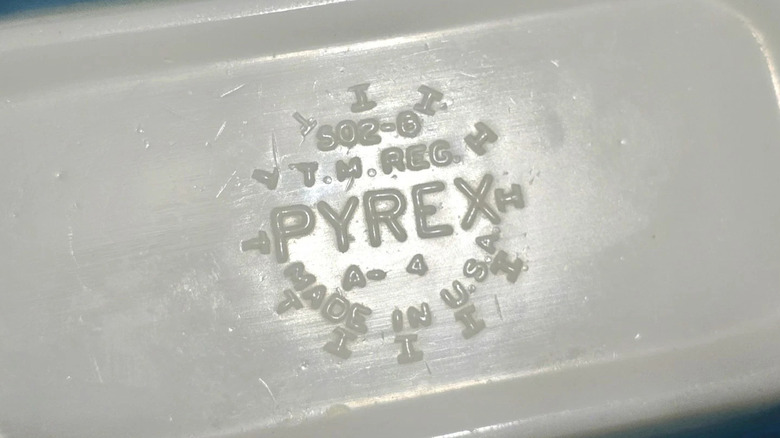
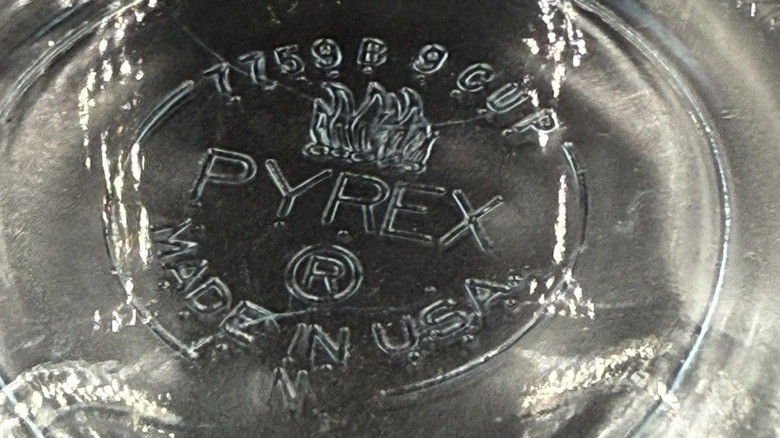
When it comes to Pyrex, a backstamp is not a stamp, nor is it on the cookware's back. Embossed backstamps were molded onto the bottoms of many Pyrex pieces in predictable, if somewhat complicated, ways. The best general advice is to learn to recognize the all-caps PYREX mark that graces most of the glassware from the collectible period. On the earliest, clear bakeware, PYREX was in an all-caps serif typeface, along with Corning Glassworks's CG monogram, which is occasionally mistaken for a dollar sign. Eight decades of variation ensue from there, starting with a number of patent and trademark references. Backstamps on individual dishes varied wildly through the years, and the specifics of these can help you accurately date a piece. But if you're standing in a thrift store, it's usually good enough to master the broad strokes. Amid all the patent-trademark wrangling, color opalware was introduced. During the first colorful decade, certain pieces didn't show the PYREX branding but included the silhouette of a glassblower called "Little Joe" that was sometimes used in conjunction with the word "CORNING."
"MADE IN U.S.A." was added to the bottom of the mark in the mid-1950s and used into the 1960s. Corning discontinued the circular backstamp format during the '60s and switched to straight lines of type. Newer backstamps dropped the "made in U.S.A." and replaced it with "by CORNING, Corning, NY, USA," alongside details like "NO BROILER OR STOVETOP" or "BAKING AND MICROWAVE." Non-U.S.-made Pyrex, including Australian and English glassware, will usually have different backstamps and criteria for collectability than the U.S. dishes.
Pick up on the patterns
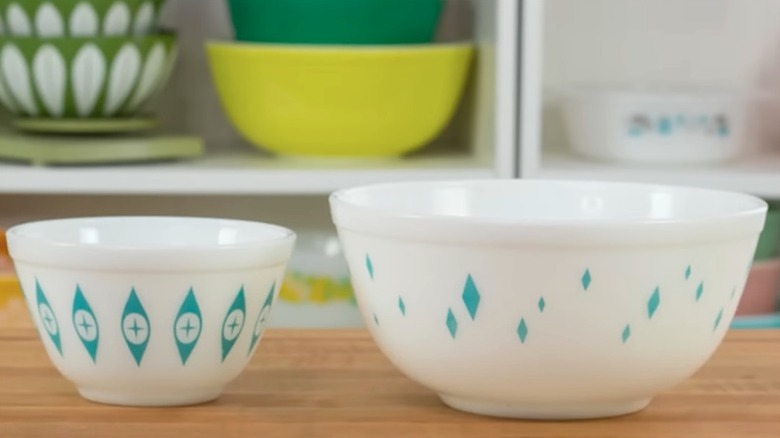
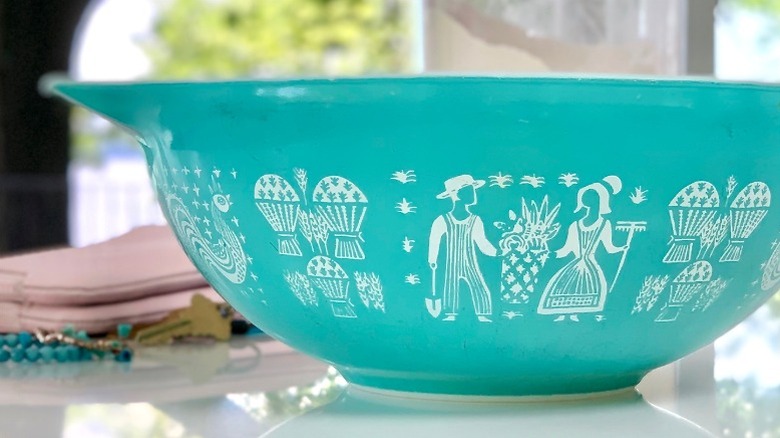
When you're chasing valuable Pyrex in a thrift store, there are two key things to know about the patterned glassware offered by Corning starting in 1956. The first is that there were two types of patterns — standard patterns that were sometimes produced for a decade or longer and promotional patterns that were sometimes made for as little as a single season and on a very limited number of pieces. (Some earlier solid-colored pieces were also parts of promotions, like the 1953 Heinz promo.)
The second thing to know is that patterns made Pyrex even more collectible than the solid colors. This is, of course, especially true of the limited-run promotional patterns. In 2017, a promotional "Lucky In Love" casserole dish (released in 1959) sold in a Goodwill auction for $5,994 ... and this is nowhere near the current record, but we'll come back to that. Other promotional patterns have sold for as much as $4,700. All told, Corning produced more than 150 silk-screened opalware patterns. A great resource for collectors is The Pyrex Collector's pattern database, which catalogs over 170 patterns (some of which are solid colors).
Don't go cold on Flameware
The claim to fame of Pyrex has always been that it is oven-safe. Borosilicate glass resists thermal shock — the uneven expansion materials experience when heated unevenly — to some degree. It can generally handle the temperatures inside a preheated oven but not the uneven heating on the stovetop. In the 1930s, in an effort to ward off the waning sales that would come with its patent expirations, Corning began developing an aluminosilicate glass that was stovetop- and oven-safe. The resulting skillets and saucepans were launched around 1936, followed later by coffee percolators, tea pots, and other Flameware-branded cookware.
During its first decade of production, Flameware was easily identified by its slight blue tint, though later models are clear, starting in the mid-1940s. The earliest Flameware had green ink stamps rather than molded backstamps, and as you might guess, many of those have long since worn away. But most Flameware backstamps were molded and generally included the word "PYREX," various production codes, and — like the green stamps — the brand's flame logo, which can also be found on the metal bands of coffee and tea pots.
Flameware for sale on eBay averages around $30 per piece. The most expensive pieces, such as 1950s coffee percolators or cooking sets, could potentially fetch over $200. While thrift store pricing may eventually catch up, deals on quality and high-value vintage Pyrex can still be found.
Inspect the condition, and know why you're collecting
There are many types of collector, and knowing your goals can help you zero in on the right pieces and the right prices. Bakers and home chefs might be willing to buy pieces with scratches and other damage that wouldn't be desirable in the collectibles market. Those collecting for nostalgic purposes or home decorators chasing the mid-century look, as well as those buying for resale, will probably be more particular and pay higher prices. And pure collectors often have extremely high standards, along with deep pockets. Condition is paired with the scarcity of the glassware and patterns being sought, which can drive prices far beyond what you might expect to easily find in thrift shops. The best specimens are shiny and undamaged, with their colors not faded or otherwise damaged — an all-too-common consequence of washing colored Pyrex in a dishwasher.
Pyrex prices are all over the map, but individual pieces tend to sell for around $20 to $50. Sets often run north of $100. A few factors may push the price higher ... desirable and rare patterns, prototypes, limited-run employee gift promotions, for example. The rarest patterns and most unique color effects can go for thousands of dollars. And remember that $6,000 "Lucky In Love" casserole dish? Selling at auction for $22,000, one Pyrex collectible caused major eBay drama in 2022. The dish, which also sported the "Lucky in Love" pattern, almost sold, rather, because the winning bidder backed out, after which it was purchased privately by Instagram Pyrex aficionado Nate Smith for an undisclosed price.