

The Space-Saving Alternative To Bulky Closet Doors That's Perfect For Small Bedrooms

Anyone who's lived in a small bedroom or studio-style apartment knows the struggle of clunky closet doors. Traditional closets are often outfitted with swinging or bifold-style doors. Swinging ones open too far out, while bifolds stack to the side when opened, obstructing space on both sides. When open, these bulky doors can be difficult to walk past and limit access inside a closet. Instead of settling for this inconvenience, opt for a different type of closet door that adds style and function. Accordion doors are often overlooked in home design when they could be the saving grace for a small bedroom.
Accordion doors also fold when pushed aside. However, they don't jut out and block walkways and storage areas like bifold designs. Instead, they bunch into several narrow sections, condensing how much space they take up. Given this design, they can fit directly next to furniture or walls and won't bump into them when opened. This makes them easy to squeeze into very tight spaces. Essentially, if a closet had any other door style before, it's likely that an accordion door will fit too. This style was popular in the 1950s and 1960s and was often installed as a partition to create more separated spaces in homes without taking up too much room. Naturally, this is why it works so well in small homes and compact bedrooms.
How to choose the right accordion door as an alternative closet door
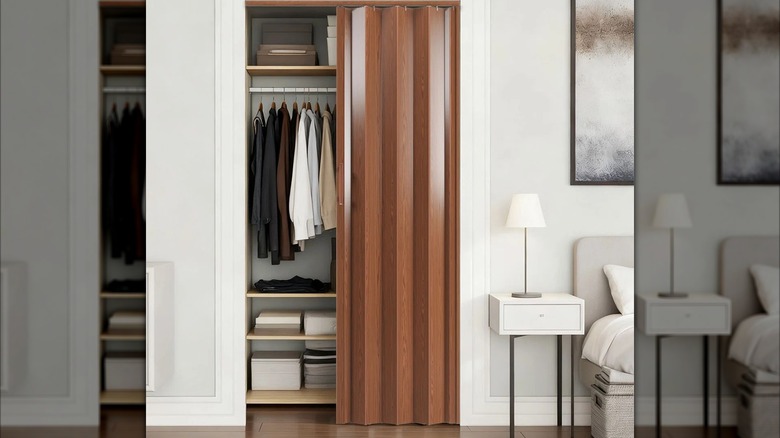
The beauty of accordion doors is that they come in a variety of styles, colors, and finishes, and this closet door alternative can redesign your storage for the better. They're typically made of metal, vinyl, PVC, and wood. Plastic and fabric options are the cheapest, easiest to install, and come in many colors and designs. By contrast, wood models don't have as many style options, but they can be stained, painted, and finished to your preference. Many wood-look accordion doors are made with plywood or MDF, which makes them more affordable like their plastic counterparts. It's recommended to choose either MDF, wood, or plastic for an interior closet door, since metal versions are usually installed as exterior entryways.
Make the right measurements before ordering an accordion door for your closet. Your door should be as wide as — or slightly wider than — the dimensions of the closet opening. If it's too narrow, it won't cover the entire closet when closed, which is both a functional and aesthetic blunder. In terms of height, fortunately, most accordion doors are 80 inches tall, the same height as a standard closet door. If it is taller than the closet, you can easily measure and trim any excess length from the bottom with a hacksaw.
How to install an accordion door in a small bedroom closet
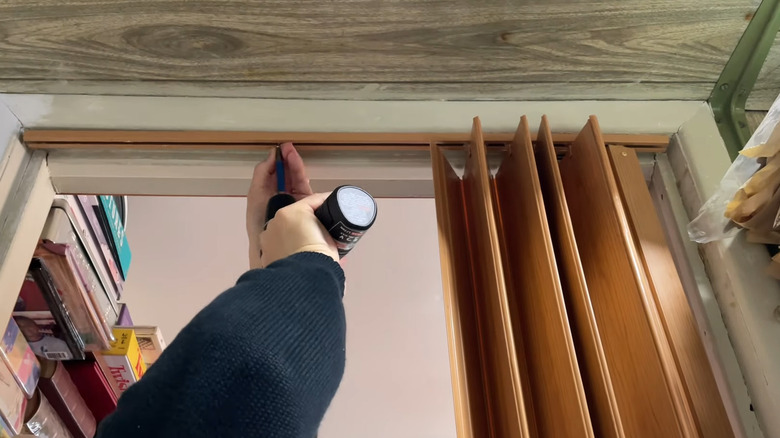
You could hire a professional for upwards of $100 to install your accordion closet door, though keep in mind that this cost varies depending on location. To make this project even more budget-friendly, consider doing it yourself. The door already comes with the proper hardware and fasteners. Just grab a drill, a tape measure, and a screwdriver. If the panels or tracks need to be modified, you'll also need a hacksaw, a square tool, a sharpie, and 220-grit sandpaper.
Before beginning, you should know how to correctly take a door off its hinges and remove everything (including the hardware), so you have just a bare frame. Most manufacturers' instructions recommend trimming the top track ⅛ inch shorter than the top wall. Once cut, drill the corresponding holes into the wall and insert the provided anchors. Only mount the middle part of the track first. Then, assemble your accordion door by installing the top glide rings and attaching the slide brackets. Make sure you insert the T-shaped glide into the final panel and install the door handle as well. Choose which direction the door will slide beforehand, so you have the best access in a small space.
From there, rotate the top track diagonally to insert the panels and glides. Return the track to a straight position, fasten the remaining screws, and install the final locking click. This project sounds more complicated than it is. However, most reviewers of popular accordion door brands say it takes less than an hour to DIY — in fact, many claim it takes under 20 minutes.