

Not Traditional Hardwood Or LVP: The Floors Ben And Erin Napier Swear By For Durability

The durability of a floor's finish is sometimes tested using a rotary platform abraser. It's a tool for accelerating wear, and in a less jargon-y world, it might be called a "grandchild simulator." Grandchildren are what "Home Town" hosts Erin and Ben Napier were up against in Season 2, Episode 2, of the HGTV series when choosing durable flooring for a homeowner with a large family. The Napiers' recommendation? Installing engineered hardwood flooring throughout the house.
The "Home Town" team replaced the existing plywood floors and carpeting with engineered wood for around $10,000. Ben Napier described the flooring, saying, "You can sand it and refinish it after it gets some beatin' and bangin' on it from grandchildren." But the ability to be restored is just one of several benefits of engineered hardwood. It's made of multiple layers of substrate, usually plywood or high-density fiberboard (HDF), topped with a veneer of actual hardwood that can usually be sanded down and refinished. The particular flooring chosen by the Napiers, a forged bronze Anderson Casitablanca, has more going for it than veneer.
The floor's wear layer, which Ben Napier described as oak, is actually kupay (Copaifera langsdorfii), a significantly harder wood that is sometimes confused with super-hard curupay. In addition to being sandable, Casitablanca has a rustic, hand-scraped look that hides minor damage. But that's just the start of what engineered hardwood can do for you.
The options and variations in engineered hardwood flooring
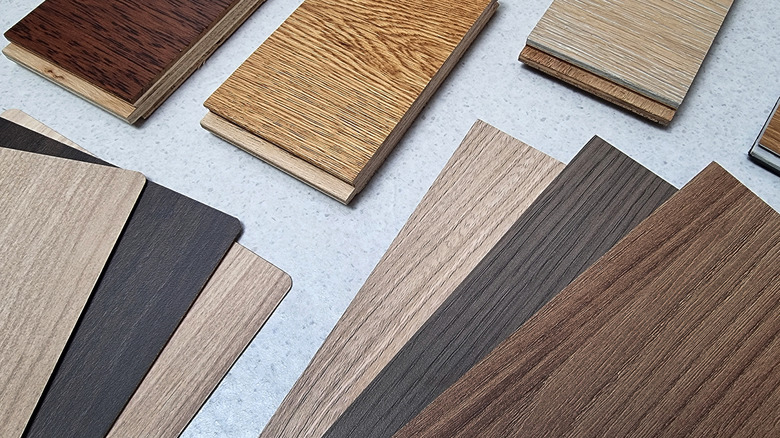
At its heart, engineered hardwood is more like plywood than anything else. The hardwood wear layer is supported by three to 12 plies of wood strips (much like veneer) laminated together with glue. The wood grain in each layer is run perpendicular to adjacent layers in a design called cross-lamination, which results in exceptional dimensional stability compared with solid wood. For some products, some of the supporting plies are made of HDF rather than veneers. Real plywood flooring is the strongest option and more suitable for use in basements, homes with radiant heat systems, and so on. Flooring that includes HDF layers tends to be less stable but more affordable. The hardwood veneer wear layer can be between ½ millimeter and 6 millimeters thick, usually in the 4-to-6-millimeter range, with thicker veneers allowing for more future refinishing.
Just about every aspect of engineered hardwood comes in different varieties to meet your desired aesthetics and quality level. Select the veneer species, plank width, grade of wood, and gloss of your finish. You can choose among different edge styles as well as plank thicknesses. And you have all the installation options — glue-down, tongue and groove, or click-lock engineered hardwood planks.
For the "Home Town" grandmother, all this meant a floor made of 5-inch-wide, ⅜-inch-thick boards. The planks' beveled edges lent the random-length boards a slightly rustic look. The rich "forged bronze" reddish brown is further protected by a UV aluminum oxide finish, a durable layer that protects against UV exposure, abrasive traffic, and chemical wear.
How engineered hardwood compares to real hardwood and laminate
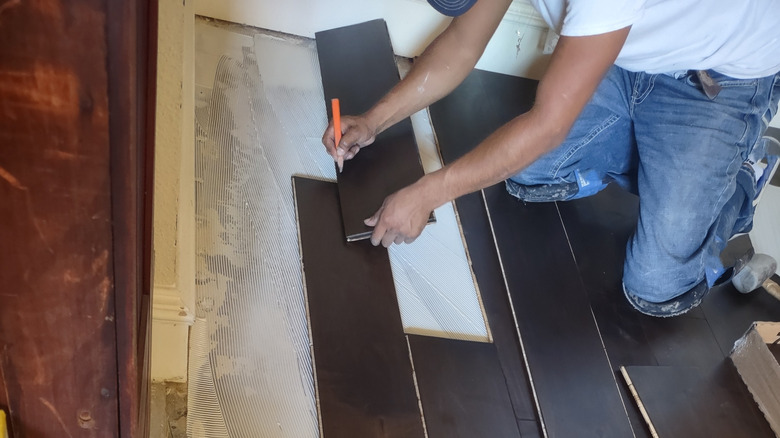
Comparing engineered hardwood to real hardwood, luxury vinyl plank (LVP), and laminate flooring (a fiberboard core printed with an image of wood on its wear layer that costs only $1 to $3 per square foot) is revealing. Good engineered wood is more durable, moisture-resistant, and varied than laminate, but it's also more expensive at $3 to $12 per square foot. Engineered wood is less water-resistant than LVP — suitable for rooms with minor humidity problems but few spills and no standing water. The variation in LVP can differ by price, but real wood veneers are unique and won't repeat patterns. LVP is slightly more expensive at $4 to $12 per square foot and can't be refinished — but often doesn't need to be, given its durability and scratch resistance. Engineered hardwood has an advantage in its overall feel, which is closer to solid wood than LVP's usually is.
Engineered hardwood also compares well to solid wood. They come in roughly the same thicknesses, but solid wood can be refinished more times and lasts 25% to 33% longer than engineered wood, depending on the thickness of its top veneer. Engineered flooring can be faster to install than nail-down hardwood, and it typically costs 15% to 30% less to install. Hardwood's long-term durability relies on your willingness to refinish the floors, and it discounts the fact that engineered floors are better at handling moisture and temperature variation. So, engineered flooring might be a better option if you're determined to have wood floors in your kitchen. As the Napiers have shown, it's a cost-effective choice if you value character and durability.