

Why You Might Want To Think Twice Before Using Command Hooks Again
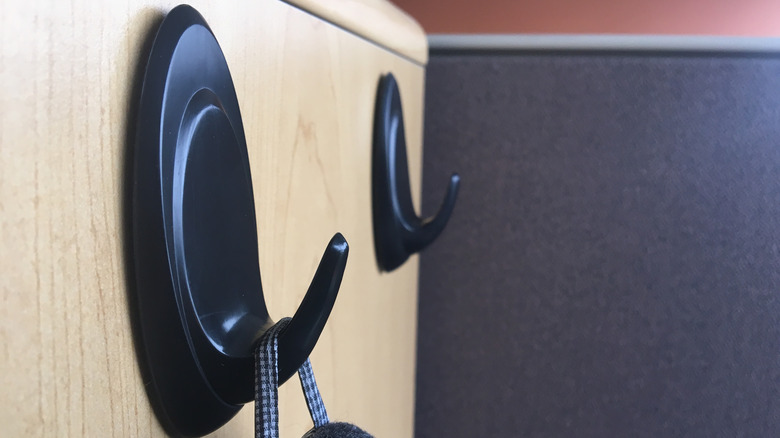
3M makes over 200 Command-branded products for both general and very specific purposes, from hanging window treatments without drilling to bird feeders and deck lighting. They are generally respected products that get good reviews, but they have some limitations that are important to bear in mind.
These limitations mostly come down to carefully reading — and complying with — the package directions. Command Hooks have weight limits, environmental requirements, inflexible preparation steps, and surface specs that you have to take seriously, or risk damage to either your walls or whatever you're hanging on them.
Weight is, of course, the simplest variable. Most Command hooks come in 1-, 3-, 5, and 8-pound varieties. (Some Command Strips and a few hooks can handle even more weight.) The company's website helpfully explains some common equivalents to help you dial in the amount of weight your hooks can handle: A bag of coffee might weigh 1 pound, a bag of apples 3 pounds, a bag of potatoes 5 pounds, and a gallon of milk weighs about 8 pounds. By all accounts, the hooks can handle the weights they claim ... but there's a catch, and it's no secret.
Follow the Command Hooks directions
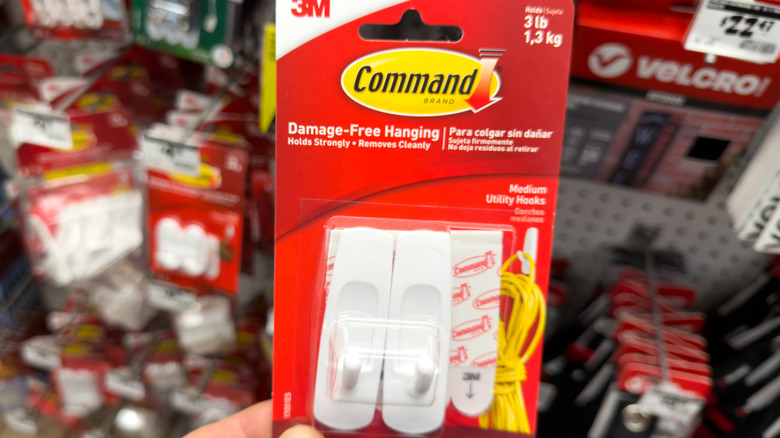
Command Hook package directions are non-negotiable. This has to do with the limitations of the materials involved, and you're stuck with it. Let's consider the instructions for using a Command Medium Designer Hook. First, there are a bunch of no-nos: Don't use the hooks to hang valuable items or frames; don't hang things above a bed; don't hang the hooks on wallpaper or freshly painted walls; don't use them outdoors; and only use them in a temperature-controlled room.
Okay, now that we have that out of the way, what should you do? Clean the wall with rubbing alcohol (not household cleaners), then install the hook and hold it for 10 seconds. Next, remove the hook and press the adhesive strip for 30 seconds. Re-attach the hook and let it cure for an hour. When removing the adhesive wall hooks, first remove the plastic hook, then hold the mounting base in place with one hand while slowly stretching the strip tab along the wall for at least 12 inches. Don't attempt to re-use the strip.
That's not so bad, although we wouldn't bet on everyone following that one-hour waiting time rule. But it's a little more complicated than it seems, and you can find a clue right in 3M's product description: "Command Designer Hooks hold strongly on a variety of indoor surfaces including painted walls, finished wood, glass, tile, metal, and other smooth surfaces."
What they (sort of) don't tell you about using Command Hooks
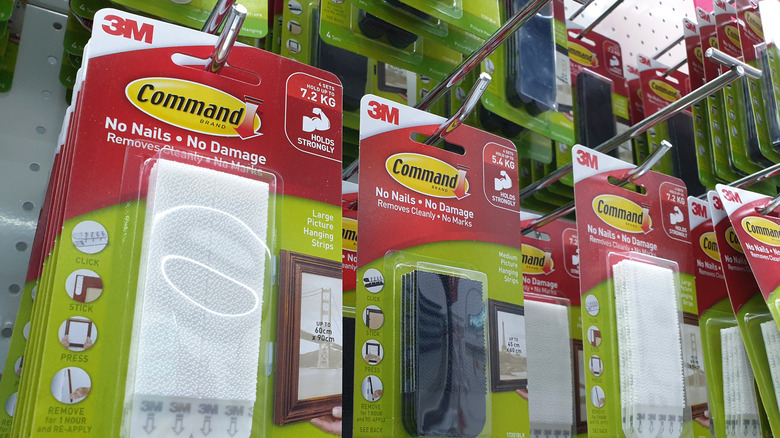
Reviewers find that Command Hooks can fail under a number of circumstances not clearly spelled out in the package direction. This especially includes trying to use them on an uneven, porous, or textured surface. The problem is that this limits the surface contact made by the adhesive strips, and can essentially eliminate the hooks' effectiveness. It's also important to apply the strips in temperatures of at least 15 degrees Fahrenheit for the adhesive to set properly, though this shouldn't be a challenge for most users. The other common problem is that high heat or humidity can negatively affect the strength of the adhesive.
Command's Australian website includes some answers to frequently asked questions that aren't included on the U.S. site, and these shed some light on the issues. At temperatures above about 104 degrees Fahrenheit, the company recommends actually removing the load from your Command Hooks because the adhesive can soften and fail. The site also suggests using Command water-resistant products in high humidity, but doesn't specify what level of humidity requires this replacement.
Consumers curious about all this have tested Command Hooks and found that they actually hold quite a bit more than their rated weight when all the conditions are right. So before you use Command Hooks, consider all the requirements carefully. If you're up for it, you can use them to store more stuff in less space, at least until that heat wave comes.