

Lighten Up Dark Cabinets Without Paint Using HGTV Star David Bromstad's Trick

We may receive a commission on purchases made from links.
A client looking for a home told David Bromstad she didn't care for dark cabinets, so when he presented a house with dark kitchen cabinets in Season 13 episode 10 of "My Lottery Dream Home," Bromstad recommended stripping the finish from the cabinets and bleaching them to remove yellow and orange tones and achieve a more modern look.
Bleaching cabinets is a step along the way to refinishing cabinetry and furniture rather than simply replacing them. Uniformly bleached cabinets can often be given a protective clear coat and used as-is. The process is also used as a way to prepare cabinets for a new finish that wouldn't work well over the old one.
There are three processes that are described as "wood bleaching," each involving different chemicals and achieving different results. Applying household chlorine bleach to cabinets won't remove natural color, but only dyes. However, chlorine bleach can damage wood fibers, and it's primarily used as a spot stain remover. The second chemical process involves using oxalic acid to lighten water and rust stains or remove a wine stain from wood. The method most used for lightening cabinets overall is a two-part sodium hydroxide (also known as caustic soda or lye) and hydrogen peroxide process that's sold as a kit under a number of brand names.
Bleaching with hydrogen peroxide and sodium hydroxide
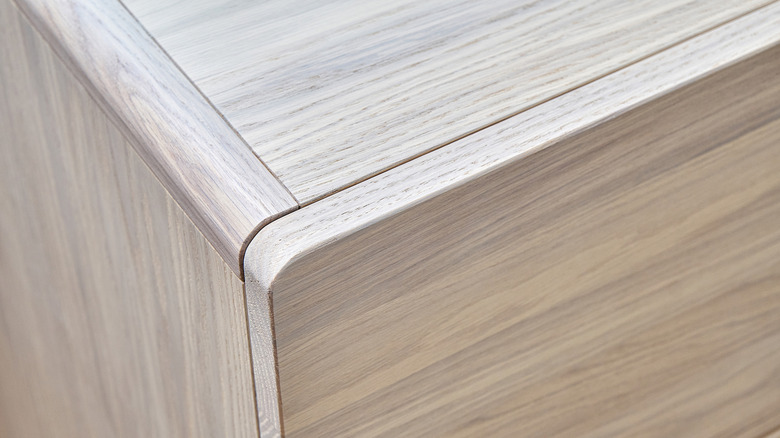
The two-step wood bleaching process is a safe but precise process that, in another context, the U.S. Forestry Service colorfully referred to as "dancing with a dragon," so be sure to wear gloves and safety goggles and work in a well-ventilated space (preferably outdoors). Start by removing your cabinet doors and drawers, then remove all hardware — hinges, drawer pulls, and handles. If you're so inclined, use a chemical stripper like CitriStrip to strip paint or stain from the wood drawer fronts and doors, as well as the cabinet carcasses. Follow the package directions, then sand, clean, and allow all surfaces to dry.
A typical kit like Zinsser Wood Bleach will come with A and B solutions, which contain borax, sodium hydroxide, and hydrogen peroxide. Apply the A solution with a synthetic-bristle brush, rag, or sponge, saturating the wood. Apply the B solution over A and allow to dry, ideally overnight, then sand lightly.
Don't bleach veneers, laminates, sealed or painted wood, or antiques. The manufacturer of Zinsser Wood Bleach advises against bleaching softwoods as well, but provides alternative instructions in case you are determined to. Some instructions advise rinsing with a mild acid like vinegar to neutralize the chemicals. There is, in fact, a peculiar amount of variation in the wood-bleaching process as described by different practitioners. These sometimes involve combining the chemicals up front and then applying them, or applying them in reverse order. But stick with your wood bleach's package instructions instead.
Risks and limitations of the cabinet-bleaching process
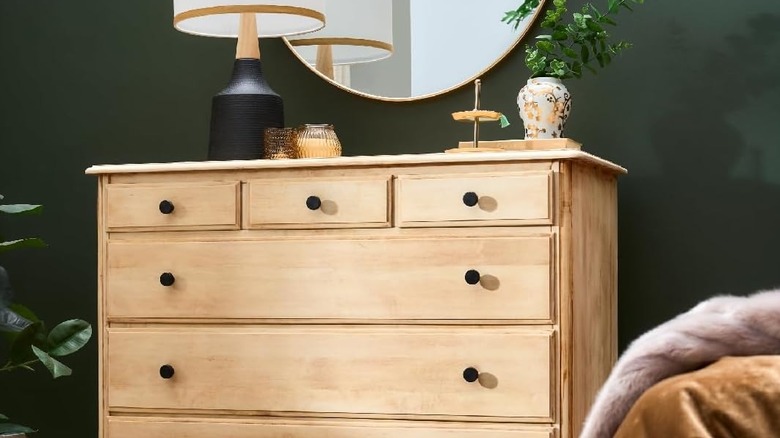
Combining hydrogen peroxide and sodium hydroxide in the wrong amounts can kickstart an exothermic reaction that generates quite a lot of heat and spattering chemicals. Those chemicals are corrosive and potentially explosive, so it's important to use a commercially available product like Zinsser Wood Bleach and always follow the package directions.
There are also a number of ways for this process to fail. Stripping and then bleaching a previously stained or painted piece can have dramatically uneven results, owing mostly to an incomplete or uneven removal of the original cabinet finish. Also note that the more nooks and crevices a piece has, the more challenging it can be to strip evenly. And you're not necessarily saved by unornamented, unpainted, and unstained cabinets. Most cabinets — even natural wood cabinets — include a clear coat that adds a luster to the wood and protects both the wood and whatever finish has been applied to it. This (often invisible) layer must be chemically stripped and sanded away before bleaching can begin.
If you aren't confident in your ability to pull off wood bleaching but require lighter cabinets, consider whitewashing the wood instead. The results don't necessarily have the same modern look, but it will be lighter. And whitewashing is also a viable way to rescue a wood bleaching effort that didn't produce the evenly lightened results you were hoping for.