

The One Tool Every DIYer Needs: A Pliers Wrench
We may receive a commission on purchases made from links.
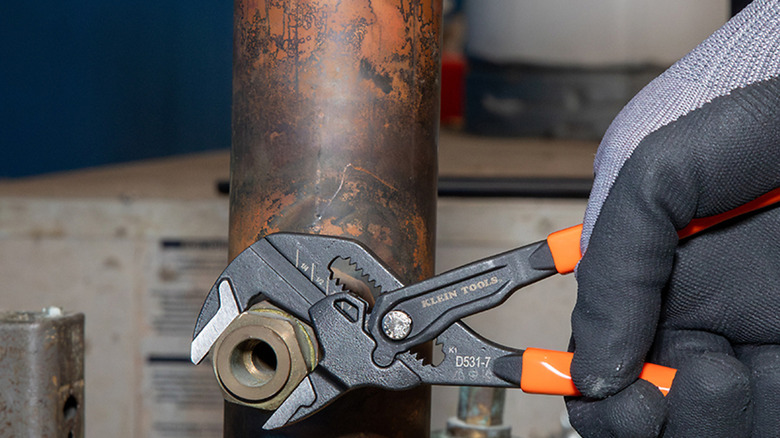
Professionals won't usually admit to it, and casual DIYers don't know any better. Trying to install or remove a hexagonal bolt or nut with standard pliers isn't just bad form; it's a behavior that's taboo for some good reasons. The main problem is that it doesn't work well. Even worse, you have a pretty good chance of destroying the nut or bolt in the process.
Unfortunately, the orthodox answer — which is to use a wrench instead — isn't much better. What you need is a combination device called a pliers wrench. There's something about the concept that sounds suspect. Solving a problem by combining all the previous attempts to solve it has a kind of as-seen-on-TV feel to it, like a self-twirling spaghetti fork that also grates Parmesan. However, the pliers wrench isn't a contrived gimmick product, but an evolution of previous, widely used tools — tools with problems.
Consider the major difficulties created by using the usual tools to drive or remove hex-head bolts or nuts (or any fastener with flat opposing sides, like the connectors on that stuck showerhead you're trying to remove). You must buy individual wrenches to match each bolt size, and that only gets you close. Adjustable wrenches are slow to operate, loosen as you use them, and aren't very firm to start. Pliers' jaw angles tend to be all wrong, and even when they work, you end up with rounded-off bolts that are difficult to remove because of plier damage. The pliers wrench solves all these, collectively among the most vexing (or is it hexing?) problems in tools.
The pros and other pros of using a pliers wrench
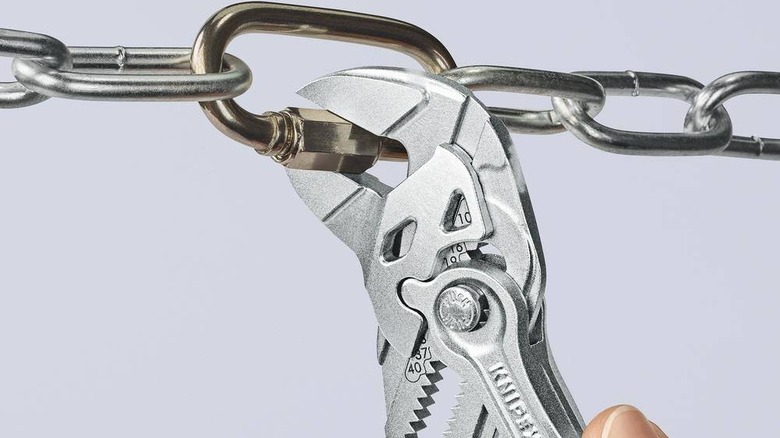
A pliers wrench gives you the leverage and infinite adjustability of pliers; the parallel (and usually smooth) jaws of an adjustable wrench; and all the sizes of a full set of metric and Society of Automotive Engineers (SAE) wrenches, but without the expense, storage, and retrieval issues. The only downside is that pliers wrenches aren't good at turning round things ... but that's like saying a chisel isn't great for opening paint cans. Who said it was?
Most models have a push-button mechanism for quickly selecting a size preset, which is fine-tuned when you squeeze the pliers. The button frees the lower jaw to move between presets along a linear track that's perpendicular to the jaw face. That means that, at any position, the two jaws' faces remain perfectly parallel. Typical pliers, on the other hand, have a pivot point and only approach parallel when they're closed. This design means you have constant, perfect contact with opposing fastener spaces. Even an appropriately sized open-ended wrench has comparatively large tolerances, which can result in damage as you torque the wrench's flats against the hex's corners.
In action, a pliers wrench has a ratcheting action. It's tight when tightening and automatically loosens when you turn the tool back for another rotation, all while your push-button adjustment stays fixed. Some models, like Knipex's, have narrow heads that are useful in tight spaces, like when you're leveling a stove range. The result of all this, combined with the handle leverage, is (among all the other benefits) a 10:1 lever ratio ... that is, the Knipex version of the pliers wrench will multiply your effort by 10.
What you can expect to pay for a pliers wrench
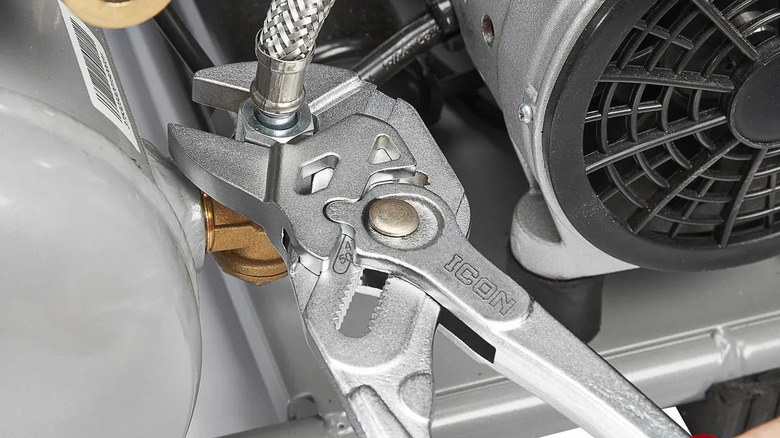
For awhile, German brand Knipex was almost synonymous with pliers wrenches, even though the company has historically made other tools, including other innovative wrenches. When the company's original patent expired in 2010, many clones and competitors flooded the marketplace. Still, Knipex seems to command a lot of consumer loyalty, sometimes prompting starry-eyed exaggerations — one Redditor described it as "the apex of human tool innovation" that will "bring you success and joy." This comes at a fairly high price for a wrench — $58-109 for the Knipex model, currently $67.90 for the 10-inch version at Lowes. However, that's thinking of it as a wrench, rather than a set of wrenches and ratchets.
The price for 10-inch (sometimes 250-260mm, depending on the manufacturer) pliers wrench averages $63.29. European models cost significantly more ($87.37) than U.S.- and bargain-priced clones ($57.67). Versions are also available from China (Temu, $61.11) and Vietnam (Wiha, $31). For the most part, these models are practically identical with only slight variations. Channellock pliers wrenches, for example, only seem to come with crosshatch teeth, rather than the standard smooth jaws. Fujiya, a Japanese tool maker, has an interesting take on pliers wrench design, but it doesn't seem to be available in a 10-inch version (The 150mm Fujiya is $50-54). That means that this one tool — even if it's a little pricey — does the job better than any alternative, and it costs less than the set of traditional tools you'd need to do it.