

Jenny Marrs' Gorgeous Backsplash Idea Instantly Adds Vintage Charm To Any Kitchen
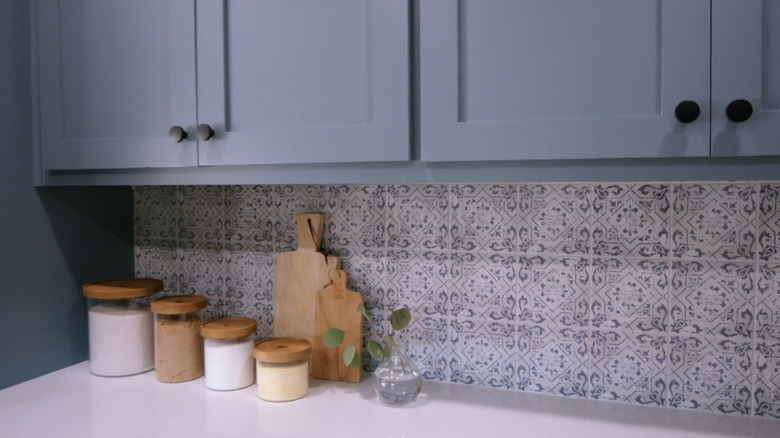
The backsplash tile used in Jenny Marrs' "Rough Rancher Made Modern Farmhouse" ("Fixer To Fabulous" Season 3, Episode 12 ... though Discovery+ has it as Season 3, Episode 6) is so delicate and pretty that it looks like it can't be modern. From a distance, the patterned tile is lacey, the pattern fine enough that you're tempted to try to blink away the blurriness. Up close, the Elida Ceramica Cardoso Deco 6-inch square tile looks like a faded and worn print of a gray-blue classical pattern. Marrs chose the tile to complement the warm blue she chose for the kitchen cabinets, but it does a lot more than that. And none of it is accidental.
Backsplashes occupy a strange visual space, when you think about it. What would normally, spatially be the background — the more distant field against which foreground objects stand out — is sometimes exactly that. At other times, a bold tile might pull itself to the perceptual fore, leaving the surrounding cabinetry and expanses of stainless steel or whatever appliances are trending in the background. This backsplash accomplishes both. The eye is drawn to the pattern, then released by its gauziness to focus on the blue of the simple, beautiful cabinets ... only to return to the tile again in a moment. This seems to be part of its plan. Unlike other modern porcelain tiles that masquerade as encaustic, this distressed tile masquerades as something fragile and old, with enough of its boldness left to hang onto your attention. It's almost insistently vintage. And, adding compliment to complement, it's also among the prettiest kitchen floor tile ideas we've seen this year.
What is this tile, anyway?
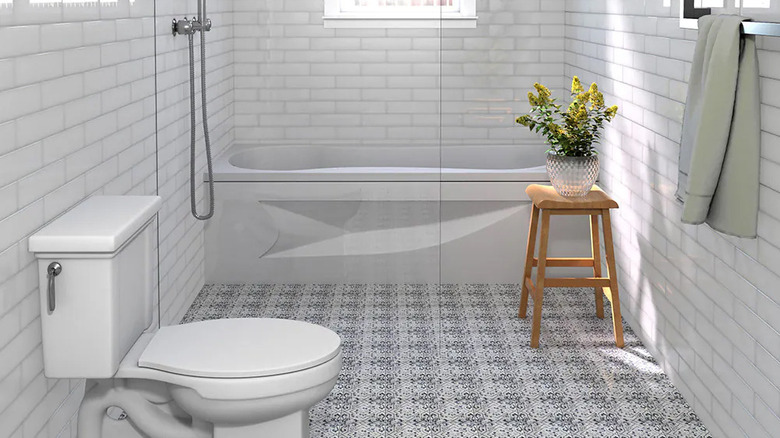
With all that masquerading going on, one wonders what's actually happening on this Marrs' client's kitchen walls. We'll get there, but suffice it to say that it's more deceptive and more genius than you might guess. And it seems to be part of a movement of distressed tile in this genre. Before we can figure out what that genre might be, it helps to think about how we think about it. On first seeing the kitchen, Marrs's client asks if it's wallpaper ... thinking, no doubt, that would be a curious choice for a backsplash. Marrs explains that it has that quality because of its vintage feel.
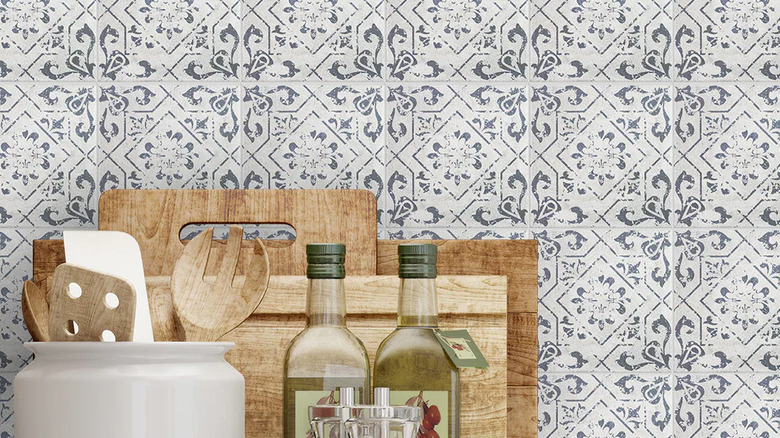
Tiles in this style are mainly monochromatic, light shades of amber, graphite, or even champagne. It won't be hard to match your kitchen's main color palette, so long as you've chosen a good color palette. There are exceptions to the monochrome rule, if only slight ones. Artmore Tile's Tiesto line introduces patterns and colors that give the muted impression of the tiles of Seville or the azulejos of Portugal, and not far from the Mexican-inspired tile that sometimes enlivens backsplashes. Within what seems like the fairly narrow confines of the style, there's quite a lot of variety: the lightness of Boutique Ceramic's Timberland Deco and the gravity (but not graveness) of Affinity Tile's Kings Star Night; or the weathered refinement of Allen + Roth's Marbella Décor and the hand-painted playfulness of Affinity Tile's Kings Blume Nero. There's a hint of craft in these, but it's the stencil sort of craft rather than the inlay sort, and the difference runs deep.
A shallow dive into encaustic tile
How this style came about, and came to be referred to as "encaustic," is a deeply weird journey full of misunderstanding and adaptation and, eventually, seriously smart product development. "Encaustic" entered the tile lexicon by mistake; it was confused with a style of painting that uses beeswax and determination to produce art described as luminous, lustrous, and vibrant, with depth and translucency. So the label stuck, and "encaustic tile" came to mean ceramic tile in which clay of different colors was inlaid in the clay field and then fired, producing a tile that was virtually incapable of showing wear on a human timescale.
Later the term was applied to a layered concrete tile produced with pigmented cement and a hydraulic press ... a grippier affair when laid horizontally, and which one sharp headline writer referred to as cement tile that will stop you in your tracks." For these traditional ceramic and cement encaustic tiles, flaws are part of the point, integral to their materials and designs. But when the current generation of "encaustic" tile — vaguely patterned on the inlaid tile of the Middle Ages, but with none of its vibrancy or actual depth — the flaws were also missing. They were durable and weatherproof porcelain tiles sporting digitally printed with patterns that might vaguely suggest Seville in the colorless hours after twilight. When someone had the stroke of genius to start introducing flaws — and evoking faded, abraded stencils and aged fabrics — they created out of whole kaolin something that looks antique more than clay encaustics ever have, but is affordable — another thing "real" encaustic tile never was.