

Remove Stubborn Old Stains From Clothing With A Few Ordinary Household Staples
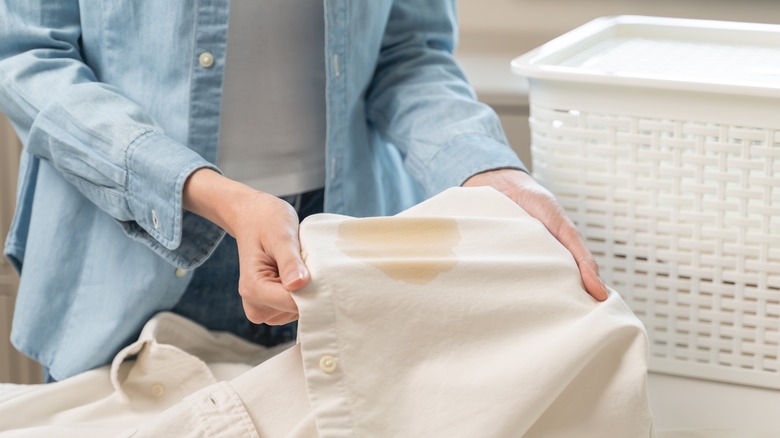
Advice, like stained clothing, is a fact of life. The minute you wipe off your oil dipstick with your shirt sleeve or stick an onion ring in your pocket for later, three friends will emerge and tell you that dishwashing liquid coupled with your usual laundry detergent is the way to deal with tough stains. Fortunately, your friends have gotten it right this time. Mostly.
Dish soap is effective for greasy, waxy, or oily spots, but less useful for other common stains like coffee, tea, red wine, blood, and ink. Everything depends on the nature, severity, and age of the discoloration, but removing set-in grease stains from already-washed clothes can be difficult. Laundry stripping (a three-ingredient laundry hack that's gross, satisfying, and exceptionally hard on your clothes) might be a better choice for stains that have been set for a while.
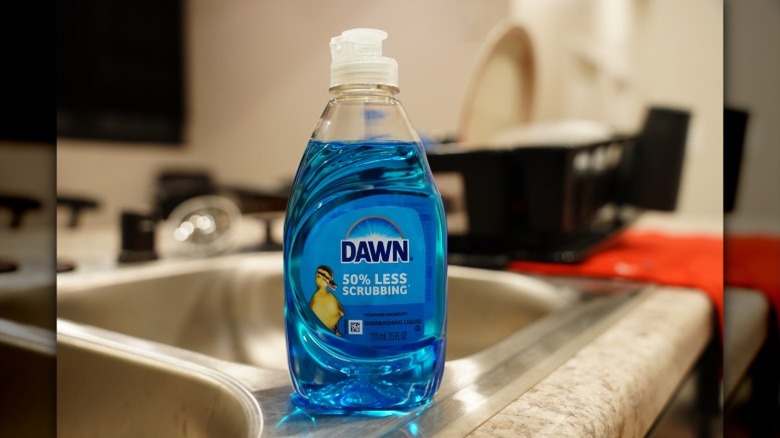
Dish soap is most effective as a pre-treatment. Just rub some dishwashing liquid (Dawn seems to be the most commonly mentioned, but any of our editors' favorite dish soaps should work) and launder as usual. In some circumstances, you might get better results from letting the pre-treated fabric soak for 10 to 15 minutes. Since there's a small chance of damage to the fabric, exhaust all the methods you're more comfortable with before trying the dish soap trick. Try to deal with stains as soon as you can and delay drying the fabric or applying hot water to it until you've tried to get rid of the stain. Of course, don't put more than a few drops of dish liquid in your washer unless you're up for a laundry room bubble party.
The facts of surfactants (and other laundry staples)
Dish liquid works on grease stains because its chemistry is particularly well-suited to dissolving oils while many other cleaner components are better suited for other types of stains. The saponified fats (soap), emulsifiers, and other surfactants in dish liquid work their magic with molecules that are attracted to both oil and (even more strongly) water. When these amphiphilic molecules are in contact with both grease and water, the stronger attraction pulls the grease away from the fabric. The oil is then encapsulated by the emulsifying surfactants and can be washed away. By reducing the surface tension of water, surfactants also cause it to be more easily absorbed into fabrics.
Stains that aren't fundamentally oil or grease won't react as well to dishwashing liquid, and that's where your usual laundry detergent comes in. It brings other pieces of the cleaning and stain-removal puzzle to the table. Enzymes are good at breaking down protein-based stains like blood, while oxidizers like peroxide, chlorine bleach, and borax break apart long-stained molecules that can then be more easily washed away; sometimes removing the color of the stain as well. Solvents are often used to dissolve stains with a similar chemical composition to the solvent itself, while acidic solutions are best targeted at stains caused by mineral deposit or rust. Whiteners and optical brighteners reflect light in a way that makes a stain less visible, and abrasive cleaners attempt to mechanically remove stains ... which is not really the way to handle cleaning clothes.
Possible downsides of using dishwashing liquid on laundry

There are always naysayers, of course, and sometimes they even have a point. If you happen across laundry experts online who tell you that dish soap is too acidic for fabrics to handle, they've got their facts wrong ... but maybe not the overall point. The problem is that most cleaners are alkaline, not acidic, and dishwashing liquid specifically tends to have a pH of around 7-10; neutral to moderately alkaline. Dawn dishwashing liquid, for example, typically has a pH between 9 and 10.
A high, alkaline pH can damage some fabrics, particularly wool and silk. (Dawn only recommends this treatment for cotton and poly-cotton blends.) Some experts offer similar warnings for cotton fabrics, claiming it's best to clean them at a neutral pH between 6 and 8. What's important to remember is that dish liquids with a fairly high pH (say, the 11.1 pH of most Dawn Powerwash products) will be quickly diluted in your washing machine to a fabric-safe level. As in, with a pH under 10 or, even better, somewhere in the 7-8 range. The over-use of surfactants inevitably ends up in wastewater and can have negative environmental consequences, but a small amount used to spot-clean clothing will not register compared with the massive amounts used in industry, including in textile production.